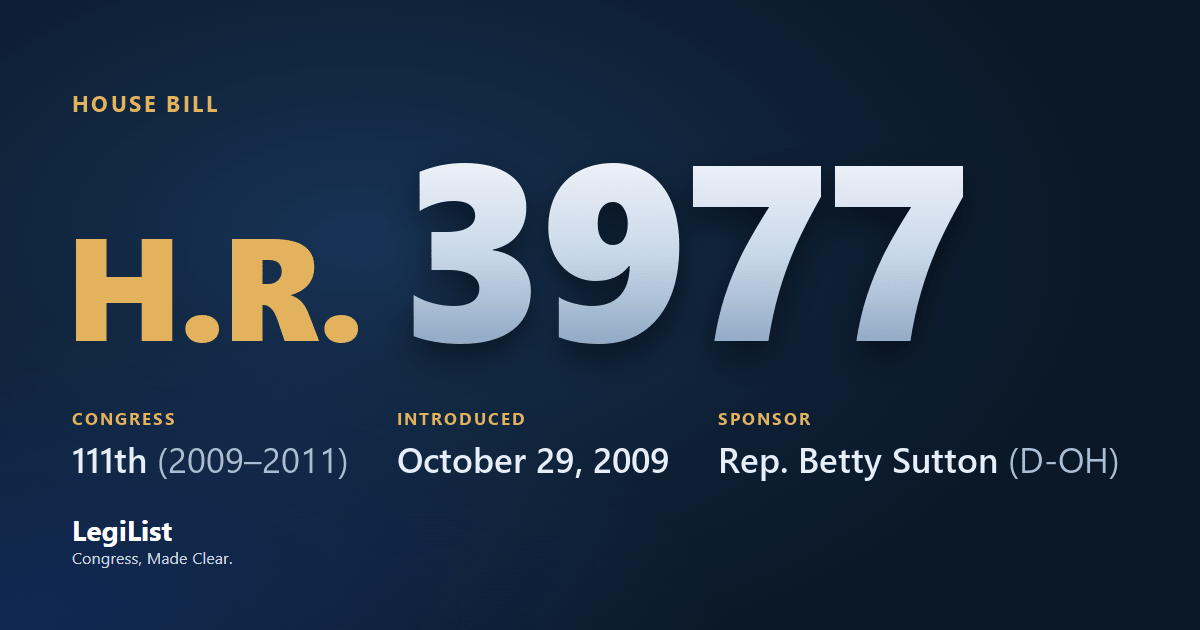
Credit Card Fee Limitation and Accountability Act
Latest action · Oct 29, 2009 Referred to the House Committee on Financial Services.
Progress
Where this bill reached, and when. A stage with no date was not reached; one that failed a vote and later carried shows the date it carried.
- IntroducedOct 29, 2009
- Passed HouseNot reached
- Passed SenateNot reached
- To the PresidentNot reached
- Became lawNot reached
Summary
Credit Card Fee Limitation and Accountability Act - Amends the Truth in Lending Act, as amended by the Credit CARD Act of 2009, to prohibit a creditor from imposing upon an open-end consumer credit account any fee related to failure of the consumer to: (1) use the credit card to obtain an extension of credit; (2) carry an outstanding balance from any billing cycle to another; and (3) obtain a minimum amount of credit under such account during any specified period.
Permits a consumer to: (1) cancel an account within 45 days of receiving notice of an annual fee if no such fee existed upon the account's initial opening; and (2) pay any outstanding account balance at the time of cancellation in accordance with the terms in effect at the time of such cancellation.
Prohibits a creditor, as a result of such cancellation, from taking action against a consumer which would adversely affect the consumer's ability to obtain credit under open-end consumer credit plan.
Requires any annual fee that a card issuer may impose with respect to a credit card account under an open-end consumer credit plan to be reasonable.
Directs the Board of Governors of the Federal Reserve System to issue final rules, within six months after the enactment of this Act, to establish standards for assessing whether the amount of any annual fee is reasonable.
Amends the Fair Credit Reporting Act to prohibit a consumer credit reporting entity from taking action or making any determination based upon consumer cancellation of a credit card account which would result in a consumer credit score lower than that which would result without taking such cancellation into account.
Cosponsors 15
Members who signed on, in the order they did. Signatures ran from Oct 29, 2009 to Nov 4, 2009; 10 are original cosponsors, there from the day it was introduced.
| Seat | Cosponsor | Signed on | |
|---|---|---|---|
| D-NJ | Albio Sires | Original | Oct 29, 2009 |
| D-FL | Alcee L. Hastings | Original | Oct 29, 2009 |
| D-MI | Bart Stupak | Original | Oct 29, 2009 |
| D-CO | Betsy Markey | Original | Oct 29, 2009 |
| D-FL | Corrine Brown | Original | Oct 29, 2009 |
| D-CT | Joe Courtney | Original | Oct 29, 2009 |
| D-OH | Marcy Kaptur | Original | Oct 29, 2009 |
| D-HI | Mazie K. Hirono | Original | Oct 29, 2009 |
| D-IL | Phil Hare | Original | Oct 29, 2009 |
| D-AZ | Raúl M. Grijalva | Original | Oct 29, 2009 |
| D-CA | Bob Filner | Nov 2, 2009 | |
| D-IA | Bruce L. Braley | Nov 2, 2009 | |
| D-PA | Christopher P. Carney | Nov 2, 2009 | |
| D-VA | James P. Moran | Nov 2, 2009 | |
| D-CA | George Miller | Nov 4, 2009 |
Committees 1
Where it was sent and what each committee and subcommittee did with it, in order.
| Chamber | Committee | What it did |
|---|---|---|
| House | Financial Services Committee | Referred Oct 29, 2009 |
Actions 2
Everything that happened, newest first.
- Oct 29, 2009Introduced in House
- Oct 29, 2009Referred to the House Committee on Financial Services.
Titles 2
Every title it has carried, official and short, at each stage.
- Official Title as Introduced
- To amend the Truth in Lending Act to establish limits on certain fees with regard to credit card accounts under open end consumer credit plans, and for other purposes.
- Short Titles as Introduced
- Credit Card Fee Limitation and Accountability Act
Subjects
Assigned by the Library of Congress. Policy area: Finance and Financial Sector.
Text 1
Each version as it was printed, newest first.
- Oct 29, 2009Introduced in House
Everything here is as published by Congress: the summary is the Congressional Research Service's, the action wording is the clerks', and the subjects are the Library of Congress's. How far it got is read from the actions themselves, taking the most recent one of each kind, so a bill that failed a vote and later passed is shown as having passed. Records come from this bill on Congress.gov and govinfo.gov; cost estimates are the Congressional Budget Office's, and the hearings are the printed hearings GovInfo publishes, which can appear months after the hearing.