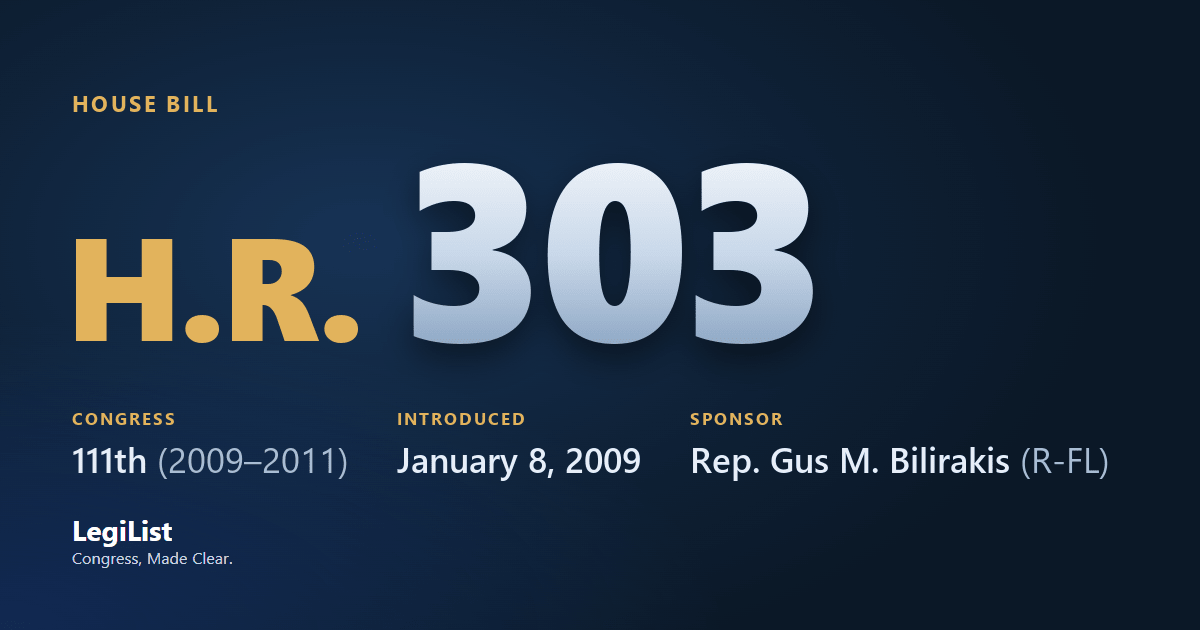
Retired Pay Restoration Act
Latest action · Jan 30, 2009 Referred to the Subcommittee on Military Personnel.
Progress
Where this bill reached, and when. A stage with no date was not reached; one that failed a vote and later carried shows the date it carried.
- IntroducedJan 8, 2009
- Passed HouseNot reached
- Passed SenateNot reached
- To the PresidentNot reached
- Became lawNot reached
Summary
Retired Pay Restoration Act - Expresses the sense of Congress that military retired pay should not be reduced because a military retiree is also eligible for veterans' disability compensation awarded for a service-connected disability.
Allows the receipt of both military retired pay and veterans' disability compensation with respect to any service-connected disability (under current law, only a disability rated at 50% or more). Repeals provisions phasing in the full concurrent receipt of such pay through December 31, 2013.
Makes eligible for the full concurrent receipt of both veterans' disability compensation and either military retired pay or combat-related special pay those individuals who were retired or separated from military service due to a service-connected disability.
Cosponsors 136
Members who signed on, in the order they did. Signatures ran from Feb 3, 2009 to Sep 15, 2010.
| Seat | Cosponsor | Signed on | |
|---|---|---|---|
| R-KY | Ed Whitfield | Feb 3, 2009 | |
| R-CA | Elton Gallegly | Feb 3, 2009 | |
| R-FL | Ginny Brown-Waite | Feb 3, 2009 | |
| D-ME | Michael H. Michaud | Feb 3, 2009 | |
| R-AL | Mike Rogers | Feb 3, 2009 | |
| R-TN | Zach Wamp | Feb 3, 2009 | |
| R-FL | C. W. Bill Young | Feb 10, 2009 | |
| D-PA | Christopher P. Carney | Feb 10, 2009 | |
| R-AR | John Boozman | Feb 10, 2009 | |
| R-TX | John R. Carter | Feb 10, 2009 | |
| D-NC | David E. Price | Feb 13, 2009 | |
| R-NJ | Frank A. LoBiondo | Feb 13, 2009 | |
| R-OR | Greg Walden | Feb 13, 2009 | |
| R-KS | Jerry Moran | Feb 13, 2009 | |
| R-CA | Ken Calvert | Feb 13, 2009 |
Committees 2
Where it was sent and what each committee and subcommittee did with it, in order.
| Chamber | Committee | What it did |
|---|---|---|
| House | Armed Services Committee | Referred Jan 8, 2009 |
| Military Personnel Subcommittee | Referred Jan 30, 2009 | |
| House | Veterans' Affairs Committee | Referred Jan 8, 2009 |
| Disability Assistance and Memorial Affairs Subcommittee | Referred Jan 9, 2009 |
Actions 6
Everything that happened, newest first.
- Jan 30, 2009Referred to the Subcommittee on Military Personnel.
- Jan 9, 2009Referred to the Subcommittee on Disability Assistance and Memorial Affairs.
- Jan 8, 2009Introduced in House
- Jan 8, 2009Referred to House Armed Services
- Jan 8, 2009Referred to the Committee on Armed Services, and in addition to the Committee on Veterans' Affairs, for a period to be subsequently determined by the Speaker, in each case for consideration of such provisions as fall within the jurisdiction of the committee concerned.
- Jan 8, 2009Referred to House Veterans' Affairs
Related bills 1
Companion bills and other measures the record links to this one.
| Bill | Title | Relationship | Latest action |
|---|---|---|---|
| HR 811 | Retired Pay Restoration Act | Related bill | Feb 24, 2009 |
Titles 2
Every title it has carried, official and short, at each stage.
- Official Title as Introduced
- To amend title 10, United States Code, to permit additional retired members of the Armed Forces who have a service-connected disability to receive both disability compensation from the Department of Veterans Affairs for their disability and either retired pay by reason of their years of military service or Combat-Related Special Compensation and to eliminate the phase-in period under current law with respect to such concurrent receipt.
- Short Titles as Introduced
- Retired Pay Restoration Act
Subjects
Assigned by the Library of Congress. Policy area: Armed Forces and National Security.
Text 1
Each version as it was printed, newest first.
- Jan 8, 2009Introduced in House
Support LegiList
This page is free, carries no paywall, and is built and maintained by one person. If the record here is useful to you, a few dollars keeps it going.
Everything here is as published by Congress: the summary is the Congressional Research Service's, the action wording is the clerks', and the subjects are the Library of Congress's. How far it got is read from the actions themselves, taking the most recent one of each kind, so a bill that failed a vote and later passed is shown as having passed. Records come from this bill on Congress.gov and govinfo.gov; cost estimates are the Congressional Budget Office's, and the hearings are the printed hearings GovInfo publishes, which can appear months after the hearing.