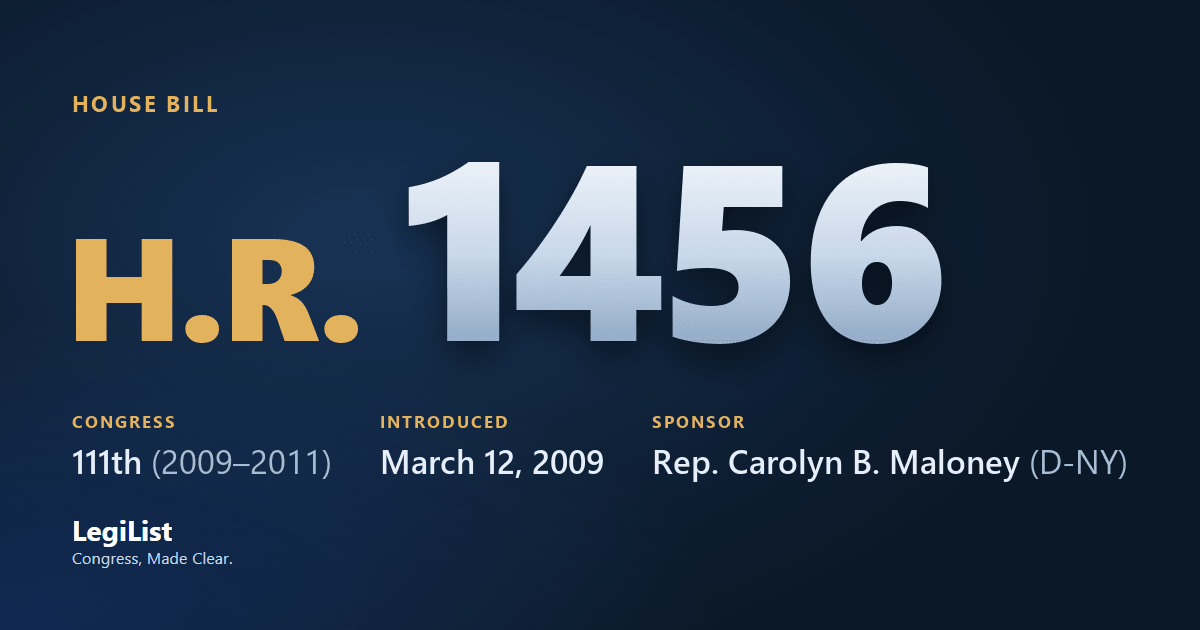
Consumer Overdraft Protection Fair Practices Act
Latest action · Mar 19, 2009 Subcommittee Hearings Held.
Progress
Where this bill reached, and when. A stage with no date was not reached; one that failed a vote and later carried shows the date it carried.
- IntroducedMar 12, 2009
- Passed HouseNot reached
- Passed SenateNot reached
- To the PresidentNot reached
- Became lawNot reached
Summary
Consumer Overdraft Protection Fair Practices Act - Amends the Truth in Lending Act to set forth restrictions upon overdraft protection fees or services placed upon a consumer account in order to cover any debit due to insufficient funds in such account.
Prohibits certain misrepresentations made by an institution that it will extend credit to cover all overdrafts.
Prohibits specified advertising claims regarding overdraft protection programs or services, including any representation or statement encouraging use of the account as a service to: (1) meet short-term credit needs; or (2) obtain advances on a consumer's next payment of salary, wages, benefits, or other income.
Authorizes the Board of Governors of the Federal Reserve System to restrict additional acts or practices the Board deems unfair or deceptive in connection with the offering, operation, and advertising of overdraft protection programs and services.
Amends the Electronic Fund Transfer Act to set forth restrictions governing overdraft protection services and fees concerning payment of an electronic fund transfer initiated by the consumer at an automated teller machine (ATM) despite of a lack of sufficient funds in the consumer's account.
Amends the Expedited Funds Availability Act to prohibit a depository institution from: (1) imposing overdraft protection fees for paying any check drawn on the account in spite of a lack of sufficient funds unless the account holder has affirmatively requested such service; or (2) engaging in a pattern or practice of delaying the posting of any deposit in an account, or manipulating the process of posting any check or other debit against an account, if such pattern or practice results in an overdraft that triggers payment of an overdraft protection fee.
Cosponsors 16
Members who signed on, in the order they did. Signatures ran from Mar 12, 2009 to Oct 8, 2009; 6 are original cosponsors, there from the day it was introduced.
| Seat | Cosponsor | Signed on | |
|---|---|---|---|
| D-CA | Anna G. Eshoo | Original | Mar 12, 2009 |
| D-NC | Brad Miller | Original | Mar 12, 2009 |
| D-NY | Gary L. Ackerman | Original | Mar 12, 2009 |
| D-CA | Jackie Speier | Original | Mar 12, 2009 |
| D-MA | John F. Tierney | Original | Mar 12, 2009 |
| D-MN | Keith Ellison | Original | Mar 12, 2009 |
| D-IL | Janice D. Schakowsky | Mar 23, 2009 | |
| D-MA | Michael E. Capuano | Mar 30, 2009 | |
| D-CA | George Miller | Sep 10, 2009 | |
| D-AZ | Raúl M. Grijalva | Sep 22, 2009 | |
| D-MA | Bill Delahunt | Sep 25, 2009 | |
| D-NY | Jose E. Serrano | Sep 25, 2009 | |
| D-CA | Michael M. Honda | Sep 25, 2009 | |
| D-PA | Paul E. Kanjorski | Sep 25, 2009 | |
| D-MD | Chris Van Hollen | Oct 8, 2009 |
Committees 1
Where it was sent and what each committee and subcommittee did with it, in order.
| Chamber | Committee | What it did |
|---|---|---|
| House | Financial Services Committee | Referred Mar 12, 2009 |
| Consumer Protection and Financial Institutions Subcommittee | Referred Mar 19, 2009Hearings Mar 19, 2009 |
Actions 5
Everything that happened, newest first.
- Mar 19, 2009Referred to the Subcommittee on Financial Institutions and Consumer Credit.
- Mar 19, 2009Subcommittee Hearings Held.
- Mar 12, 2009Introduced in House
- Mar 12, 2009Sponsor introductory remarks on measure. (CR E663)
- Mar 12, 2009Referred to the House Committee on Financial Services.
In the Congressional Record 1
Days the Record’s own index lists this bill, newest first, with the pages and the members it names. Pages starting H are the House, S the Senate, E Extensions of Remarks.
| Where | In the Record | Members | Date |
|---|---|---|---|
| Extensions | Debate and remarks E663 | Carolyn B. Maloney D-NY | Mar 12, 2009 |
Research
What has been written about this bill: committee reports, cost estimates, the sponsor’s authority statement, printed hearings and the Congressional Research Service’s work.
Printed hearings 2
Hearings whose printed record names this bill, newest first: hearings on it, and wider hearings where it came up.
| Number | Hearing | Committee | Held |
|---|---|---|---|
| Serial No. 111-24 | H.R. 1214, THE PAYDAY LOAN REFORM ACT OF 2009136 pages | Financial Services Committee | Apr 2, 2009 |
| Serial No. 111-17 | H.R. 627, THE CREDIT CARDHOLDERS' BILL OF RIGHTS ACT OF 2009; AND H.R. 1456, THE CONSUMER OVERDRAFT PROTECTION FAIR PRACTICES ACT OF 2009235 pages | Financial Services Committee | Mar 19, 2009 |
Titles 2
Every title it has carried, official and short, at each stage.
- Official Title as Introduced
- To extend the protections of the Truth in Lending Act to overdraft protection programs and services provided by depository institutions, to require customer consent before a depository institution may initiate overdraft protection services and fees, to enhance the information made available to consumers relating to overdraft protection services and fees, to prohibit systematic manipulation in the posting of checks and other debits to a depository account for the purpose of generating overdraft protection fees, and for other purposes.
- Short Titles as Introduced
- Consumer Overdraft Protection Fair Practices Act
Subjects
Assigned by the Library of Congress. Policy area: Finance and Financial Sector.
Text 1
Each version as it was printed, newest first.
- Mar 12, 2009Introduced in House
Support LegiList
This page is free, carries no paywall, and is built and maintained by one person. If the record here is useful to you, a few dollars keeps it going.
Everything here is as published by Congress: the summary is the Congressional Research Service's, the action wording is the clerks', and the subjects are the Library of Congress's. How far it got is read from the actions themselves, taking the most recent one of each kind, so a bill that failed a vote and later passed is shown as having passed. Records come from this bill on Congress.gov and govinfo.gov; cost estimates are the Congressional Budget Office's, and the hearings are the printed hearings GovInfo publishes, which can appear months after the hearing.