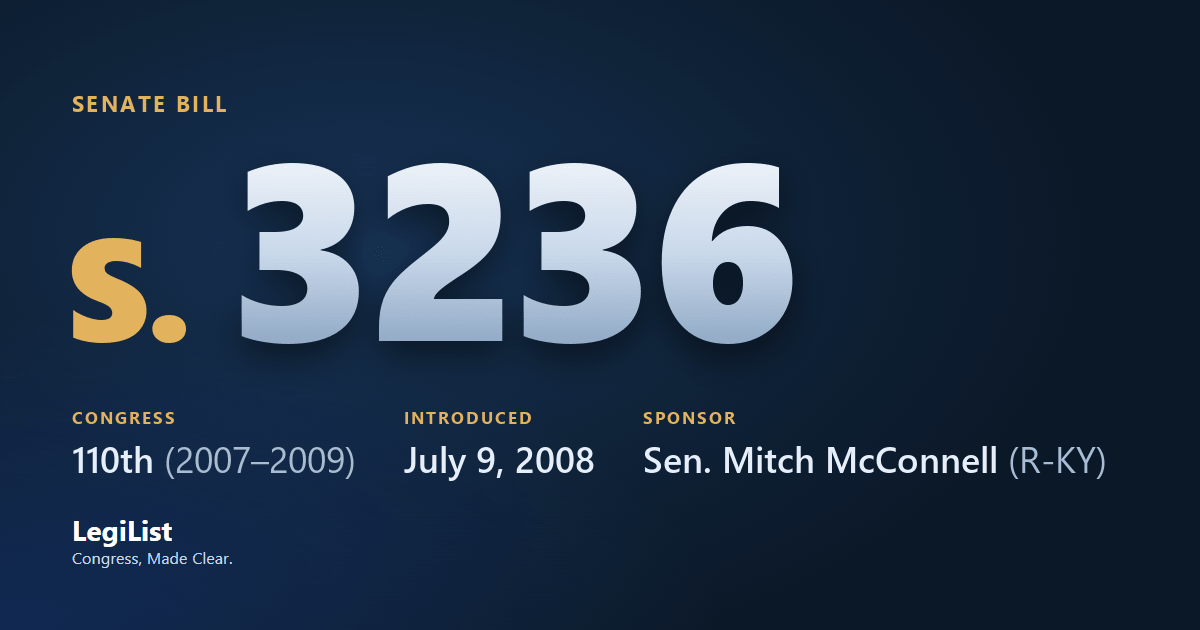
Medicare and Medicaid Extension Act of 2008
Latest action · Jul 11, 2008 Read the second time. Placed on Senate Legislative Calendar under General Orders. Calendar No. 874.
Progress
Where this bill reached, and when. A stage with no date was not reached; one that failed a vote and later carried shows the date it carried.
- IntroducedJul 9, 2008
- Passed SenateNot reached
- Passed HouseNot reached
- To the PresidentNot reached
- Became lawNot reached
Summary
Medicare and Medicaid Extension Act of 2008 - Amends title XVIII (Medicare) of the Social Security Act (SSA) to extend: (1) the physician payment update; (2) the floor on the work geographic adjustment under the Medicare physician fee schedule; (3) the treatment of certain physician pathology services; (4) the exceptions process for therapy caps; (5) the payment rule for brachytherapy and therapeutic radiopharmaceuticals; and (6) the accommodation of physicians ordered to active duty in the Armed Services.
Delays generally until after 2011 full implementation of the Medicare competitive acquisition program for the purchase of durable medical equipment (DME), prosthetics, orthotics, and supplies (DMEPOS).
Revises such program, dividing its implementation into two rounds, and specifying covered item updates for 2009-2014.
Prescribes requirements for application of accreditation in implementing quality standards.
Requires suppliers to disclose subcontractors.
Directs the Secretary of Health and Human Services to provide for a competitive acquisition ombudsman within the Centers for Medicare & Medicaid Services to respond to complaints and inquiries by suppliers and individuals.
Specifies topics for the Comptroller General's required study and report to Congress on the impact of competitive acquisition of DME on suppliers, manufacturers, and patients.
Sets forth a special rule for the competitive acquisition program for diabetic testing strips.
Amends SSA title XIX (Medicaid) to extend the qualifying individual (QI), transitional medical assistance (TMA), abstinence education, and Medicaid disproportionate share hospital (DSH) programs.
Cosponsors 2
Members who signed on, in the order they did. All signed on Jul 9, 2008.
| Seat | Cosponsor | Signed on | |
|---|---|---|---|
| R-IA | Chuck Grassley | Original | Jul 9, 2008 |
| R-AZ | Jon Kyl | Original | Jul 9, 2008 |
Actions 3
Everything that happened, newest first.
- Jul 11, 2008Read the second time. Placed on Senate Legislative Calendar under General Orders. Calendar No. 874.
- Jul 9, 2008Introduced in Senate
- Jul 9, 2008Introduced in the Senate. Read the first time. Placed on Senate Legislative Calendar under Read the First Time. (text of measure as introduced: CR S6506-6509)
In the Congressional Record 2
Days the Record’s own index lists this bill, newest first, with the pages and the members it names. Pages starting H are the House, S the Senate, E Extensions of Remarks.
| Where | In the Record | Members | Date |
|---|---|---|---|
| Senate | Debate and remarks S6583 | Harry Reid D-NV | Jul 11, 2008 |
| Senate | Debate and remarks S6510Text printed S6506–S6509 | Harry Reid D-NV, Mitch McConnell R-KY (text) | Jul 9, 2008 |
Titles 2
Every title it has carried, official and short, at each stage.
- Official Title as Introduced
- A bill to amend titles XVIII and XIX of the Social Security Act to extend provisions under Medicare and Medicaid programs, and for other purposes.
- Short Titles as Introduced
- Medicare and Medicaid Extension Act of 2008
Subjects
Assigned by the Library of Congress. Policy area: Health.
- Access to health care
- Accreditation (Medical care)
- Armed Forces and National Security
- Armed forces reserves
- Cancer
- Congress
- Congressional investigations
- Congressional reporting requirements
- Department of Health and Human Services
- Diabetes
- Drug therapy
- Executive reorganization
- Government Operations and Politics
- Health
- Health education
- Hospitals
- Medicaid
- Medical fees
- Medical laboratories
- Medical supplies
- Medical tests
- Medically uninsured
- Medicare
- Ombudsman
- Physicians
- Prosthesis
- Quality of care
- Radiotherapy
- Sexual abstinence
- Social Welfare
- Subcontractors
Text 1
Each version as it was printed, newest first.
- Jul 11, 2008Placed on Calendar Senate
Support LegiList
This page is free, carries no paywall, and is built and maintained by one person. If the record here is useful to you, a few dollars keeps it going.
Everything here is as published by Congress: the summary is the Congressional Research Service's, the action wording is the clerks', and the subjects are the Library of Congress's. How far it got is read from the actions themselves, taking the most recent one of each kind, so a bill that failed a vote and later passed is shown as having passed. Records come from this bill on Congress.gov and govinfo.gov; cost estimates are the Congressional Budget Office's, and the hearings are the printed hearings GovInfo publishes, which can appear months after the hearing.