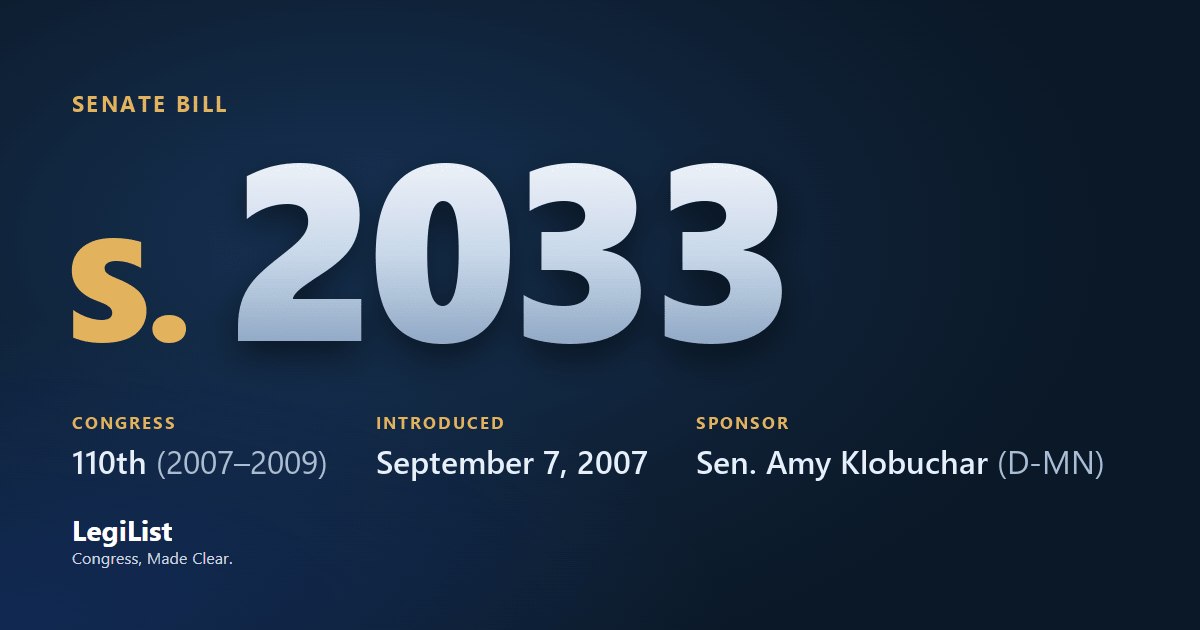
Cell Phone Consumer Empowerment Act of 2007
Latest action · Oct 17, 2007 Committee on Commerce, Science, and Transportation. Hearings held. Hearings printed: S.Hrg. 110-1175.
Progress
Where this bill reached, and when. A stage with no date was not reached; one that failed a vote and later carried shows the date it carried.
- IntroducedSep 7, 2007
- Passed SenateNot reached
- Passed HouseNot reached
- To the PresidentNot reached
- Became lawNot reached
Summary
Cell Phone Consumer Empowerment Act of 2007 - Requires that a wireless telephone service provider disclose, in a plain and conspicuous way, contract information regarding terms, charges, minutes, taxes and surcharges, and E-911 service in any publication of the contract, before a consumer enters into the contract, and in advertising.
Requires wireless service bills to be clearly organized and use plain language, have taxes and fees in a separate section, and itemize roaming charges.
Requires each provider to make available a map showing the wireless telephone service area of the provider and the wireless telephone service area of the provider in each state.
Requires the Federal Communications Commission (FCC) to monitor the quality of wireless telephone service provided in the United States by requiring semiannual reports of wireless service providers.
Requires that early termination fees be prorated over the term of a wireless subscriber's contract in a way that reasonably links the fee to recovery of the cost of the device or other legitimate business expenses.
Regulates service contract extensions, cancellation penalties, and changes in rates, terms, or conditions.
Amends the Servicemembers Civil Relief Act to allow a member of the uniformed services to terminate a cellular phone service contract in specified circumstances involving service of at least 90 days.
Preempts inconsistent state laws.
Cosponsors 4
Members who signed on, in the order they did. Signatures ran from Sep 7, 2007 to Mar 6, 2008; 1 is an original cosponsor, there from the day it was introduced.
| Seat | Cosponsor | Signed on | |
|---|---|---|---|
| D-WV | John D. Rockefeller IV | Original | Sep 7, 2007 |
| D-ND | Byron L. Dorgan | Oct 18, 2007 | |
| D-WI | Russell D. Feingold | Oct 25, 2007 | |
| D-VA | Jim Webb | Mar 6, 2008 |
Committees 1
Where it was sent and what each committee and subcommittee did with it, in order.
| Chamber | Committee | What it did |
|---|---|---|
| Senate | Commerce, Science, and Transportation Committee | Referred Sep 7, 2007Hearings Oct 17, 2007 |
Actions 3
Everything that happened, newest first.
- Oct 17, 2007Committee on Commerce, Science, and Transportation. Hearings held. Hearings printed: S.Hrg. 110-1175.
- Sep 7, 2007Introduced in Senate
- Sep 7, 2007Read twice and referred to the Committee on Commerce, Science, and Transportation.
Research
What has been written about this bill: committee reports, cost estimates, the sponsor’s authority statement, printed hearings and the Congressional Research Service’s work.
Printed hearings 1
Hearings whose printed record names this bill, newest first: hearings on it, and wider hearings where it came up.
| Number | Hearing | Committee | Held |
|---|---|---|---|
| S. Hrg. 110-1175 | CONSUMER WIRELESS ISSUES93 pages | Commerce, Science, and Transportation Committee | Oct 17, 2007 |
Titles 2
Every title it has carried, official and short, at each stage.
- Official Title as Introduced
- A bill to provide for greater disclosure to, and empowerment of, consumers who have entered into a contract for cellular telephone service.
- Short Titles as Introduced
- Cell Phone Consumer Empowerment Act of 2007
Subjects
Assigned by the Library of Congress. Policy area: Science, Technology, Communications.
- Administrative procedure
- Administrative remedies
- Advertising
- Armed forces abroad
- Armed Forces and National Security
- Business records
- Civil actions and liability
- Commerce
- Consumer education
- Consumer protection
- Contracts
- Crime and Law Enforcement
- Emergency communication systems
- Emergency Management
- Federal Communications Commission
- Federal preemption
- Fees
- Government Operations and Politics
- Government paperwork
- Independent regulatory commissions
- Law
- Maps
- Military personnel
- Quality of products
- Science, Technology, Communications
- State laws
- Telecommunication rates
- Wireless communication
Text 1
Each version as it was printed, newest first.
- Sep 7, 2007Introduced in Senate
Support LegiList
This page is free, carries no paywall, and is built and maintained by one person. If the record here is useful to you, a few dollars keeps it going.
Everything here is as published by Congress: the summary is the Congressional Research Service's, the action wording is the clerks', and the subjects are the Library of Congress's. How far it got is read from the actions themselves, taking the most recent one of each kind, so a bill that failed a vote and later passed is shown as having passed. Records come from this bill on Congress.gov and govinfo.gov; cost estimates are the Congressional Budget Office's, and the hearings are the printed hearings GovInfo publishes, which can appear months after the hearing.