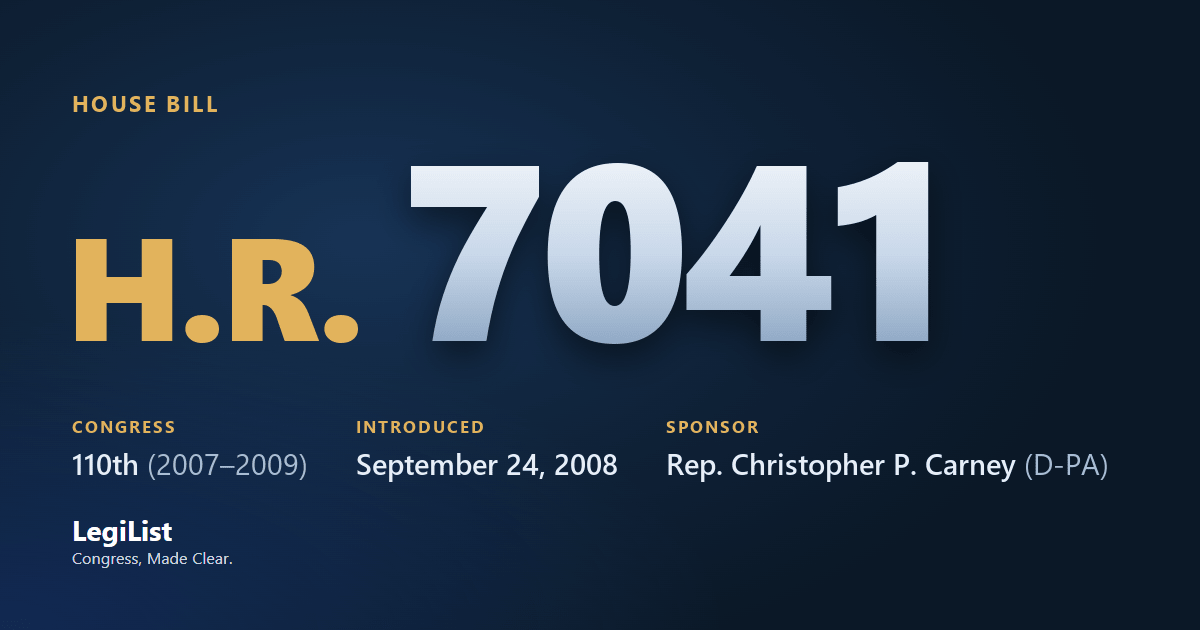
Laboratory Surge Capacity Preparedness Act
Latest action · Sep 29, 2008 Referred to the Subcommittee on Emergency Communications, Preparedness, and Response.
Progress
Where this bill reached, and when. A stage with no date was not reached; one that failed a vote and later carried shows the date it carried.
- IntroducedSep 24, 2008
- Passed HouseNot reached
- Passed SenateNot reached
- To the PresidentNot reached
- Became lawNot reached
Summary
Laboratory Surge Capacity Preparedness Act - Directs the Secretary of Homeland Security to award grants to regional biocontainment laboratories for maintaining surge capacity that can be used to respond to acts of bioterrorism or outbreaks of infectious diseases. Authorizes the Secretary to award such a grant only if the laboratory agrees to allow the Secretary and other relevant federal agencies to inspect laboratory facilities.
Requires the Secretary to report to Congress on: (1) activities undertaken to integrate the network of regional biocontainment laboratories with the laboratory response network of the Centers for Disease Control and Prevention (CDC); and (2) the extent to which additional Biosafety Level 3 laboratories are needed to fulfill the national's laboratory surge capacity needs.
Cosponsors 13
Members who signed on, in the order they did. Signatures ran from Sep 24, 2008 to Sep 29, 2008; 11 are original cosponsors, there from the day it was introduced.
| Seat | Cosponsor | Signed on | |
|---|---|---|---|
| D-PA | Allyson Y. Schwartz | Original | Sep 24, 2008 |
| D-PA | Chaka Fattah | Original | Sep 24, 2008 |
| D-NJ | Donald M. Payne | Original | Sep 24, 2008 |
| D-NJ | Frank Pallone, Jr. | Original | Sep 24, 2008 |
| D-NC | G. K. Butterfield | Original | Sep 24, 2008 |
| D-PA | Jason Altmire | Original | Sep 24, 2008 |
| D-PA | Michael F. Doyle | Original | Sep 24, 2008 |
| D-NC | Mike McIntyre | Original | Sep 24, 2008 |
| R-AL | Spencer Bachus | Original | Sep 24, 2008 |
| D-TN | Steve Cohen | Original | Sep 24, 2008 |
| D-PA | Tim Holden | Original | Sep 24, 2008 |
| D-PA | Robert A. Brady | Sep 29, 2008 | |
| R-PA | Tim Murphy | Sep 29, 2008 |
Committees 2
Where it was sent and what each committee and subcommittee did with it, in order.
| Chamber | Committee | What it did |
|---|---|---|
| House | Energy and Commerce Committee | Referred Sep 24, 2008 |
| Health Subcommittee | Referred Sep 24, 2008 | |
| House | Homeland Security Committee | Referred Sep 24, 2008 |
| Emergency Management and Technology Subcommittee | Referred Sep 29, 2008 |
Actions 4
Everything that happened, newest first.
- Sep 29, 2008Referred to the Subcommittee on Emergency Communications, Preparedness, and Response.
- Sep 24, 2008Introduced in House
- Sep 24, 2008Referred to the Committee on Energy and Commerce, and in addition to the Committee on Homeland Security, for a period to be subsequently determined by the Speaker, in each case for consideration of such provisions as fall within the jurisdiction of the committee concerned.
- Sep 24, 2008Referred to the Subcommittee on Health.
Titles 2
Every title it has carried, official and short, at each stage.
- Official Title as Introduced
- To authorize the Secretary of Homeland Security to award grants on a competitive basis to regional biocontainment laboratories for maintaining surge capacity that can be used to respond to acts of bioterrorism or outbreaks of infectious diseases, and for other purposes.
- Short Titles as Introduced
- Laboratory Surge Capacity Preparedness Act
Subjects
Assigned by the Library of Congress. Policy area: Emergency Management.
Text 1
Each version as it was printed, newest first.
- Sep 24, 2008Introduced in House
Support LegiList
This page is free, carries no paywall, and is built and maintained by one person. If the record here is useful to you, a few dollars keeps it going.
Everything here is as published by Congress: the summary is the Congressional Research Service's, the action wording is the clerks', and the subjects are the Library of Congress's. How far it got is read from the actions themselves, taking the most recent one of each kind, so a bill that failed a vote and later passed is shown as having passed. Records come from this bill on Congress.gov and govinfo.gov; cost estimates are the Congressional Budget Office's, and the hearings are the printed hearings GovInfo publishes, which can appear months after the hearing.