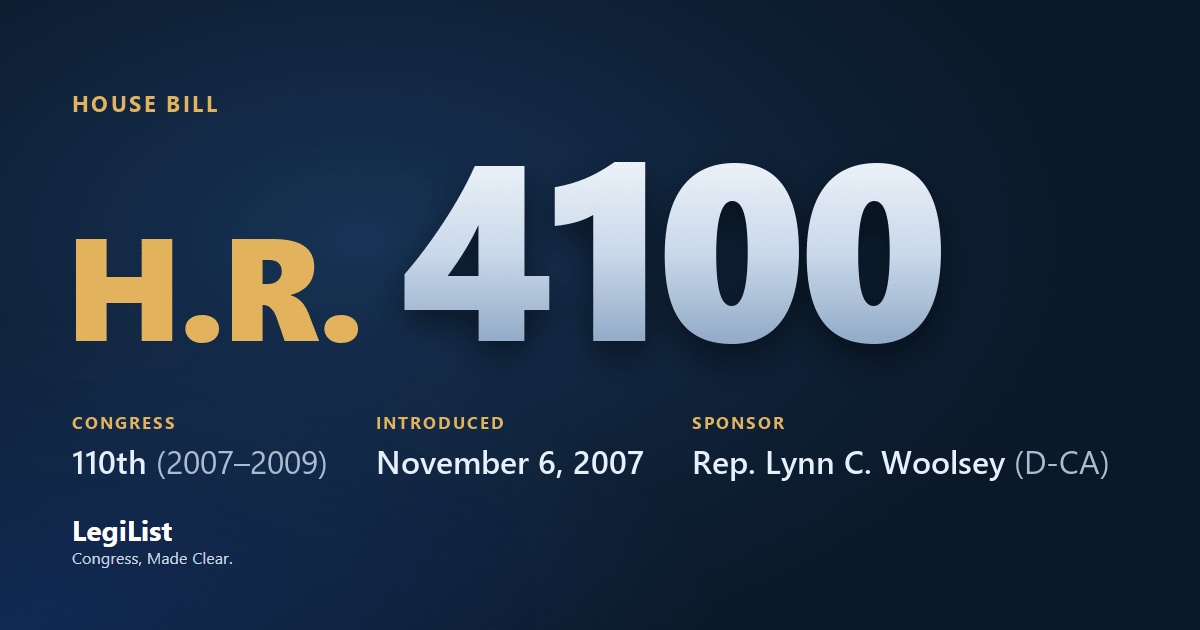
To amend the Elementary and Secondary Education Act of 1965 to establish an instructional level assessment pilot program.
Latest action · Jan 22, 2008 Referred to the Subcommittee on Early Childhood, Elementary, and Secondary Education.
Progress
Where this bill reached, and when. A stage with no date was not reached; one that failed a vote and later carried shows the date it carried.
- IntroducedNov 6, 2007
- Passed HouseNot reached
- Passed SenateNot reached
- To the PresidentNot reached
- Became lawNot reached
Summary
Amends the Elementary and Secondary Education Act of 1965 to require the Secretary of Education to: (1) award competitive grants to up to 10 states for pilot programs to determine the effectiveness of assessing disabled students who are achieving significantly below grade-level proficiency at their instructional level; and (2) provide quality instruction to such students.
Requires each grantee to identify a minimum of five local educational agencies (LEAs) to participate in its pilot program and limit student participation to 0.5% of the students assessed in each participating LEA.
Requires such states and LEAs to ensure that each participating student's individualized education program team: (1) administers, after securing parental consent, a scientifically-valid and reliable assessment based on the student's instructional level in reading and/or math; and (2) based on such assessment, develops a series of targeted interventions designed to close identified gaps in the student's instructional and grade-level content knowledge.Prohibits the use of such assessment results in determinations of adequate yearly progress (AYP) toward state academic performance standards.
Cosponsors 11
Members who signed on, in the order they did. Signatures ran from Nov 6, 2007 to Jul 30, 2008; 9 are original cosponsors, there from the day it was introduced.
| Seat | Cosponsor | Signed on | |
|---|---|---|---|
| D-TN | Bart Gordon | Original | Nov 6, 2007 |
| D-MS | Bennie G. Thompson | Original | Nov 6, 2007 |
| D-IA | David Loebsack | Original | Nov 6, 2007 |
| D-NJ | Donald M. Payne | Original | Nov 6, 2007 |
| D-KY | John A. Yarmuth | Original | Nov 6, 2007 |
| D-CA | Linda T. Sánchez | Original | Nov 6, 2007 |
| D-CA | Michael M. Honda | Original | Nov 6, 2007 |
| D-IL | Phil Hare | Original | Nov 6, 2007 |
| D-TN | Steve Cohen | Original | Nov 6, 2007 |
| R-IL | Mark Kirk | Nov 15, 2007 | |
| D-HI | Mazie K. Hirono | Jul 30, 2008 |
Committees 1
Where it was sent and what each committee and subcommittee did with it, in order.
| Chamber | Committee | What it did |
|---|---|---|
| House | Education and Workforce Committee | Referred Nov 6, 2007 |
| Early Childhood, Elementary, and Secondary Education Subcommittee | Referred Jan 22, 2008 |
Actions 3
Everything that happened, newest first.
- Jan 22, 2008Referred to the Subcommittee on Early Childhood, Elementary, and Secondary Education.
- Nov 6, 2007Introduced in House
- Nov 6, 2007Referred to the House Committee on Education and Labor.
Research
What has been written about this bill: committee reports, cost estimates, the sponsor’s authority statement, printed hearings and the Congressional Research Service’s work.
Printed hearings 1
Hearings whose printed record names this bill, newest first: hearings on it, and wider hearings where it came up.
| Number | Hearing | Committee | Held |
|---|---|---|---|
| Serial No. 110-138 | LEGISLATIVE PROPOSALS BEFORE THE 110TH CONGRESS TO AMEND FEDERAL RESTITUTION LAWS288 pages | Judiciary Committee | Apr 3, 2008 |
Titles 1
Every title it has carried, official and short, at each stage.
- Official Title as Introduced
- To amend the Elementary and Secondary Education Act of 1965 to establish an instructional level assessment pilot program.
Subjects
Assigned by the Library of Congress. Policy area: Education.
- Compensatory education
- Congressional reporting requirements
- Disabled
- Economics and Public Finance
- Education
- Educational accountability
- Educational tests
- Elementary and secondary education
- Elementary education
- Families
- Federal aid to education
- Government Operations and Politics
- Government paperwork
- Mathematics
- Parent and child
- Reading
- Secondary education
- Special education
Text 1
Each version as it was printed, newest first.
- Nov 6, 2007Introduced in House
Everything here is as published by Congress: the summary is the Congressional Research Service's, the action wording is the clerks', and the subjects are the Library of Congress's. How far it got is read from the actions themselves, taking the most recent one of each kind, so a bill that failed a vote and later passed is shown as having passed. Records come from this bill on Congress.gov and govinfo.gov; cost estimates are the Congressional Budget Office's, and the hearings are the printed hearings GovInfo publishes, which can appear months after the hearing.