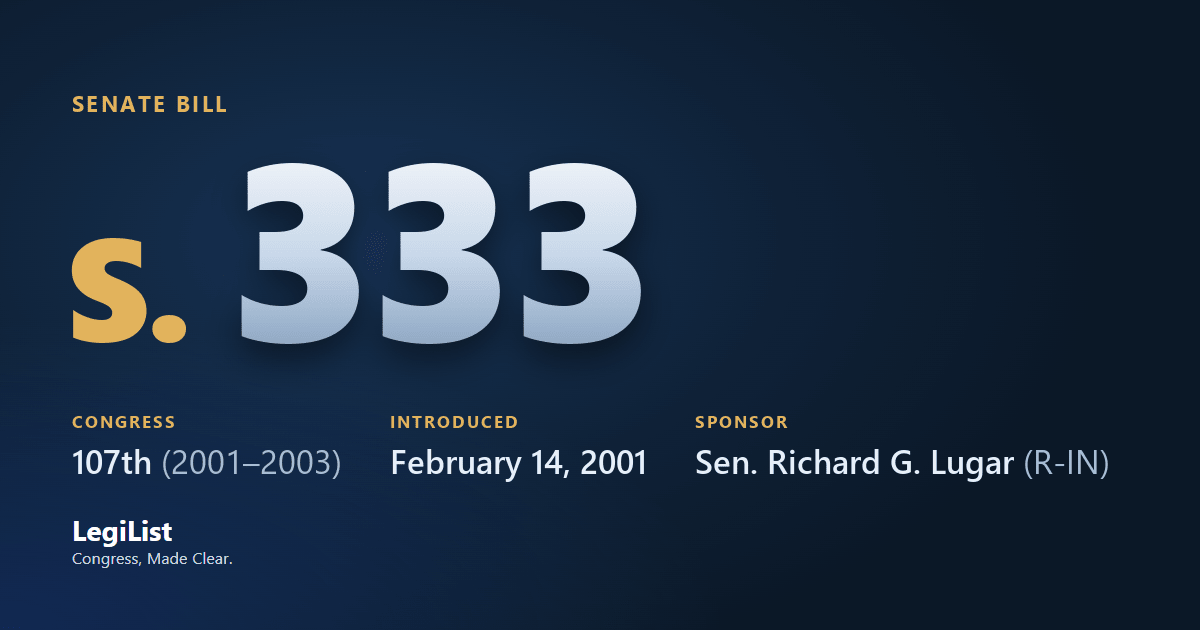
Rural America Prosperity Act of 2001
Latest action · Feb 14, 2001 Read twice and referred to the Committee on Finance. (text of measure as introduced: CR S1407-1417)
Progress
Where this bill reached, and when. A stage with no date was not reached; one that failed a vote and later carried shows the date it carried.
- IntroducedFeb 14, 2001
- Passed SenateNot reached
- Passed HouseNot reached
- To the PresidentNot reached
- Became lawNot reached
Summary
Directs the Comptroller General to conduct a a study of the costs of regulations on farmers, ranchers, and foresters.
Reciprocal Trade Agreement Authorities Act of 2001 - Authorizes the President, upon a determination that import restrictions are unduly burdening U.S. foreign trade, to enter into foreign trade agreements which: (1) open and expand U.S. market access; (2) reduce or eliminate trade barriers for U.S. exports; and (3) free investment fund transfers.
Agricultural Trade Freedom Act - Amends the Agricultural trade Act of 1978 to exempt, with exceptions, agricultural commodities, livestock, and products made available as a result of commercial sales from a unilateral trade sanction imposed by the United States on another country.
Cosponsors 4
Members who signed on, in the order they did. Signatures ran from Feb 14, 2001 to Apr 30, 2001; 3 are original cosponsors, there from the day it was introduced.
| Seat | Cosponsor | Signed on | |
|---|---|---|---|
| R-MT | Conrad R. Burns | Original | Feb 14, 2001 |
| R-KY | Mitch McConnell | Original | Feb 14, 2001 |
| R-KS | Pat Roberts | Original | Feb 14, 2001 |
| R-MS | Thad Cochran | Apr 30, 2001 |
Committees 1
Where it was sent and what each committee and subcommittee did with it, in order.
| Chamber | Committee | What it did |
|---|---|---|
| Senate | Finance Committee | Referred Feb 14, 2001 |
Actions 3
Everything that happened, newest first.
- Feb 14, 2001Introduced in Senate
- Feb 14, 2001Sponsor introductory remarks on measure. (CR S1406)
- Feb 14, 2001Read twice and referred to the Committee on Finance. (text of measure as introduced: CR S1407-1417)
In the Congressional Record 1
Days the Record’s own index lists this bill, newest first, with the pages and the members it names. Pages starting H are the House, S the Senate, E Extensions of Remarks.
| Where | In the Record | Members | Date |
|---|---|---|---|
| Senate | Debate and remarks S1406Text printed S1407–S1417 | Richard G. Lugar R-IN (text) | Feb 14, 2001 |
Titles 4
Every title it has carried, official and short, at each stage.
- Official Title as Introduced
- A bill to provide tax and regulatory relief for farmers and to improve the competitiveness of American agricultural commodities and products in global markets.
- Short Titles as Introduced
- Rural America Prosperity Act of 2001
- Short Titles as Introduced for portions of this bill
- Agricultural Trade Freedom Act
- Reciprocal Trade Agreement Authorities Act of 2001
Subjects
Assigned by the Library of Congress. Policy area: Agriculture and Food.
- Administrative procedure
- Agricultural biotechnology
- Agricultural innovations
- Agricultural production
- Agricultural subsidies
- Agriculture and Food
- Agriculture in foreign trade
- American investments
- Animals
- Antidumping
- Barter
- Business income tax
- Capital gains tax
- Child labor
- Chile
- Civil Rights and Liberties, Minority Issues
- Commerce
- Compensation (Law)
- Congress
- Congress and foreign policy
- Congressional investigations
- Congressional oversight
- Congressional reporting requirements
- Congressional veto
- Congressional-executive relations
- Congressional-Presidential relations
- Conservation easements
- Consumer protection
- Cost of living adjustments
- Countervailing duties
- Developing countries
- Dispute settlement
- Dumping
- Economic growth
- Economic impact statements
- Economics and Public Finance
- Employee rights
- Environmental Protection
- Estate tax
- Excise tax
- Expedited congressional procedure
- Export subsidies
- Exports
- Expropriation
- Families
- Family farms
- Farm income
- Farm lands
- Farmers
- Federal advisory bodies
- Finance and Financial Sector
- Financial services
- Financial statements
- Food relief
- Food safety
- Foreign investments
- Foreign Trade and International Finance
- Foreign trade promotion
- Forestry
- Free trade
- Full employment policies
- Gift tax
- Government Operations and Politics
- Government paperwork
- Health
- Health insurance
- House rules and procedure
- Human rights
- Import relief
- Income tax
- Indexing (Economic policy)
- Information technology
- Inheritance tax
- Insurance premiums
- Intellectual property
- International Affairs
- International competitiveness
- International labor activities
- Labor and Employment
- Latin America
- Law
- Legislation
- Legislative resolutions
- Livestock
- Medical economics
- Minimum tax
- National forests
- Nontariff trade barriers
- Occupational health and safety
- Personal income tax
- President and foreign policy
- Public Lands and Natural Resources
- Real estate appraisal
- Reciprocity
- Regulatory impact statements
- Restrictive trade practices
- Sanctions (International law)
- Science, Technology, Communications
- Self-employed
- Senate rules and procedure
- Service industries
- Standard of living
- Tariff
- Tariff agreements
- Tax administration
- Tax credits
- Tax cuts
- Tax deductions
- Tax deferral
- Tax exclusion
- Tax exemption
- Tax penalties
- Tax rates
- Tax returns
- Taxation
- Technological innovations
- Trade agreements
- Trade negotiations
- Trusts and trustees
- Valuation
- Wilderness areas
Text 1
Each version as it was printed, newest first.
- Feb 14, 2001Introduced in Senate
Support LegiList
This page is free, carries no paywall, and is built and maintained by one person. If the record here is useful to you, a few dollars keeps it going.
Everything here is as published by Congress: the summary is the Congressional Research Service's, the action wording is the clerks', and the subjects are the Library of Congress's. How far it got is read from the actions themselves, taking the most recent one of each kind, so a bill that failed a vote and later passed is shown as having passed. Records come from this bill on Congress.gov and govinfo.gov; cost estimates are the Congressional Budget Office's, and the hearings are the printed hearings GovInfo publishes, which can appear months after the hearing.