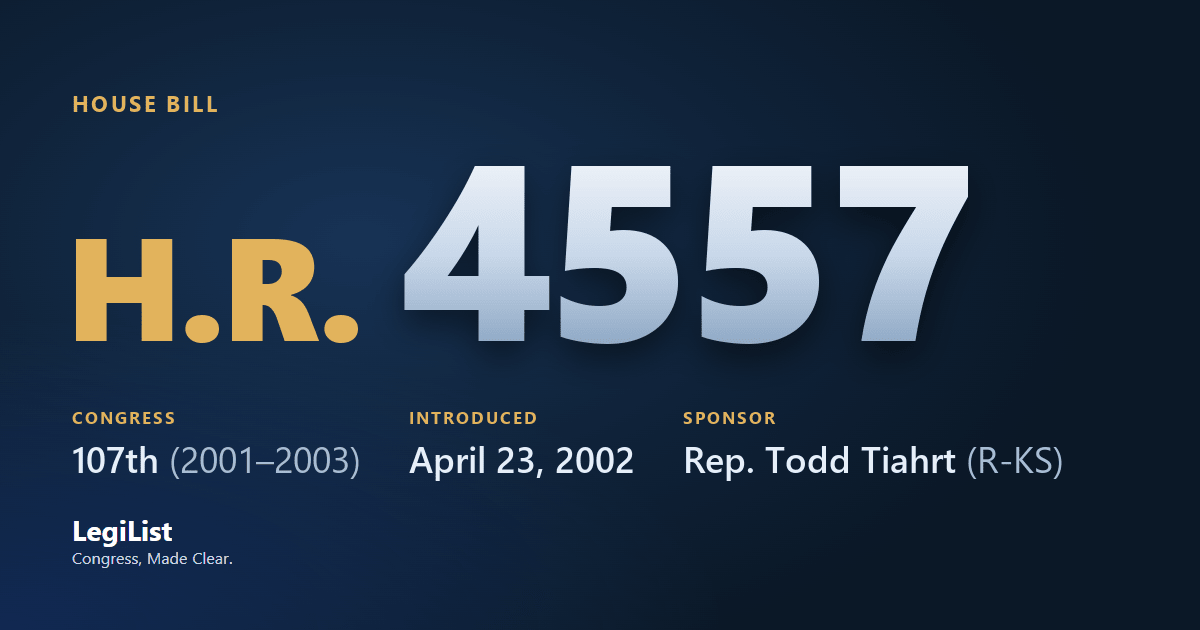
Defense Recurring Reports Elimination Act of 2002
Latest action · Apr 23, 2002 Referred to the House Committee on Armed Services.
Progress
Where this bill reached, and when. A stage with no date was not reached; one that failed a vote and later carried shows the date it carried.
- IntroducedApr 23, 2002
- Passed HouseNot reached
- Passed SenateNot reached
- To the PresidentNot reached
- Became lawNot reached
Summary
Cosponsors 1
Members who signed on, in the order they did. All signed on Apr 23, 2002.
| Seat | Cosponsor | Signed on | |
|---|---|---|---|
| R-IL | Mark Kirk | Original | Apr 23, 2002 |
Committees 1
Where it was sent and what each committee and subcommittee did with it, in order.
| Chamber | Committee | What it did |
|---|---|---|
| House | Armed Services Committee | Referred Apr 23, 2002 |
Actions 2
Everything that happened, newest first.
- Apr 23, 2002Introduced in House
- Apr 23, 2002Referred to the House Committee on Armed Services.
Titles 2
Every title it has carried, official and short, at each stage.
- Official Title as Introduced
- To reduce recurring reporting requirements imposed by law on the Department of Defense.
- Short Titles as Introduced
- Defense Recurring Reports Elimination Act of 2002
Subjects
Assigned by the Library of Congress. Policy area: Armed Forces and National Security.
- Air force
- American military assistance
- Ammunition
- Antimissile missiles
- Arab countries
- Arab-Israeli conflict
- Architecture
- Armed forces abroad
- Armed Forces and National Security
- Armed forces reserves
- Arms control agreements
- Arms sales
- Arts, Culture, Religion
- Aviation safety
- Bomber aircraft
- Boycott
- Building construction
- Building leases
- Cargo preference
- Civil-military relations
- College costs
- Commemorations
- Commerce
- Commercial blacklisting
- Congress
- Congress and military policy
- Congressional oversight
- Congressional reporting requirements
- Cost effectiveness
- Day care
- Defense budgets
- Defense burdensharing
- Defense contracts
- Defense industries
- Defense procurement
- Department of Defense
- Developing countries
- Diversification in industry
- Drug abuse
- Drug law enforcement
- East Asia
- Economics and Public Finance
- Education
- Energy
- Energy conservation
- Engineering
- Families
- Family services
- Federal advisory bodies
- Federal employees
- Federal office buildings
- Foreign corporations
- Foreign Trade and International Finance
- Gifts
- Government contractors
- Government corporations
- Government downsizing
- Government Operations and Politics
- Government trust funds
- Governmental investigations
- Health
- Higher education
- Housing and Community Development
- International Affairs
- Israel
- Labor and Employment
- Land transfers
- Leases
- Logistics
- Medical education
- Middle East and North Africa
- Military agreements
- Military aircraft
- Military base agreements
- Military base closures
- Military base conversion
- Military bases
- Military communications
- Military construction operations
- Military dependents
- Military hospitals
- Military housing
- Military medals, decorations, etc.
- Military medicine
- Military personnel
- Military promotions
- Military readiness
- Military research
- Military technology
- Military training
- NATO countries
- NATO military forces
- Naval personnel
- Officer personnel
- Pacific area
- Performance measurement
- Personnel records
- Physicians' assistants
- Post exchanges
- Public Lands and Natural Resources
- Public utilities
- Public-private partnerships
- Radar defense networks
- Relocation
- Rent
- Rental housing
- Reprogramming of appropriated funds
- Research and development
- Research centers
- Science, Technology, Communications
- Security classification (Government documents)
- Security clearances
- Service academies
- Technology transfer
- Texas
- Transportation and Public Works
- Treaties
- Warships
- Women
- Women soldiers
- Youth services
Text 1
Each version as it was printed, newest first.
- Apr 23, 2002Introduced in House
Support LegiList
This page is free, carries no paywall, and is built and maintained by one person. If the record here is useful to you, a few dollars keeps it going.
Everything here is as published by Congress: the summary is the Congressional Research Service's, the action wording is the clerks', and the subjects are the Library of Congress's. How far it got is read from the actions themselves, taking the most recent one of each kind, so a bill that failed a vote and later passed is shown as having passed. Records come from this bill on Congress.gov and govinfo.gov; cost estimates are the Congressional Budget Office's, and the hearings are the printed hearings GovInfo publishes, which can appear months after the hearing.