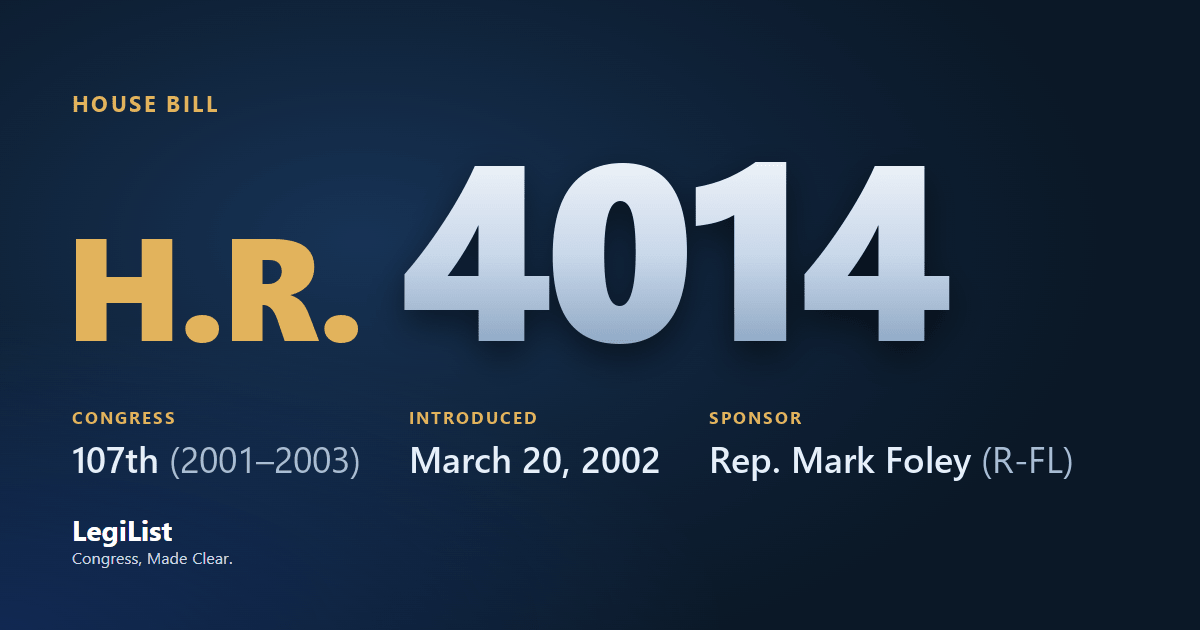
Rare Diseases Orphan Product Development Act of 2002
Latest action · Nov 6, 2002 Became Public Law No: 107-281.
Progress
Where this bill reached, and when. A stage with no date was not reached; one that failed a vote and later carried shows the date it carried.
- IntroducedMar 20, 2002
- Passed HouseOct 1, 2002
- Passed SenateOct 17, 2002
- To the PresidentOct 28, 2002
- Became lawNov 6, 2002Public Law 107-281
Summary
Cosponsors 58
Members who signed on, in the order they did. Signatures ran from Mar 20, 2002 to Sep 4, 2002; 8 are original cosponsors, there from the day it was introduced.
| Seat | Cosponsor | Signed on | |
|---|---|---|---|
| D-IL | Bobby L. Rush | Original | Mar 20, 2002 |
| D-CA | Henry A. Waxman | Original | Mar 20, 2002 |
| R-PA | James C. Greenwood | Original | Mar 20, 2002 |
| D-MI | John D. Dingell | Original | Mar 20, 2002 |
| R-IL | John Shimkus | Original | Mar 20, 2002 |
| R-NJ | Marge Roukema | Original | Mar 20, 2002 |
| R-NY | Peter T. King | Original | Mar 20, 2002 |
| D-OH | Sherrod Brown | Original | Mar 20, 2002 |
| D-MD | Albert Russell Wynn | Apr 9, 2002 | |
| D-MA | Barney Frank | Apr 9, 2002 | |
| R-NJ | Christopher H. Smith | Apr 9, 2002 | |
| R-MD | Constance A. Morella | Apr 9, 2002 | |
| D-GA | Cynthia A. McKinney | Apr 9, 2002 | |
| D-NY | Edolphus Towns | Apr 9, 2002 | |
| D-NJ | Frank Pallone, Jr. | Apr 9, 2002 |
Committees 1
Where it was sent and what each committee and subcommittee did with it, in order.
| Chamber | Committee | What it did |
|---|---|---|
| House | Energy and Commerce Committee | Referred Mar 20, 2002Markup Sep 5, 2002Reported Oct 1, 2002 |
| Health Subcommittee | Referred Mar 26, 2002 |
Actions 20
Everything that happened, newest first.
- Nov 6, 2002Signed by President.
- Nov 6, 2002Became Public Law No: 107-281.
- Oct 28, 2002Presented to President.
- Oct 18, 2002Message on Senate action sent to the House.
- Oct 17, 2002Passed/agreed to in Senate: Passed Senate without amendment by Unanimous Consent. (consideration: CR S10769)
- Oct 2, 2002Received in the Senate, read twice.
- Oct 1, 2002Reported by the Committee on Energy and Commerce. H. Rept. 107-702.
- Oct 1, 2002Placed on the Union Calendar, Calendar No. 435.
- Oct 1, 2002Mr. Shimkus moved to suspend the rules and pass the bill.
- Oct 1, 2002Considered under suspension of the rules. (consideration: CR H6815-6818)
- Oct 1, 2002DEBATE - The House proceeded with forty minutes of debate ob H.R. 4014.
- Oct 1, 2002At the conclusion of debate, the chair put the question on the motion to suspend the rules. Mr. Waxman objected to the vote on the grounds that a quorum was not present. Further proceedings on the motion were postponed. The point of no quorum was withdrawn.
- Oct 1, 2002Considered as unfinished business. (consideration: CR H6883)
- Oct 1, 2002Passed/agreed to in House: On motion to suspend the rules and pass the bill Agreed to by voice vote. (text: CR H6815)
- Oct 1, 2002Motion to reconsider laid on the table Agreed to without objection.
- Sep 5, 2002Committee Consideration and Mark-up Session Held.
- Sep 5, 2002Ordered to be Reported by Unanimous Consent.
- Mar 26, 2002Referred to the Subcommittee on Health.
- Mar 20, 2002Introduced in House
- Mar 20, 2002Referred to the House Committee on Energy and Commerce.
In the Congressional Record 2
Days the Record’s own index lists this bill, newest first, with the pages and the members it names. Pages starting H are the House, S the Senate, E Extensions of Remarks.
| Where | In the Record | Members | Date |
|---|---|---|---|
| Senate | Debate and remarks S10769 | Harry Reid D-NV | Oct 17, 2002 |
| House | Debate and remarks H6814–H6818, H6883Text printed H6815 | Henry A. Waxman D-CA, John D. Dingell D-MI, John Shimkus R-IL, Joseph R. Pitts R-PA, Mark Foley R-FL, Michael Bilirakis R-FL, Ron Kind D-WI | Oct 1, 2002 |
Research
What has been written about this bill: committee reports, cost estimates, the sponsor’s authority statement, printed hearings and the Congressional Research Service’s work.
Committee report
Congressional Budget Office cost estimates 2
- Sep 27, 2002H.R. 4014, Rare Diseases Orphan Product Development Act of 2002<p>Cost estimate for the bill as ordered reported by the House Committee on Energy and Commerce on September 5, 2002</p>
- Sep 27, 2002H.R. 4014, Rare Diseases Orphan Product Development Act of 2002Cost estimate for the bill as ordered reported by the House Committee on Energy and Commerce on September 5, 2002
Printed hearings 1
Hearings whose printed record names this bill, newest first: hearings on it, and wider hearings where it came up.
| Number | Hearing | Committee | Held |
|---|---|---|---|
| S. Hrg. 107-761 | AGRICULTURE, RURAL DEVELOPMENT, AND RELATED AGENCIES APPROPRIATIONS FOR FISCAL YEAR 2003803 pages | Appropriations Committee | Feb 27, 2002–Mar 20, 2002 |
CRS reports 4
Congressional Research Service work that CRS links to this bill or the law it became, newest first.
Cite it 4
Products on other subjects that cite it, usually among other measures.
| Product | Title | Kind | Published |
|---|---|---|---|
| R48503 | Child Welfare and Child Support: The Supporting America’s Children and Families Act (P.L. 118-258) | Report | Apr 7, 2025 |
| R41658 | Commemorative Works in the District of Columbia: Background and Practice | Report | May 8, 2023 |
| R41607 | Neglected Tropical Diseases: Background, Responses, and Issues for Congress Archived | Report | Jan 21, 2011 |
| RL30894 | Child Welfare: Reauthorization of the Promoting Safe and Stable Families Program in the 107th Congress Archived | Report | Jan 24, 2002 |
Titles 4
Every title it has carried, official and short, at each stage.
- Official Title as Introduced
- To amend the Federal Food, Drug, and Cosmetic Act with respect to the development of products for rare diseases.
- Short Titles as Introduced
- Rare Diseases Orphan Product Development Act of 2002
- Short Titles as Passed House
- Rare Diseases Orphan Product Development Act of 2002
- Short Titles as Enacted
- Rare Diseases Orphan Product Development Act of 2002
Subjects
Assigned by the Library of Congress. Policy area: Health.
Text 5
Each version as it was printed, newest first.
- —Enrolled Bill
- Oct 2, 2002Received in Senate
- Oct 1, 2002Engrossed in House
- Oct 1, 2002Reported in House
- Mar 20, 2002Introduced in House
Everything here is as published by Congress: the summary is the Congressional Research Service's, the action wording is the clerks', and the subjects are the Library of Congress's. How far it got is read from the actions themselves, taking the most recent one of each kind, so a bill that failed a vote and later passed is shown as having passed. Records come from this bill on Congress.gov and govinfo.gov; cost estimates are the Congressional Budget Office's, and the hearings are the printed hearings GovInfo publishes, which can appear months after the hearing.