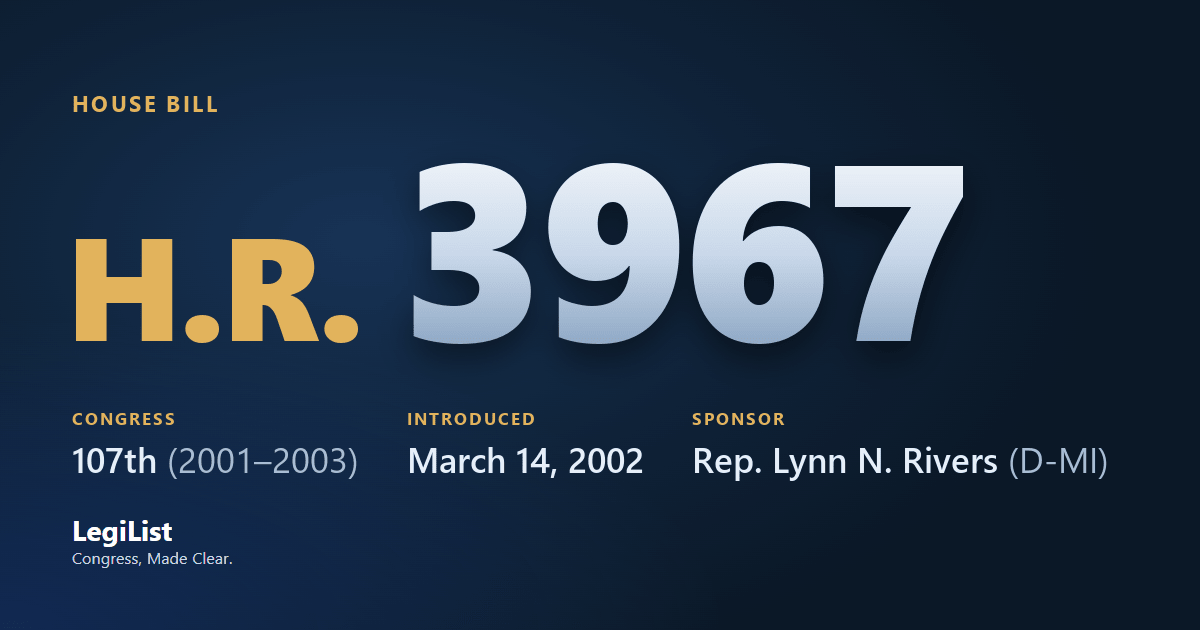
Genomic Research and Diagnostic Accessibility Act of 2002
Latest action · May 6, 2002 Referred to the Subcommittee on Courts, the Internet, and Intellectual Property.
Progress
Where this bill reached, and when. A stage with no date was not reached; one that failed a vote and later carried shows the date it carried.
- IntroducedMar 14, 2002
- Passed HouseNot reached
- Passed SenateNot reached
- To the PresidentNot reached
- Became lawNot reached
Summary
Exempts medical practitioners or related health care entities from patent infringement remedies by reason of their performance of genetic diagnostic, prognostic, or predictive tests.
Repeals patent infringement liability with respect to certain medical activities of persons or their employees or agents who are engaged in the commercial development, manufacture, sale, importation, or distribution of a machine, or composition of matter or the provision of pharmacy or clinical laboratory services (other than clinical laboratory services provided in a physician's office).
Requires funding agreements with small business firms or nonprofit organizations to contain appropriate provisions that require the contractor, within 30 days after applying for a patent on a subject invention which involves a patent for, or a patent for use of, genetic sequence information, to make that information public. Subjects Federal agencies to a similar requirement when applying for patents on genetic sequence information.
Cosponsors 3
Members who signed on, in the order they did. Signatures ran from Mar 14, 2002 to Jun 18, 2002; 1 is an original cosponsor, there from the day it was introduced.
| Seat | Cosponsor | Signed on | |
|---|---|---|---|
| R-FL | Dave Weldon | Original | Mar 14, 2002 |
| R-NJ | Christopher H. Smith | May 9, 2002 | |
| D-TX | Eddie Bernice Johnson | Jun 18, 2002 |
Committees 1
Where it was sent and what each committee and subcommittee did with it, in order.
| Chamber | Committee | What it did |
|---|---|---|
| House | Judiciary Committee | Referred Mar 14, 2002 |
| Courts, Intellectual Property, Artificial Intelligence, and the Internet Subcommittee | Referred May 6, 2002 |
Actions 4
Everything that happened, newest first.
- May 6, 2002Referred to the Subcommittee on Courts, the Internet, and Intellectual Property.
- Mar 14, 2002Introduced in House
- Mar 14, 2002Sponsor introductory remarks on measure. (CR E353-355)
- Mar 14, 2002Referred to the House Committee on the Judiciary.
In the Congressional Record 1
Days the Record’s own index lists this bill, newest first, with the pages and the members it names. Pages starting H are the House, S the Senate, E Extensions of Remarks.
| Where | In the Record | Members | Date |
|---|---|---|---|
| Extensions | Debate and remarks E353–E355 | Lynn N. Rivers D-MI | Mar 14, 2002 |
Titles 2
Every title it has carried, official and short, at each stage.
- Official Title as Introduced
- To amend title 35, United States Code, to provide for noninfringing uses of patents on genetic sequence information for purposes of research and genetic diagnostic testing, and to require public disclosure of such information in certain patent applications.
- Short Titles as Introduced
- Genomic Research and Diagnostic Accessibility Act of 2002
Subjects
Assigned by the Library of Congress. Policy area: Science, Technology, Communications.
- Chromosome mapping
- Commerce
- Federal aid to research
- Genetic research
- Government contractors
- Government Operations and Politics
- Government paperwork
- Government publicity
- Health
- Human genetics
- Intellectual property
- Inventions
- Medical tests
- Nonprofit organizations
- Patent infringement
- Patents
- Research grants
- Science, Technology, Communications
- Small business
Text 1
Each version as it was printed, newest first.
- Mar 14, 2002Introduced in House
Support LegiList
This page is free, carries no paywall, and is built and maintained by one person. If the record here is useful to you, a few dollars keeps it going.
Everything here is as published by Congress: the summary is the Congressional Research Service's, the action wording is the clerks', and the subjects are the Library of Congress's. How far it got is read from the actions themselves, taking the most recent one of each kind, so a bill that failed a vote and later passed is shown as having passed. Records come from this bill on Congress.gov and govinfo.gov; cost estimates are the Congressional Budget Office's, and the hearings are the printed hearings GovInfo publishes, which can appear months after the hearing.