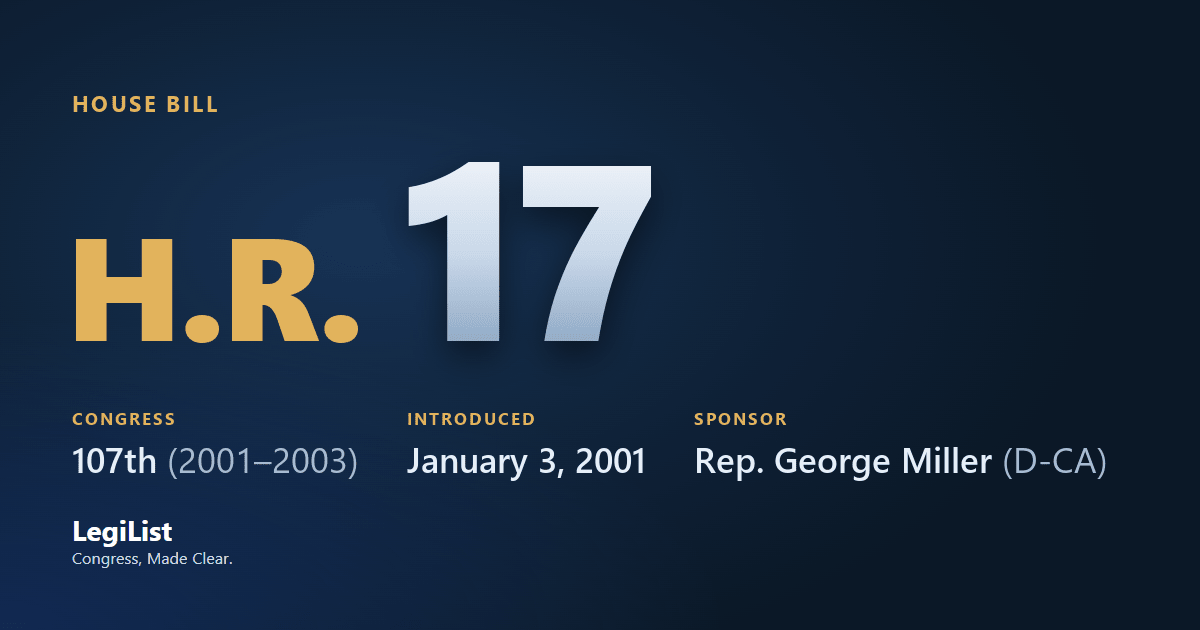
Younger Americans Act
Latest action · Mar 2, 2001 Referred to the Subcommittee on Education Reform.
Progress
Where this bill reached, and when. A stage with no date was not reached; one that failed a vote and later carried shows the date it carried.
- IntroducedJan 3, 2001
- Passed HouseNot reached
- Passed SenateNot reached
- To the PresidentNot reached
- Became lawNot reached
Summary
Establishes in the Executive Office of the President: (1) the Office of National Youth Policy ; (2) a Director of the Office; and (3) the Council on National Youth Policy within the Office.
Directs the Associate Commissioner of the Family and Youth Services Bureau of the Administration on Children, Youth, and Families in the Department of Health and Human Services to make block grant allotments to States for State and community programs for youth to assure access to the five core resources listed in the national youth policy. Provides for reservations of funds for Native American organizations, outlying areas, and Federal discretionary programs to respond to needs of youth in correctional and other out-of-home settings, high poverty areas, rural areas, and other high-risk situations.
Sets forth requirements for State agencies, planning and mobilization areas, distribution of funds for State activities and local allocations, community boards and area agencies on youth, area plans, grants and contracts to eligible entities, and youth development program activities.
Authorizes awarding of grants and contracts to eligible entities for specified evaluation, education and training, research, and dissemination activities.
Directs the Associate Commissioner to: (1) develop and establish systems for evaluating activities under this Act, and for providing education and training of personnel of States, area agencies, and community boards to work with youth; and (2) conduct an independent biennial evaluation of the impact of programs assisted under this Act and other initiatives to promote positive youth development.
Cosponsors 80
Members who signed on, in the order they did. Signatures ran from Jan 3, 2001 to Sep 19, 2002; 4 are original cosponsors, there from the day it was introduced.
| Seat | Cosponsor | Signed on | |
|---|---|---|---|
| R-NY | Benjamin A. Gilman | Original | Jan 3, 2001 |
| D-TN | Bob Clement | Original | Jan 3, 2001 |
| R-NY | Jack Quinn | Original | Jan 3, 2001 |
| R-NJ | Marge Roukema | Original | Jan 3, 2001 |
| D-NJ | Donald M. Payne | Jan 30, 2001 | |
| D-SC | James E. Clyburn | Jan 30, 2001 | |
| D-TX | Martin Frost | Jan 30, 2001 | |
| D-HI | Patsy T. Mink | Jan 30, 2001 | |
| D-VI | Donna M. Christensen | Feb 6, 2001 | |
| D-NY | Maurice D. Hinchey | Feb 26, 2001 | |
| D-MD | Albert Russell Wynn | Feb 27, 2001 | |
| D-FL | Allen Boyd | Feb 27, 2001 | |
| D-OR | Earl Blumenauer | Feb 27, 2001 | |
| D-NY | Gregory W. Meeks | Feb 27, 2001 | |
| D-RI | Patrick J. Kennedy | Feb 27, 2001 |
Committees 1
Where it was sent and what each committee and subcommittee did with it, in order.
| Chamber | Committee | What it did |
|---|---|---|
| House | Education and Workforce Committee | Referred Jan 3, 2001 |
| Early Childhood, Elementary, and Secondary Education Subcommittee | Referred Mar 2, 2001 |
Actions 4
Everything that happened, newest first.
- Mar 2, 2001Referred to the Subcommittee on Education Reform.
- Jan 3, 2001Introduced in House
- Jan 3, 2001Sponsor introductory remarks on measure. (CR E8)
- Jan 3, 2001Referred to the House Committee on Education and the Workforce.
In the Congressional Record 2
Days the Record’s own index lists this bill, newest first, with the pages and the members it names. Pages starting H are the House, S the Senate, E Extensions of Remarks.
| Where | In the Record | Members | Date |
|---|---|---|---|
| House | Debate and remarks H3267, H3271 | George Miller D-CA, Marge Roukema R-NJ | Jun 20, 2001 |
| Extensions | Debate and remarks E4, E8 | George Miller D-CA, Marge Roukema R-NJ | Jan 3, 2001 |
Titles 2
Every title it has carried, official and short, at each stage.
- Official Title as Introduced
- To provide assistance to mobilize and support United States communities in carrying out youth development programs that assure that all youth have access to programs and services that build the competencies and character development needed to fully prepare the youth to become adults and effective citizens.
- Short Titles as Introduced
- Younger Americans Act
Subjects
Assigned by the Library of Congress. Policy area: Families.
- Advice and consent of the Senate
- Arts, Culture, Religion
- Block grants
- Camping
- Child abuse
- Child mental health services
- Child safety
- Citizen participation
- Civics education
- Commerce
- Community centers
- Community organization
- Computer literacy
- Congress
- Congressional reporting requirements
- Counseling
- Crime and Law Enforcement
- Dropouts
- Economics and Public Finance
- Education
- Elementary and secondary education
- Entrepreneurs
- Environmental education
- Environmental Protection
- Ethics
- Evaluation research (Social action programs)
- Executive Office of the President
- Executive reorganization
- Families
- Federal advisory bodies
- Federal aid to child health services
- Federal aid to Indians
- Federal aid to youth services
- Federal-local relations
- Federal-state relations
- Government Operations and Politics
- Health
- Higher education
- Housing and Community Development
- Indian children
- Indian youth
- Juvenile corrections
- Labor and Employment
- Lifestyle
- Literacy programs
- Mental health services for youth
- Mentoring
- Minorities
- Music
- Parent and child
- Performing arts
- Physical fitness
- Poor children
- Presidential appointments
- Recreation centers
- Religion
- Rural conditions
- Science, Technology, Communications
- Social Welfare
- Sports and Recreation
- Urban affairs
- Volunteer workers in social service
- Youth
- Youth employment
- Youth services
Text 1
Each version as it was printed, newest first.
- Jan 3, 2001Introduced in House
Support LegiList
This page is free, carries no paywall, and is built and maintained by one person. If the record here is useful to you, a few dollars keeps it going.
Everything here is as published by Congress: the summary is the Congressional Research Service's, the action wording is the clerks', and the subjects are the Library of Congress's. How far it got is read from the actions themselves, taking the most recent one of each kind, so a bill that failed a vote and later passed is shown as having passed. Records come from this bill on Congress.gov and govinfo.gov; cost estimates are the Congressional Budget Office's, and the hearings are the printed hearings GovInfo publishes, which can appear months after the hearing.