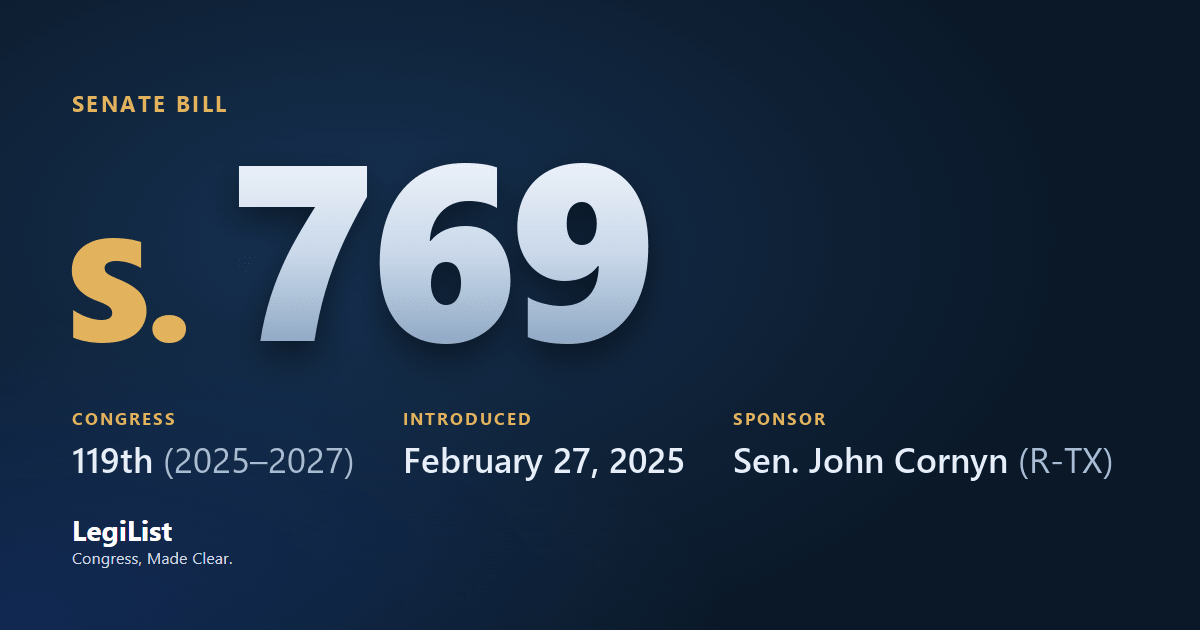
United States Research Protection Act of 2025
Latest action · Jul 22, 2025 Placed on Senate Legislative Calendar under General Orders. Calendar No. 123.
Progress
Where this bill reached, and when. A stage with no date was not reached; one that failed a vote and later carried shows the date it carried.
- IntroducedFeb 27, 2025
- Passed SenateNot reached
- Passed HouseNot reached
- To the PresidentNot reached
- Became lawNot reached
Summary
United States Research Protection Act of 2025
This bill clarifies the definition of a malign foreign talent recruitment program under the Research and Development, Competition, and Innovation Act.
The Research and Development, Competition, and Innovation Act, which was included in the CHIPS and Science Act, prohibits researchers who receive federal funds from participating in malign foreign talent recruitment programs, in which foreign countries incentivize or compensate researchers for activities that present a conflict of interest for the researcher or that are otherwise unauthorized (e.g., sharing proprietary information without proper authorization).
The bill clarifies that these restrictions apply to programs that are sponsored by a foreign country of concern, including China, Iran, North Korea, and Russia. The bill also clarifies that malign foreign talent recruitment programs may involve direct or indirect compensation or incentives from such countries.
Cosponsors 4
Members who signed on, in the order they did. Signatures ran from Feb 27, 2025 to Nov 20, 2025; 1 is an original cosponsor, there from the day it was introduced.
| Seat | Cosponsor | Signed on | |
|---|---|---|---|
| D-CA | Alex Padilla | Original | Feb 27, 2025 |
| R-UT | John R. Curtis | Apr 10, 2025 | |
| R-FL | Rick Scott | Sep 15, 2025 | |
| R-PA | David McCormick | Nov 20, 2025 |
Committees 1
Where it was sent and what each committee and subcommittee did with it, in order.
| Chamber | Committee | What it did |
|---|---|---|
| Senate | Commerce, Science, and Transportation Committee | Referred Feb 27, 2025Markup Apr 30, 2025Reported Jul 22, 2025 |
Actions 5
Everything that happened, newest first.
- Jul 22, 2025Committee on Commerce, Science, and Transportation. Reported by Senator Cruz without amendment. With written report No. 119-45.
- Jul 22, 2025Placed on Senate Legislative Calendar under General Orders. Calendar No. 123.
- Apr 30, 2025Committee on Commerce, Science, and Transportation. Ordered to be reported without amendment favorably.
- Feb 27, 2025Introduced in Senate
- Feb 27, 2025Read twice and referred to the Committee on Commerce, Science, and Transportation.
Research
What has been written about this bill: committee reports, cost estimates, the sponsor’s authority statement, printed hearings and the Congressional Research Service’s work.
Committee report
Congressional Budget Office cost estimate
- Jul 9, 2025S. 769, United States Research Protection Act of 2025As ordered reported by the Senate Committee on Commerce, Science, and Transportation on April 30, 2025
Titles 3
Every title it has carried, official and short, at each stage.
- Official Title as Introduced
- A bill to amend the Research and Development, Competition, and Innovation Act to clarify the definition of foreign country for purposes of malign foreign talent recruitment restriction, and for other purposes.
- Short Title(s) as Introduced
- United States Research Protection Act of 2025
- Short Title(s) as Reported to Senate
- United States Research Protection Act of 2025
Subjects
Assigned by the Library of Congress. Policy area: Science, Technology, Communications.
Text 2
Each version as it was printed, newest first.
- Jul 22, 2025Reported to Senate
- Feb 27, 2025Introduced in Senate
Everything here is as published by Congress: the summary is the Congressional Research Service's, the action wording is the clerks', and the subjects are the Library of Congress's. How far it got is read from the actions themselves, taking the most recent one of each kind, so a bill that failed a vote and later passed is shown as having passed. Records come from this bill on Congress.gov and govinfo.gov; cost estimates are the Congressional Budget Office's, and the hearings are the printed hearings GovInfo publishes, which can appear months after the hearing.