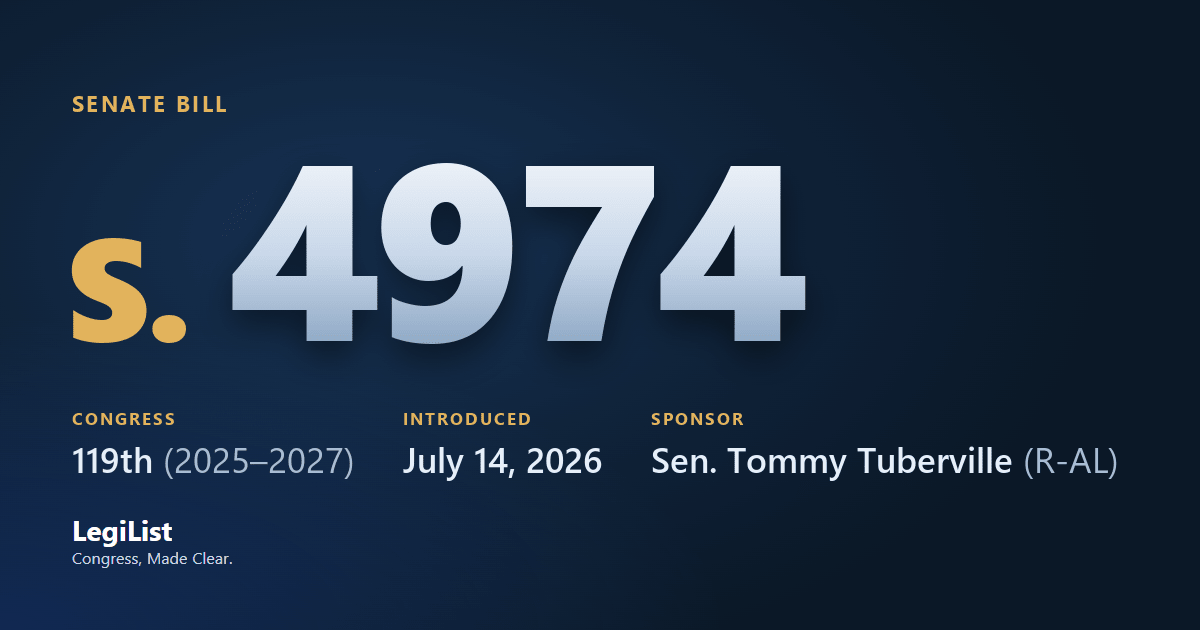
Making America's Food Safer Act
Latest action · Oct 5, 2026 Held at the desk.
Progress
Where this bill reached, and when. A stage with no date was not reached; one that failed a vote and later carried shows the date it carried.
- IntroducedJul 14, 2026
- Passed SenateSep 28, 2026
- Passed HouseNot reached
- To the PresidentNot reached
- Became lawNot reached
Summary
Making America's Food Safer Act
This bill expands the Food and Drug Administration’s (FDA’s) authority to require the destruction of unsafe imported foods, share food safety information, and make use of food facility audit information.
Specifically, the bill authorizes the FDA to order the destruction, without the opportunity for export, of any item that (1) is refused import into the United States; (2) violates federal law regulating food, drugs, medical devices, cosmetics, and tobacco products; and (3) presents a significant public health concern. Before issuing a destruction order, the FDA must provide an item’s owner or consignee with appropriate due process, including notice and an opportunity to appear. If an order is issued, the item’s owner or consignee must destroy it within 90 days at their own cost.
The bill also generally authorizes the FDA to share unredacted food safety information with state, local, tribal, and territorial authorities, including information related to foodborne illness tracking, recalls and outbreaks, and other topics. During a food safety incident, the FDA may disclose certain commercial information that is otherwise protected from disclosure.
Finally, the bill expands the FDA’s third-party audit system to make domestic food facilities eligible for voluntary audits. (Foreign facilities are eligible under current law.) The bill also authorizes the FDA to use audit results and related certifications to analyze risks and prioritize regulatory activities (e.g., inspections) to protect public health. (This information is currently used to determine whether specific food, or food from a specific facility, is eligible for import.)
Cosponsors 2
Members who signed on, in the order they did. Signatures ran from Jul 14, 2026 to Jul 20, 2026; 1 is an original cosponsor, there from the day it was introduced.
| Seat | Cosponsor | Signed on | |
|---|---|---|---|
| R-LA | Bill Cassidy | Original | Jul 14, 2026 |
| D-VA | Tim Kaine | Jul 20, 2026 |
Committees 1
Where it was sent and what each committee and subcommittee did with it, in order.
| Chamber | Committee | What it did |
|---|---|---|
| Senate | Health, Education, Labor, and Pensions Committee | Referred Jul 14, 2026Markup Jul 22, 2026Reported Jul 28, 2026 |
Actions 9
Everything that happened, newest first.
- Oct 5, 2026Message on Senate action sent to the House.
- Oct 5, 2026Received in the House.
- Oct 5, 2026Held at the desk.
- Sep 28, 2026Passed/agreed to in Senate: Passed Senate with an amendment by Unanimous Consent. (consideration: CR S5121-5122; text: CR S5121-5122)
- Jul 28, 2026Committee on Health, Education, Labor, and Pensions. Reported by Senator Cassidy with an amendment in the nature of a substitute. Without written report.
In the Congressional Record 1
Days the Record’s own index lists this bill, newest first, with the pages and the members it names. Pages starting H are the House, S the Senate, E Extensions of Remarks.
Titles 4
Every title it has carried, official and short, at each stage.
- Official Title as Introduced
- A bill to amend the Federal Food, Drug, and Cosmetic Act with respect to food safety.
- Short Title(s) as Introduced
- Making America's Food Safer Act
- Short Title(s) as Reported to Senate
- Making America's Food Safer Act
- Short Title(s) as Passed Senate
- Making America's Food Safer Act
Subjects
Assigned by the Library of Congress. Policy area: Health.
Text 3
Each version as it was printed, newest first.
- Sep 28, 2026Engrossed in Senate
- Jul 28, 2026Reported to Senate
- Jul 14, 2026Introduced in Senate
Support LegiList
This page is free, carries no paywall, and is built and maintained by one person. If the record here is useful to you, a few dollars keeps it going.
Everything here is as published by Congress: the summary is the Congressional Research Service's, the action wording is the clerks', and the subjects are the Library of Congress's. How far it got is read from the actions themselves, taking the most recent one of each kind, so a bill that failed a vote and later passed is shown as having passed. Records come from this bill on Congress.gov and govinfo.gov; cost estimates are the Congressional Budget Office's, and the hearings are the printed hearings GovInfo publishes, which can appear months after the hearing.