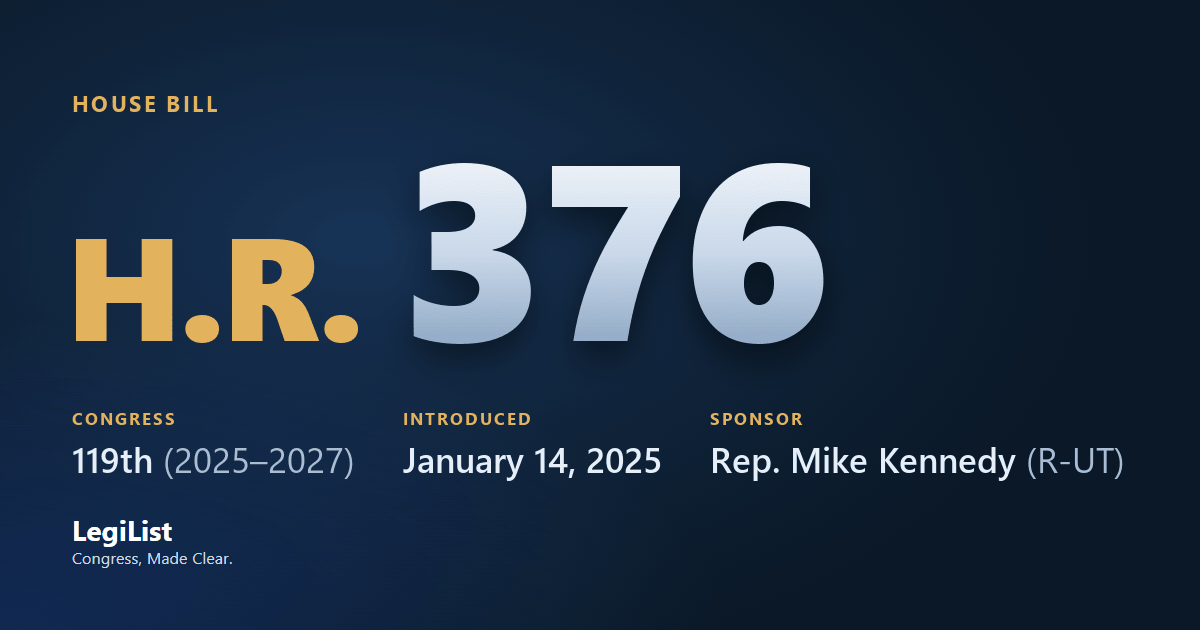
Historic Roadways Protection Act
Latest action · Jan 14, 2025 Referred to the House Committee on Natural Resources.
Progress
Where this bill reached, and when. A stage with no date was not reached; one that failed a vote and later carried shows the date it carried.
- IntroducedJan 14, 2025
- Passed HouseNot reached
- Passed SenateNot reached
- To the PresidentNot reached
- Became lawNot reached
Summary
Historic Roadways Protection Act
This bill prohibits the Bureau for Land Management (BLM) from closing historical roads on public lands in certain areas of Utah until the Federal District Court for Utah makes a decision on each of the R.S. 2477 cases, which are cases brought by Utah and counties to keep historical roads on BLM land in Utah open for public use.
By way of background, a provision of the Mining Law of 1866, commonly known as R.S. 2477, granted rights-of-way to states and counties across public lands for the construction of roads for public use in order to promote settlement of the American West. In 1976, Congress repealed R.S. 2477 when it enacted the Federal Land Policy and Management Act (FLPMA), but FLPMA preserved rights-of-way that had been established under R.S. 2477. After the BLM released travel management plans that closed some historical roads, Utah and 22 counties filed lawsuits about their rights-of-way across public lands for historical roads.
Until the BLM certifies that those cases have been decided, the bill prohibits the BLM from obligating or expending federal funds to (1) finalize or implement a new travel management plan for certain travel management areas in Utah; or (2) implement, with respect to land within the boundary of Utah, the Indian Creek (Canyon Rims) Travel Management Plan, the San Rafael Desert Travel Management Plan, the San Rafael Swell Travel Management Plan, or the Labyrinth/Gemini Bridges Travel Management Plan.
Cosponsors 3
Members who signed on, in the order they did. All signed on Jan 14, 2025.
| Seat | Cosponsor | Signed on | |
|---|---|---|---|
| R-UT | Blake D. Moore | Original | Jan 14, 2025 |
| R-UT | Burgess Owens | Original | Jan 14, 2025 |
| R-UT | Celeste Maloy | Original | Jan 14, 2025 |
Committees 1
Where it was sent and what each committee and subcommittee did with it, in order.
| Chamber | Committee | What it did |
|---|---|---|
| House | Natural Resources Committee | Referred Jan 14, 2025 |
Actions 2
Everything that happened, newest first.
- Jan 14, 2025Introduced in House
- Jan 14, 2025Referred to the House Committee on Natural Resources.
In the Congressional Record 1
Days the Record’s own index lists this bill, newest first, with the pages and the members it names. Pages starting H are the House, S the Senate, E Extensions of Remarks.
| Where | In the Record | Members | Date |
|---|---|---|---|
| House | Lists H149H.R. 376–403 | — | Jan 14, 2025 |
Research
What has been written about this bill: committee reports, cost estimates, the sponsor’s authority statement, printed hearings and the Congressional Research Service’s work.
Constitutional authority
The sponsor’s statement, as printed in the Congressional Record, vol. 171, no. 7, January 14, 2025, page H149.
Related bills 1
Companion bills and other measures the record links to this one.
| Bill | Title | Relationship | Latest action |
|---|---|---|---|
| S 90 | Historic Roadways Protection Act | Identical bill | Feb 4, 2026 |
Titles 3
Every title it has carried, official and short, at each stage.
- Title
- Historic Roadways Protection Act
- Official Title as Introduced
- To prohibit the use of funds by the Secretary of the Interior to finalize and implement certain travel management plans in the State of Utah.
- Short Title(s) as Introduced
- Historic Roadways Protection Act
Subjects
Assigned by the Library of Congress. Policy area: Public Lands and Natural Resources.
Text 1
Each version as it was printed, newest first.
- Jan 14, 2025Introduced in House
Support LegiList
This page is free, carries no paywall, and is built and maintained by one person. If the record here is useful to you, a few dollars keeps it going.
Everything here is as published by Congress: the summary is the Congressional Research Service's, the action wording is the clerks', and the subjects are the Library of Congress's. How far it got is read from the actions themselves, taking the most recent one of each kind, so a bill that failed a vote and later passed is shown as having passed. Records come from this bill on Congress.gov and govinfo.gov; cost estimates are the Congressional Budget Office's, and the hearings are the printed hearings GovInfo publishes, which can appear months after the hearing.