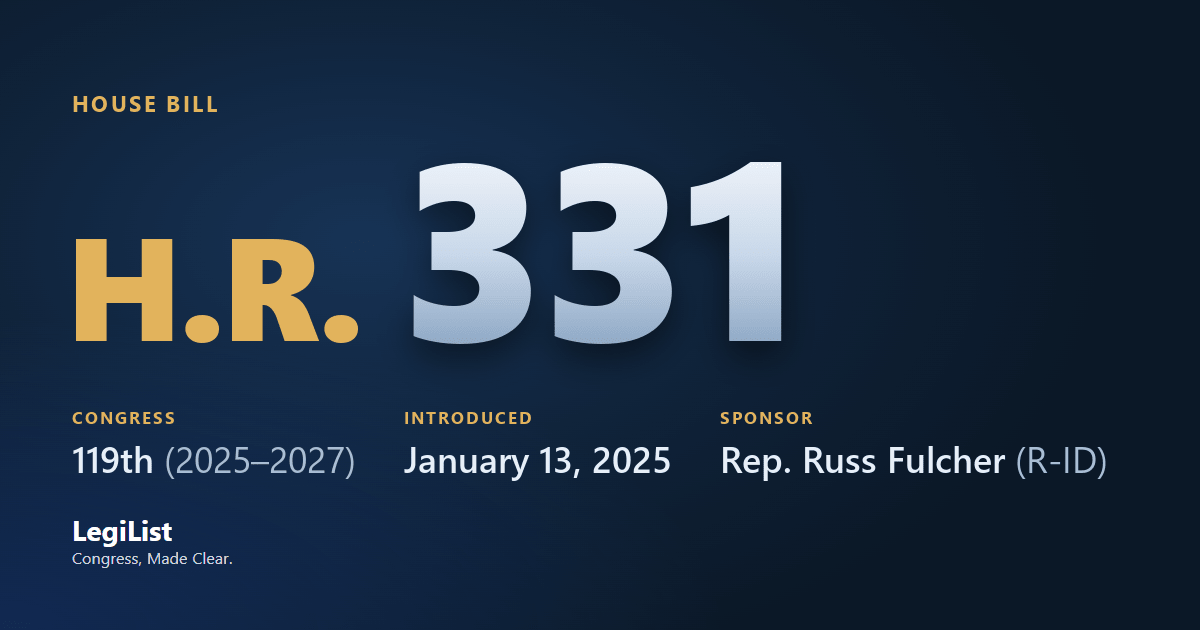
To amend the Aquifer Recharge Flexibility Act to clarify a provision relating to conveyances for aquifer recharge purposes.
Latest action · Nov 12, 2026 Placed on Senate Legislative Calendar under General Orders. Calendar No. 712.
Progress
Where this bill reached, and when. A stage with no date was not reached; one that failed a vote and later carried shows the date it carried.
- IntroducedJan 13, 2025
- Passed HouseMay 13, 2025
- Passed SenateNot reached
- To the PresidentNot reached
- Became lawNot reached
Summary
This bill modifies the Aquifer Recharge Flexibility Act to expand provisions concerning authorizations (e.g., rights-of-way) to transport water across public land administered by the Bureau of Land Management (BLM) for aquifer recharge purposes.
Under the Aquifer Recharge Flexibility Act, the holder of existing rights-of-way, easements, permits, or other authorizations to transport water across BLM land may transport the water for aquifer recharge purposes without additional authorization from the Department of the Interior so long as the use does not expand or modify the operation of such authorizations across public land.
The bill allows the holders of such authorizations to act not only on behalf of themselves, but also on behalf of states, Indian Tribes, or public entities, to use the existing authorizations for aquifer recharge without additional authorization from the Department of the Interior. Further, the bill states that this use may not be considered an expansion, modification, major federal action, or substantial deviation.
Additionally, the bill exempts holders from paying additional rents to the BLM for any use of such authorizations; however, the exemption does not apply to for-profit uses of aquifer recharge or for-profit entities.
Finally, holders of rights-of-way or other authorizations must provide notice to the BLM of the intended use of authorization as specified by the bill.
Cosponsors 1
Members who signed on, in the order they did. All signed on Jan 13, 2025.
| Seat | Cosponsor | Signed on | |
|---|---|---|---|
| R-ID | Michael K. Simpson | Original | Jan 13, 2025 |
Committees 2
Where it was sent and what each committee and subcommittee did with it, in order.
| Chamber | Committee | What it did |
|---|---|---|
| House | Natural Resources Committee | Referred Jan 13, 2025Discharged Feb 12, 2025Markup Feb 12, 2025Reported Apr 17, 2025 |
| Water, Wildlife and Fisheries Subcommittee | Referred Jan 21, 2025Hearings Jan 23, 2025 | |
| Senate | Energy and Natural Resources Committee | Referred May 14, 2025Markup Sep 30, 2026Reported Nov 12, 2026 |
Actions 18
Everything that happened, newest first.
- Nov 12, 2026Committee on Energy and Natural Resources. Reported by Senator Lee without amendment. Without written report.
- Nov 12, 2026Placed on Senate Legislative Calendar under General Orders. Calendar No. 712.
- Sep 30, 2026Committee on Energy and Natural Resources. Ordered to be reported without amendment favorably.
- May 14, 2025Received in the Senate and Read twice and referred to the Committee on Energy and Natural Resources.
- May 13, 2025Mr. Westerman moved to suspend the rules and pass the bill, as amended.
In the Congressional Record 3
Days the Record’s own index lists this bill, newest first, with the pages and the members it names. Pages starting H are the House, S the Senate, E Extensions of Remarks.
| Where | In the Record | Members | Date |
|---|---|---|---|
| House | Text printed H2625–H2627 | — | Jun 11, 2025 |
| House | Debate and remarks H1969, H1970Text printed H1969 | Bruce Westerman R-AR, Val T. Hoyle D-OR | May 13, 2025 |
| House | Lists H111H.R. 331–375 | — | Jan 13, 2025 |
Research
What has been written about this bill: committee reports, cost estimates, the sponsor’s authority statement, printed hearings and the Congressional Research Service’s work.
Committee report
Congressional Budget Office cost estimate
- Mar 31, 2025H.R. 331, a bill to amend the Aquifer Recharge Flexibility Act to clarify a provision relating to conveyances for aquifer recharge purposesAs ordered reported by the House Committee on Natural Resources on February 12, 2025
Constitutional authority
The sponsor’s statement, as printed in the Congressional Record, vol. 171, no. 6, January 13, 2025, page H111.
Printed hearings 1
Hearings whose printed record names this bill, newest first: hearings on it, and wider hearings where it came up.
| Number | Hearing | Committee | Held |
|---|---|---|---|
| Serial No. 119-2 | LEGISLATIVE HEARING62 pages | Natural Resources Committee | Jan 23, 2025 |
CRS reports 1
Congressional Research Service work that CRS links to this bill or the law it became, newest first.
Cite it 1
Products on other subjects that cite it, usually among other measures.
| Product | Title | Kind | Published |
|---|---|---|---|
| R49486 | Clean Water Act Permitting: Overview and Policy Issues | Report | Oct 14, 2026 |
Related bills 1
Companion bills and other measures the record links to this one.
| Bill | Title | Relationship | Latest action |
|---|---|---|---|
| S 1254 | A bill to amend the Aquifer Recharge Flexibility Act to clarify a provision relating to conveyances for aquifer recharge purposes. | Related bill | Nov 12, 2026 |
Titles 2
Every title it has carried, official and short, at each stage.
- Official Title as Introduced
- To amend the Aquifer Recharge Flexibility Act to clarify a provision relating to conveyances for aquifer recharge purposes.
- Official Title from EH (Engrossed in House) bill text
- To amend the Aquifer Recharge Flexibility Act to clarify a provision relating to conveyances for aquifer recharge purposes.
Subjects
Assigned by the Library of Congress. Policy area: Water Resources Development.
Text 5
Each version as it was printed, newest first.
- Nov 12, 2026Reported to Senate
- May 14, 2025Referred in Senate
- May 13, 2025Engrossed in House
- Apr 17, 2025Reported in House
- Jan 13, 2025Introduced in House
Everything here is as published by Congress: the summary is the Congressional Research Service's, the action wording is the clerks', and the subjects are the Library of Congress's. How far it got is read from the actions themselves, taking the most recent one of each kind, so a bill that failed a vote and later passed is shown as having passed. Records come from this bill on Congress.gov and govinfo.gov; cost estimates are the Congressional Budget Office's, and the hearings are the printed hearings GovInfo publishes, which can appear months after the hearing.