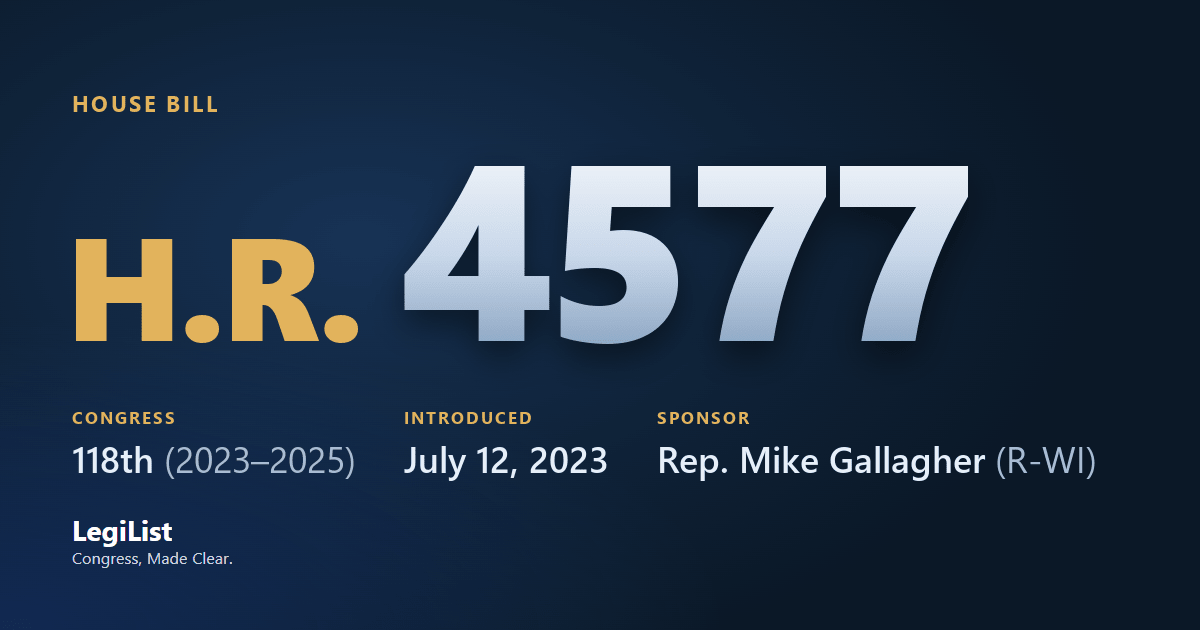
Protecting U.S. Farmland and Sensitive Sites From Foreign Adversaries Act
Latest action · Jul 14, 2023 Referred to the Subcommittee on Innovation, Data, and Commerce.
Progress
Where this bill reached, and when. A stage with no date was not reached; one that failed a vote and later carried shows the date it carried.
- IntroducedJul 12, 2023
- Passed HouseNot reached
- Passed SenateNot reached
- To the PresidentNot reached
- Became lawNot reached
Summary
Protecting U.S. Farmland and Sensitive Sites From Foreign Adversaries Act
This bill expands the jurisdiction of the Committee on Foreign Investment in the United States (CFIUS) related to agriculture and land transactions. (CFIUS reviews the national security implications of foreign investment in the United States.)
Specifically, the bill requires parties to an elevated risk real estate transaction to submit a mandatory declaration to CFIUS. Generally, this requirement applies to a transaction for a purchase or lease of certain real estate (e.g., real estate that is in close proximity to a sensitive site, such as a military installation or airspace) by a foreign adversary entity (e.g., a foreign person subject to the jurisdiction of a foreign adversary, such as China or Russia).
Additionally, the bill creates a presumption that an elevated risk real estate transaction presents a risk to national security that cannot be resolved through any agreement or condition unless CFIUS (1) determines, based on clear and convincing evidence, that the risk to national security of the transaction can be resolved in a manner other than by suspending or prohibiting the transaction; and (2) notifies Congress about this determination and its reasoning.
The bill authorizes CFIUS to consider U.S. food security as a factor in its national security reviews.
The bill also expands the membership of CFIUS to include the Secretary of Agriculture on all transactions related to the purchase of agriculture land, agriculture biotechnology, and any other transaction related to the agriculture industry in the United States.
Cosponsors 33
Members who signed on, in the order they did. Signatures ran from Jul 12, 2023 to Apr 10, 2024; 16 are original cosponsors, there from the day it was introduced.
| Seat | Cosponsor | Signed on | |
|---|---|---|---|
| R-IA | Ashley Hinson | Original | Jul 12, 2023 |
| R-WA | Dan Newhouse | Original | Jul 12, 2023 |
| R-SD | Dusty Johnson | Original | Jul 12, 2023 |
| D-HI | Ed Case | Original | Jul 12, 2023 |
| R-NY | Elise M. Stefanik | Original | Jul 12, 2023 |
| R-OK | Frank D. Lucas | Original | Jul 12, 2023 |
| D-CO | Jason Crow | Original | Jul 12, 2023 |
| R-IN | Jim Banks | Original | Jul 12, 2023 |
| D-CA | Jim Costa | Original | Jul 12, 2023 |
| D-CA | Jimmy Panetta | Original | Jul 12, 2023 |
| D-CA | John Garamendi | Original | Jul 12, 2023 |
| D-AK | Mary Sattler Peltola | Original | Jul 12, 2023 |
| D-CA | Mike Thompson | Original | Jul 12, 2023 |
| R-IA | Randy Feenstra | Original | Jul 12, 2023 |
| R-VA | Robert J. Wittman | Original | Jul 12, 2023 |
Committees 3
Where it was sent and what each committee and subcommittee did with it, in order.
| Chamber | Committee | What it did |
|---|---|---|
| House | Financial Services Committee | Referred Jul 12, 2023 |
| House | Foreign Affairs Committee | Referred Jul 12, 2023 |
| House | Energy and Commerce Committee | Referred Jul 12, 2023 |
| Commerce, Manufacturing, and Trade Subcommittee | Referred Jul 14, 2023 |
Actions 3
Everything that happened, newest first.
- Jul 14, 2023Referred to the Subcommittee on Innovation, Data, and Commerce.
- Jul 12, 2023Introduced in House
- Jul 12, 2023Referred to the Committee on Financial Services, and in addition to the Committees on Foreign Affairs, and Energy and Commerce, for a period to be subsequently determined by the Speaker, in each case for consideration of such provisions as fall within the jurisdiction of the committee concerned.
Research
What has been written about this bill: committee reports, cost estimates, the sponsor’s authority statement, printed hearings and the Congressional Research Service’s work.
Constitutional authority
The sponsor’s statement, as printed in the Congressional Record, vol. 169, no. 119, July 12, 2023, page H3477.
Printed hearings 1
Hearings whose printed record names this bill, newest first: hearings on it, and wider hearings where it came up.
| Number | Hearing | Committee | Held |
|---|---|---|---|
| Serial No. 118-21 | THE DANGER CHINA POSES TO AMERICAN AGRICULTURE187 pages | Agriculture Committee | Mar 20, 2024 |
CRS reports 2
Congressional Research Service work that CRS links to this bill or the law it became, newest first.
Cite it 2
Products on other subjects that cite it, usually among other measures.
| Product | Title | Kind | Published |
|---|---|---|---|
| R48094 | Foreign Ownership, Control, and Influence (FOCI) Risks in the Food and Agriculture Sector | Report | Jun 13, 2024 |
| R47893 | Selected Recent Actions Involving Foreign Ownership and Investment in U.S. Food and Agriculture: In Brief Archived | Report | Jan 5, 2024 |
Related bills 1
Companion bills and other measures the record links to this one.
| Bill | Title | Relationship | Latest action |
|---|---|---|---|
| HR 3378 | Agricultural Security Risk Review Act | Related bill | Dec 19, 2024 |
Titles 2
Every title it has carried, official and short, at each stage.
- Official Title as Introduced
- To protect U.S. food security, give the Committee on Foreign Investment in the United States greater jurisdiction over land purchases, to impose special guards against foreign adversary purchases of land in the United States near sensitive sites, to expand the definition of sensitive sites, and for other purposes.
- Short Title(s) as Introduced
- Protecting U.S. Farmland and Sensitive Sites From Foreign Adversaries Act
Subjects
Assigned by the Library of Congress. Policy area: Foreign Trade and International Finance.
Text 1
Each version as it was printed, newest first.
- Jul 12, 2023Introduced in House
Everything here is as published by Congress: the summary is the Congressional Research Service's, the action wording is the clerks', and the subjects are the Library of Congress's. How far it got is read from the actions themselves, taking the most recent one of each kind, so a bill that failed a vote and later passed is shown as having passed. Records come from this bill on Congress.gov and govinfo.gov; cost estimates are the Congressional Budget Office's, and the hearings are the printed hearings GovInfo publishes, which can appear months after the hearing.