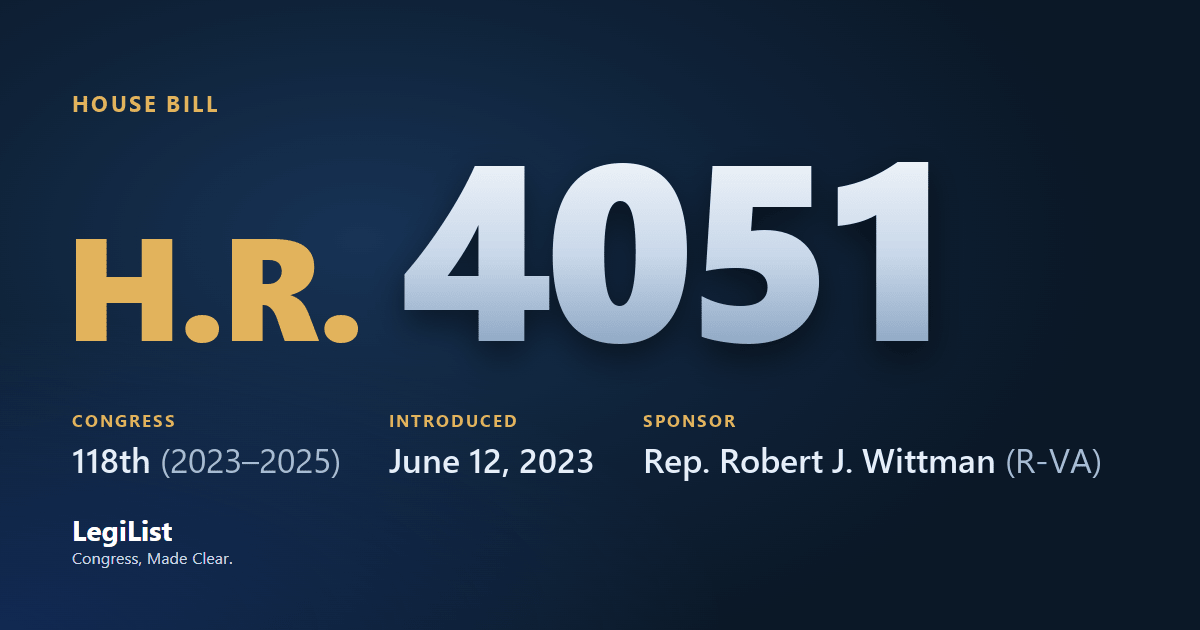
Supporting the Health of Aquatic systems through Research Knowledge and Enhanced Dialogue Act
Latest action · Feb 6, 2024 Received in the Senate and Read twice and referred to the Committee on Commerce, Science, and Transportation.
Progress
Where this bill reached, and when. A stage with no date was not reached; one that failed a vote and later carried shows the date it carried.
- IntroducedJun 12, 2023
- Passed HouseFeb 5, 2024
- Passed SenateNot reached
- To the PresidentNot reached
- Became lawNot reached
Summary
Supporting the Health of Aquatic systems through Research Knowledge and Enhanced Dialogue Act or the SHARKED Act
This bill establishes requirements to address shark depredation (i.e., consumption of a fishing catch by a shark before it is retrieved by a fisherman). Specifically, the bill directs the National Oceanic and Atmospheric Administration (NOAA) to establish a task force to identify and address critical needs with respect to shark depredation. The task force must terminate within seven years.
When making funds available under its cooperative research and management program, NOAA must also prioritize projects related to understanding shark depredation.
Cosponsors 5
Members who signed on, in the order they did. Signatures ran from Jun 12, 2023 to Oct 24, 2023; 3 are original cosponsors, there from the day it was introduced.
| Seat | Cosponsor | Signed on | |
|---|---|---|---|
| D-FL | Darren Soto | Original | Jun 12, 2023 |
| R-LA | Garret Graves | Original | Jun 12, 2023 |
| D-TX | Marc A. Veasey | Original | Jun 12, 2023 |
| D-NH | Chris Pappas | Oct 24, 2023 | |
| R-FL | Daniel Webster | Oct 24, 2023 |
Committees 2
Where it was sent and what each committee and subcommittee did with it, in order.
| Chamber | Committee | What it did |
|---|---|---|
| House | Natural Resources Committee | Referred Jun 12, 2023Discharged Sep 20, 2023Markup Sep 20, 2023Reported Jan 30, 2024 |
| Water, Wildlife and Fisheries Subcommittee | Referred Jul 21, 2023Hearings Jul 27, 2023Discharged Sep 20, 2023 | |
| Senate | Commerce, Science, and Transportation Committee | Referred Feb 6, 2024 |
Actions 15
Everything that happened, newest first.
- Feb 6, 2024Received in the Senate and Read twice and referred to the Committee on Commerce, Science, and Transportation.
- Feb 5, 2024Mr. Westerman moved to suspend the rules and pass the bill, as amended.
- Feb 5, 2024Considered under suspension of the rules. (consideration: CR H400-403)
- Feb 5, 2024DEBATE - The House proceeded with forty minutes of debate on H.R. 4051.
- Feb 5, 2024Passed/agreed to in House: On motion to suspend the rules and pass the bill, as amended Agreed to by voice vote. (text: CR H400-401)
- Feb 5, 2024Motion to reconsider laid on the table Agreed to without objection.
- Jan 30, 2024Reported (Amended) by the Committee on Natural Resources. H. Rept. 118-368.
- Jan 30, 2024Placed on the Union Calendar, Calendar No. 301.
- Sep 20, 2023Subcommittee on Water, Wildlife, and Fisheries Discharged
- Sep 20, 2023Committee Consideration and Mark-up Session Held
- Sep 20, 2023Ordered to be Reported (Amended) by Unanimous Consent.
- Jul 27, 2023Subcommittee Hearings Held
- Jul 21, 2023Referred to the Subcommittee on Water, Wildlife, and Fisheries.
- Jun 12, 2023Introduced in House
- Jun 12, 2023Referred to the House Committee on Natural Resources.
In the Congressional Record 1
Days the Record’s own index lists this bill, newest first, with the pages and the members it names. Pages starting H are the House, S the Senate, E Extensions of Remarks.
| Where | In the Record | Members | Date |
|---|---|---|---|
| House | Debate and remarks H400–H403Text printed H400 | Bruce Westerman R-AR, Debbie Dingell D-MI, Garret Graves R-LA, Robert J. Wittman R-VA | Feb 5, 2024 |
Research
What has been written about this bill: committee reports, cost estimates, the sponsor’s authority statement, printed hearings and the Congressional Research Service’s work.
Committee report
Congressional Budget Office cost estimate
- Nov 20, 2023H.R. 4051, SHARKED ActAs ordered reported by the House Committee on Natural Resources on September 20, 2023
Constitutional authority
The sponsor’s statement, as printed in the Congressional Record, vol. 169, no. 102, June 12, 2023, page H2811.
Printed hearings 1
Hearings whose printed record names this bill, newest first: hearings on it, and wider hearings where it came up.
CRS reports 1
Congressional Research Service work that CRS links to this bill or the law it became, newest first.
Cite it 1
Products on other subjects that cite it, usually among other measures.
| Product | Title | Kind | Published |
|---|---|---|---|
| R48951 | Shark Conservation and Management in the United States | Report | Jul 15, 2026 |
Titles 6
Every title it has carried, official and short, at each stage.
- Official Title as Introduced
- To direct the Secretary of Commerce to establish a task force regarding shark depredation, and for other purposes.
- Short Title(s) as Introduced
- Supporting the Health of Aquatic systems through Research Knowledge and Enhanced Dialogue Act
- Short Title(s) as Reported to House
- Supporting the Health of Aquatic systems through Research Knowledge and Enhanced Dialogue Act
- Short Title(s) as Passed House
- Supporting the Health of Aquatic systems through Research Knowledge and Enhanced Dialogue Act
- Short Titles from RFS (Referred to Senate) bill text
- Supporting the Health of Aquatic systems through Research Knowledge and Enhanced Dialogue Act
- SHARKED Act
Subjects
Assigned by the Library of Congress. Policy area: Animals.
Text 4
Each version as it was printed, newest first.
- Feb 6, 2024Referred in Senate
- Feb 5, 2024Engrossed in House
- Jan 30, 2024Reported in House
- Jun 12, 2023Introduced in House
Support LegiList
This page is free, carries no paywall, and is built and maintained by one person. If the record here is useful to you, a few dollars keeps it going.
Everything here is as published by Congress: the summary is the Congressional Research Service's, the action wording is the clerks', and the subjects are the Library of Congress's. How far it got is read from the actions themselves, taking the most recent one of each kind, so a bill that failed a vote and later passed is shown as having passed. Records come from this bill on Congress.gov and govinfo.gov; cost estimates are the Congressional Budget Office's, and the hearings are the printed hearings GovInfo publishes, which can appear months after the hearing.