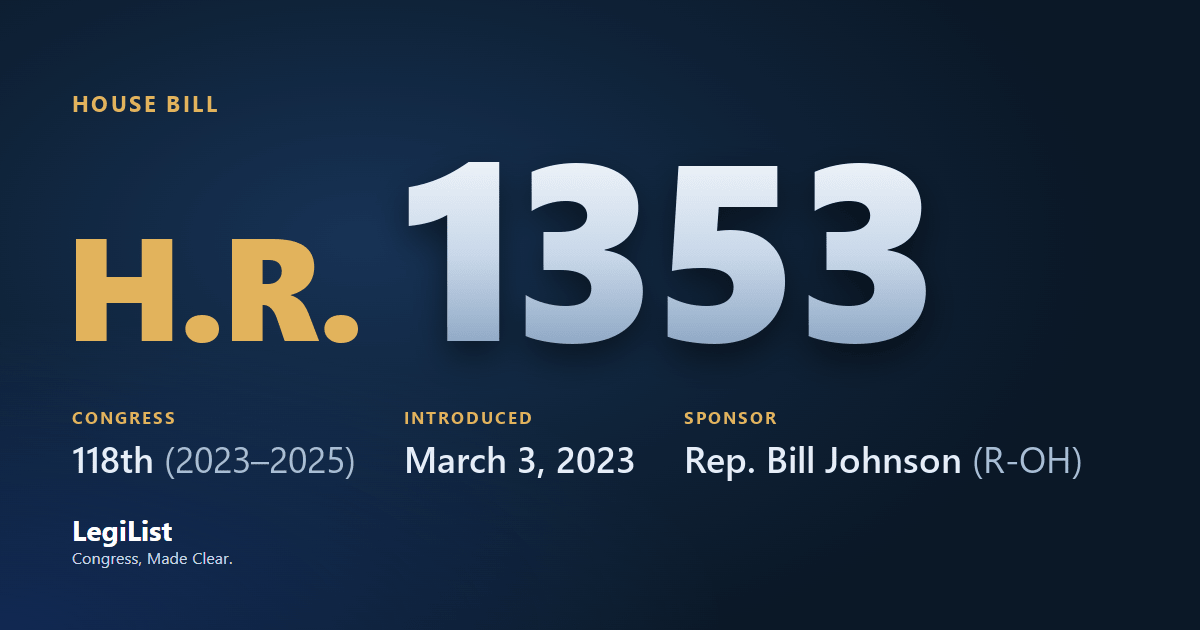
Advanced, Local Emergency Response Telecommunications Parity Act
Latest action · Apr 27, 2023 Received in the Senate and Read twice and referred to the Committee on Commerce, Science, and Transportation.
Progress
Where this bill reached, and when. A stage with no date was not reached; one that failed a vote and later carried shows the date it carried.
- IntroducedMar 3, 2023
- Passed HouseApr 26, 2023
- Passed SenateNot reached
- To the PresidentNot reached
- Became lawNot reached
Summary
Advanced, Local Emergency Response Telecommunications Parity Act or the ALERT Parity Act
This bill requires the Federal Communications Commission (FCC) to facilitate the provision of emergency communication services (e.g., 9-1-1 calls and emergency alerts) in unserved areas. An unserved area is one that has no commercial mobile service capable of providing emergency services because of a lack of infrastructure, destruction of infrastructure, a power outage, or other reason.
The FCC must establish a process for companies to apply for approval to access the electromagnetic spectrum in order to provide emergency services in unserved areas. To obtain approval, a company must demonstrate that it (1) has a technical proposal for providing services, (2) will not use the spectrum to provide additional services, and (3) has the capability to provide the services rapidly. The company must also demonstrate that the services can withstand earthquakes, hurricanes, and other major disasters. The FCC must publish a list of approved providers online.
Additionally, the bill provides protections for authorized users of the spectrum. For example, a provider with FCC approval to provide emergency services to an area under this bill may only access the spectrum if (1) the entity that is typically authorized to use it expressly consents in writing to the approved provider's use, and (2) the approved provider's use does not interfere with the authorized entity's use. Authorized entities that receive a request for consent must reasonably engage with the provider submitting the request.
The bill also limits the liability of an approved provider for certain harms resulting from the transmission of (or failure to transmit) emergency alerts or the release of subscriber information when delivering an alert.
Recorded votes 1
Newest first. Open one to see how every member voted.
| Roll call | Question | Result | Date |
|---|---|---|---|
| House 197 | On Motion to Suspend the Rules and Pass, as Amended | Passed422–1 | Apr 26, 2023 |
Cosponsors 1
Members who signed on, in the order they did. All signed on Mar 3, 2023.
| Seat | Cosponsor | Signed on | |
|---|---|---|---|
| D-WA | Kim Schrier | Original | Mar 3, 2023 |
Committees 2
Where it was sent and what each committee and subcommittee did with it, in order.
| Chamber | Committee | What it did |
|---|---|---|
| House | Energy and Commerce Committee | Referred Mar 3, 2023Markup Mar 23, 2023Markup Mar 24, 2023Reported Apr 24, 2023 |
| Communications and Technology Subcommittee | Referred Mar 3, 2023Markup Mar 8, 2023Reported Mar 8, 2023 | |
| Senate | Commerce, Science, and Transportation Committee | Referred Apr 27, 2023 |
Actions 18
Everything that happened, newest first.
- Apr 27, 2023Received in the Senate and Read twice and referred to the Committee on Commerce, Science, and Transportation.
- Apr 26, 2023Considered as unfinished business. (consideration: CR H1978-1979)
- Apr 26, 2023Passed/agreed to in House: On motion to suspend the rules and pass the bill, as amended Agreed to by the Yeas and Nays: (2/3 required): 422 - 1 (Roll no. 197). (text: 4/25/2023 CR H1922-1923)
- Apr 26, 2023Motion to reconsider laid on the table Agreed to without objection.
- Apr 25, 2023Mr. Latta moved to suspend the rules and pass the bill, as amended.
- Apr 25, 2023Considered under suspension of the rules. (consideration: CR H1921-1924)
- Apr 25, 2023DEBATE - The House proceeded with forty minutes of debate on H.R. 1353.
- Apr 25, 2023At the conclusion of debate, the Yeas and Nays were demanded and ordered. Pursuant to the provisions of clause 8, rule XX, the Chair announced that further proceedings on the motion would be postponed.
- Apr 24, 2023Reported (Amended) by the Committee on Energy and Commerce. H. Rept. 118-39.
- Apr 24, 2023Placed on the Union Calendar, Calendar No. 25.
- Mar 24, 2023Committee Consideration and Mark-up Session Held.
- Mar 24, 2023Ordered to be Reported (Amended) by the Yeas and Nays: 46 - 0.
- Mar 23, 2023Committee Consideration and Mark-up Session Held.
- Mar 8, 2023Subcommittee Consideration and Mark-up Session Held.
- Mar 8, 2023Forwarded by Subcommittee to Full Committee by the Yeas and Nays: 27 - 0 .
- Mar 3, 2023Introduced in House
- Mar 3, 2023Referred to the House Committee on Energy and Commerce.
- Mar 3, 2023Referred to the Subcommittee on Communications and Technology.
In the Congressional Record 2
Days the Record’s own index lists this bill, newest first, with the pages and the members it names. Pages starting H are the House, S the Senate, E Extensions of Remarks.
| Where | In the Record | Members | Date |
|---|---|---|---|
| House | Recorded votes H1979enact | — | Apr 26, 2023 |
| House | Debate and remarks H1922–H1924Text printed H1922 | Bill Johnson R-OH, Frank Pallone, Jr. D-NJ, Robert E. Latta R-OH | Apr 25, 2023 |
Research
What has been written about this bill: committee reports, cost estimates, the sponsor’s authority statement, printed hearings and the Congressional Research Service’s work.
Committee report
Congressional Budget Office cost estimate
- Apr 21, 2023H.R. 1353, ALERT Parity ActAs ordered reported by the House Committee on Energy and Commerce on March 24, 2023
Constitutional authority
The sponsor’s statement, as printed in the Congressional Record, vol. 169, no. 41, March 3, 2023, page H1114.
Printed hearings 1
Hearings whose printed record names this bill, newest first: hearings on it, and wider hearings where it came up.
| Number | Hearing | Committee | Held |
|---|---|---|---|
| Serial No. 118-40 | LISTEN HERE: WHY AMERICANS VALUE AM RADIO126 pages | Energy and Commerce Committee | Jun 6, 2023 |
Titles 7
Every title it has carried, official and short, at each stage.
- Official Title as Introduced
- To direct the Federal Communications Commission to issue rules for the provision of emergency connectivity service, and for other purposes.
- Short Title(s) as Introduced
- ALERT Parity Act
- Advanced, Local Emergency Response Telecommunications Parity Act
- Short Title(s) as Reported to House
- Advanced, Local Emergency Response Telecommunications Parity Act
- Short Title(s) as Passed House
- Advanced, Local Emergency Response Telecommunications Parity Act
- Short Titles from RFS (Referred to Senate) bill text
- Advanced, Local Emergency Response Telecommunications Parity Act
- ALERT Parity Act
Subjects
Assigned by the Library of Congress. Policy area: Science, Technology, Communications.
- Administrative law and regulatory procedures
- Advanced technology and technological innovations
- Congressional oversight
- Emergency communications systems
- Federal Communications Commission (FCC)
- Government information and archives
- Radio spectrum allocation
- Science, Technology, Communications
- Telephone and wireless communication
Text 4
Each version as it was printed, newest first.
- Apr 27, 2023Referred in Senate
- Apr 26, 2023Engrossed in House
- Apr 24, 2023Reported in House
- Mar 3, 2023Introduced in House
Everything here is as published by Congress: the summary is the Congressional Research Service's, the action wording is the clerks', and the subjects are the Library of Congress's. How far it got is read from the actions themselves, taking the most recent one of each kind, so a bill that failed a vote and later passed is shown as having passed. Records come from this bill on Congress.gov and govinfo.gov; cost estimates are the Congressional Budget Office's, and the hearings are the printed hearings GovInfo publishes, which can appear months after the hearing.