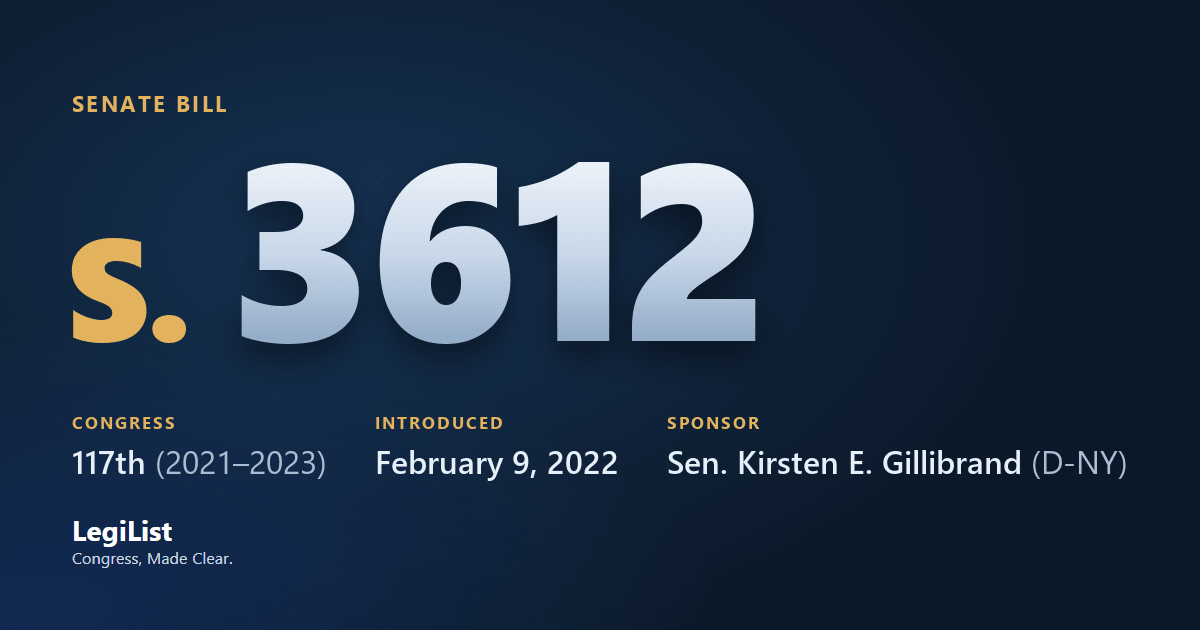
STOCK Act 2.0
Latest action · Feb 9, 2022 Read twice and referred to the Committee on Homeland Security and Governmental Affairs.
Progress
Where this bill reached, and when. A stage with no date was not reached; one that failed a vote and later carried shows the date it carried.
- IntroducedFeb 9, 2022
- Passed SenateNot reached
- Passed HouseNot reached
- To the PresidentNot reached
- Became lawNot reached
Summary
STOCK Act 2.0
This bill expands restrictions on investment practices and requirements for financial disclosures that apply to specified high-level government officials.
In particular, the bill bars individual stock trading by (1) Members of Congress, (2) the President and Vice President, (3) Supreme Court Justices, (4) governors of the Federal Reserve Board, and (5) presidents and vice presidents of Federal Reserve banks.
Additionally, the bill requires financial disclosures to include loans, contracts, and other benefits (excluding salaries, compensation, or tax refunds) from the federal government. It also requires additional officials, namely judges and senior leaders of Federal Reserve banks, to make the disclosures.
Further, the bill directs supervising ethics agencies to make the disclosures publicly available in formats that are easily searchable, sortable, and downloadable.
Cosponsors
Members who signed on, in the order they did.
Committees 1
Where it was sent and what each committee and subcommittee did with it, in order.
| Chamber | Committee | What it did |
|---|---|---|
| Senate | Homeland Security and Governmental Affairs Committee | Referred Feb 9, 2022 |
Actions 2
Everything that happened, newest first.
- Feb 9, 2022Introduced in Senate
- Feb 9, 2022Read twice and referred to the Committee on Homeland Security and Governmental Affairs.
In the Congressional Record 1
Days the Record’s own index lists this bill, newest first, with the pages and the members it names. Pages starting H are the House, S the Senate, E Extensions of Remarks.
| Where | In the Record | Members | Date |
|---|---|---|---|
| Senate | Debate and remarks S582 | Charles E. Schumer D-NY | Feb 9, 2022 |
Research
What has been written about this bill: committee reports, cost estimates, the sponsor’s authority statement, printed hearings and the Congressional Research Service’s work.
CRS reports 3
Congressional Research Service work that CRS links to this bill or the law it became, newest first.
Cite it 3
Products on other subjects that cite it, usually among other measures.
| Product | Title | Kind | Published |
|---|---|---|---|
| R47818 | Proposals to Limit Financial Activities of Members of Congress: Background and Analysis of Legislative Proposals | Report | Mar 19, 2025 |
| TE10073 | Examining Stock Trading Reforms For Congress | Testimony | Apr 8, 2022 |
| IN11860 | Stock Trading in Congress: 117th Congress Proposals to Limit or Prohibit Certain Financial Transactions Archived | Insight | Feb 17, 2022 |
Related bills 1
Companion bills and other measures the record links to this one.
| Bill | Title | Relationship | Latest action |
|---|---|---|---|
| HR 6694 | STOCK Act 2.0 | Identical bill | Nov 1, 2022 |
Titles 2
Every title it has carried, official and short, at each stage.
- Official Title as Introduced
- A bill to amend the Ethics in Government Act of 1978 and the STOCK Act to require certain senior officials to report payments received from the Federal Government, to improve the filing and disclosure of financial disclosures by Members of Congress, congressional staff, very senior employees, and others, and to ban stock trading for certain senior Government officials, and for other purposes.
- Short Title(s) as Introduced
- STOCK Act 2.0
Subjects
Assigned by the Library of Congress. Policy area: Congress.
Text 1
Each version as it was printed, newest first.
- Feb 9, 2022Introduced in Senate
Support LegiList
This page is free, carries no paywall, and is built and maintained by one person. If the record here is useful to you, a few dollars keeps it going.
Everything here is as published by Congress: the summary is the Congressional Research Service's, the action wording is the clerks', and the subjects are the Library of Congress's. How far it got is read from the actions themselves, taking the most recent one of each kind, so a bill that failed a vote and later passed is shown as having passed. Records come from this bill on Congress.gov and govinfo.gov; cost estimates are the Congressional Budget Office's, and the hearings are the printed hearings GovInfo publishes, which can appear months after the hearing.