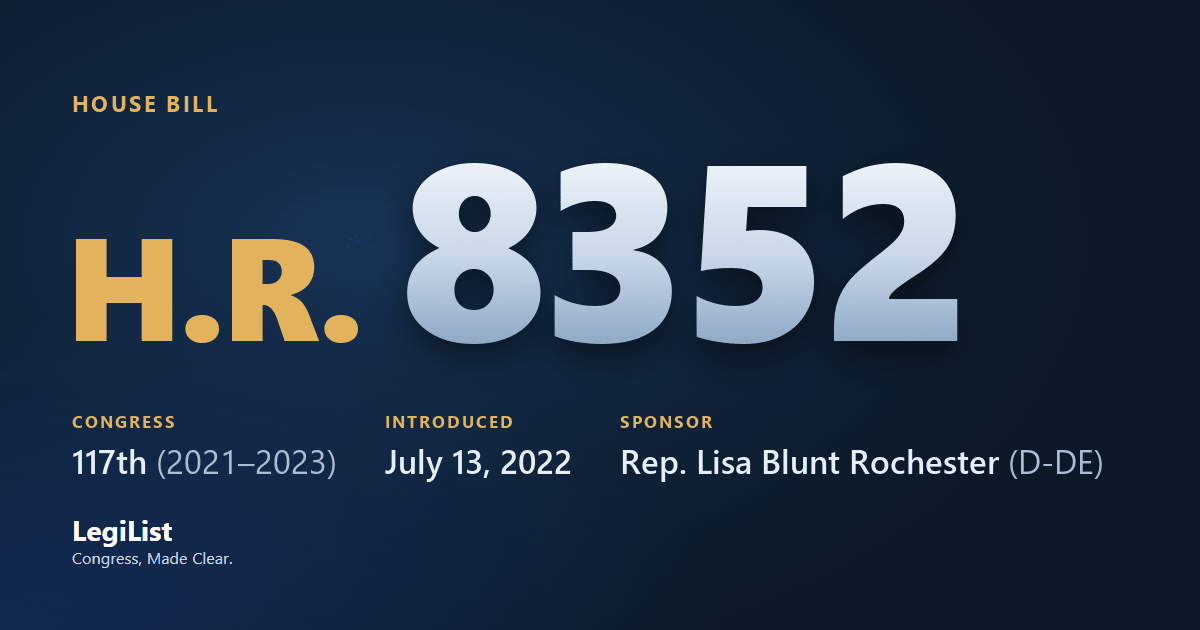
Public Health Air Quality Act of 2022
Latest action · Jul 13, 2022 Referred to the House Committee on Energy and Commerce.
Progress
Where this bill reached, and when. A stage with no date was not reached; one that failed a vote and later carried shows the date it carried.
- IntroducedJul 13, 2022
- Passed HouseNot reached
- Passed SenateNot reached
- To the PresidentNot reached
- Became lawNot reached
Summary
Public Health Air Quality Act of 2022
This bill requires the Environmental Protection Agency to take specified actions related to monitoring and improving air quality, including by implementing a program to administer or conduct emissions measurement and quantification, promulgating regulations related to specified source categories, and deploying not fewer than 1,000 air quality sensors.
Cosponsors 16
Members who signed on, in the order they did. Signatures ran from Jul 13, 2022 to Nov 29, 2022; 7 are original cosponsors, there from the day it was introduced.
| Seat | Cosponsor | Signed on | |
|---|---|---|---|
| D-VA | A. Donald McEachin | Original | Jul 13, 2022 |
| D-IL | Bobby L. Rush | Original | Jul 13, 2022 |
| D-NY | Jamaal Bowman | Original | Jul 13, 2022 |
| D-FL | Kathy Castor | Original | Jul 13, 2022 |
| D-IL | Lauren Underwood | Original | Jul 13, 2022 |
| D-CA | Nanette Diaz Barragán | Original | Jul 13, 2022 |
| D-WA | Pramila Jayapal | Original | Jul 13, 2022 |
| D-OR | Earl Blumenauer | Jul 20, 2022 | |
| D-OR | Suzanne Bonamici | Jul 20, 2022 | |
| D-CA | Jared Huffman | Jul 26, 2022 | |
| D-IL | Sean Casten | Jul 26, 2022 | |
| D-CA | Alan S. Lowenthal | Jul 28, 2022 | |
| D-CA | Barbara Lee | Sep 19, 2022 | |
| D-CA | Doris O. Matsui | Sep 19, 2022 | |
| D-CA | Ted Lieu | Sep 30, 2022 |
Committees 1
Where it was sent and what each committee and subcommittee did with it, in order.
| Chamber | Committee | What it did |
|---|---|---|
| House | Energy and Commerce Committee | Referred Jul 13, 2022 |
Actions 2
Everything that happened, newest first.
- Jul 13, 2022Introduced in House
- Jul 13, 2022Referred to the House Committee on Energy and Commerce.
Research
What has been written about this bill: committee reports, cost estimates, the sponsor’s authority statement, printed hearings and the Congressional Research Service’s work.
Constitutional authority
The sponsor’s statement, as printed in the Congressional Record, vol. 168, no. 115, July 13, 2022, page H6335.
Related bills 2
Companion bills and other measures the record links to this one.
| Bill | Title | Relationship | Latest action |
|---|---|---|---|
| S 4510 | Public Health Air Quality Act of 2022 | Related bill | Jul 12, 2022 |
| HR 9386 | Better Data for Cleaner Air Act of 2022 | Related bill | Dec 1, 2022 |
Titles 2
Every title it has carried, official and short, at each stage.
- Official Title as Introduced
- To protect clean air and public health by expanding fenceline and ambient air monitoring and access to air quality information for communities affected by air pollution, to require hazardous air pollutant monitoring at the fenceline of facilities whose emissions are linked to local health threats, to ensure the Environmental Protection Agency promulgates rules that require hazardous air pollutant data measurement and electronic submission at fencelines and stacks of industrial source categories, to expand and strengthen the national ambient air quality monitoring network, to deploy air sensors in communities affected by air pollution, and for other purposes.
- Short Title(s) as Introduced
- Public Health Air Quality Act of 2022
Subjects
Assigned by the Library of Congress. Policy area: Environmental Protection.
Text 1
Each version as it was printed, newest first.
- Jul 13, 2022Introduced in House
Support LegiList
This page is free, carries no paywall, and is built and maintained by one person. If the record here is useful to you, a few dollars keeps it going.
Everything here is as published by Congress: the summary is the Congressional Research Service's, the action wording is the clerks', and the subjects are the Library of Congress's. How far it got is read from the actions themselves, taking the most recent one of each kind, so a bill that failed a vote and later passed is shown as having passed. Records come from this bill on Congress.gov and govinfo.gov; cost estimates are the Congressional Budget Office's, and the hearings are the printed hearings GovInfo publishes, which can appear months after the hearing.