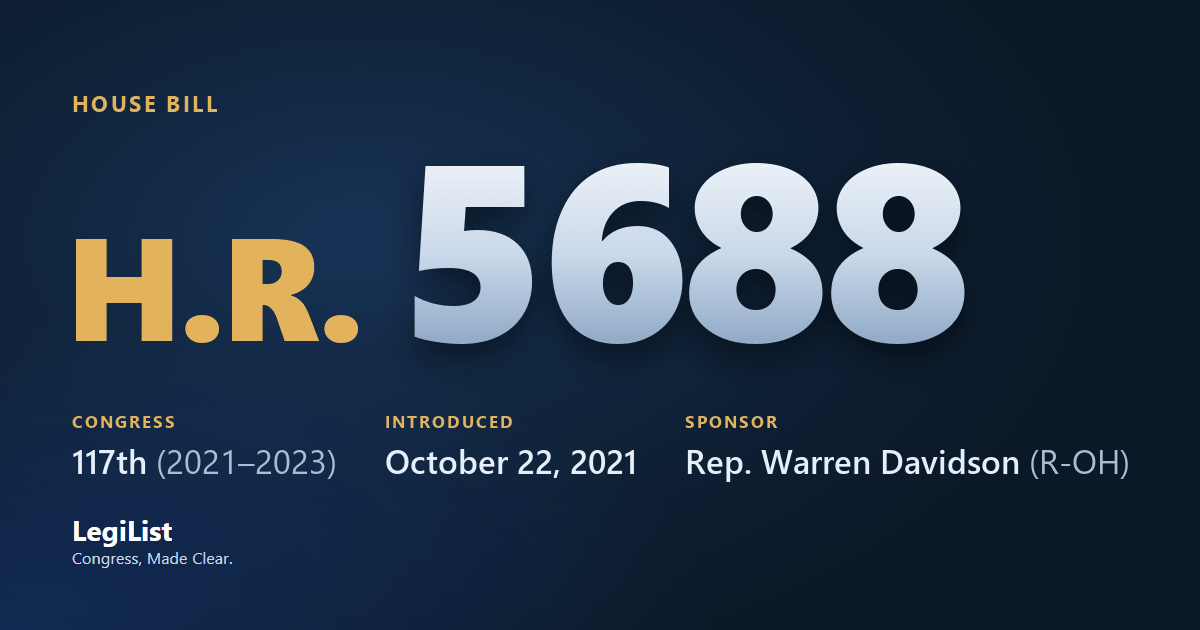
People CARE Act
Latest action · Dec 2, 2021 Referred to the Subcommittee on Nutrition, Oversight, and Department Operations.
Progress
Where this bill reached, and when. A stage with no date was not reached; one that failed a vote and later carried shows the date it carried.
- IntroducedOct 22, 2021
- Passed HouseNot reached
- Passed SenateNot reached
- To the PresidentNot reached
- Became lawNot reached
Summary
People-Centered Assistance Reform Effort Act or the People CARE Act
This bill establishes the People-Centered Assistance Reform Effort Commission within the legislative branch to review federal means-tested welfare programs.
Means-tested welfare programs are those designed to specifically provide assistance exclusively to low-income Americans. The commission shall review all federal means-tested programs, excluding various specified programs such as the Social Security benefits program, Medicare, and Department of Veterans Affairs-administered programs.
The commission's review shall cover topics including (1) ways to make the benefits programs more efficient and streamlined, (2) opportunities to reduce costs by contracting with private entities or delegating to states, (3) any programs that should be subject to discretionary appropriations, and (4) changes to allow caseworkers to have a holistic view of the beneficiary.
The commission shall report its findings to Congress, and the report shall include proposed legislation to carry out the commission's recommendations.
The Speaker of the House of Representatives and the Senate majority leader shall introduce the proposed legislation in their respective chambers. The proposed legislation shall be considered under certain expedited procedures, such as limitations on debate.
Cosponsors
Members who signed on, in the order they did.
Committees 9
Where it was sent and what each committee and subcommittee did with it, in order.
| Chamber | Committee | What it did |
|---|---|---|
| House | Ways and Means Committee | Referred Oct 22, 2021 |
| Work and Welfare Subcommittee | Referred Oct 22, 2021 | |
| House | Education and Workforce Committee | Referred Oct 22, 2021 |
| House | Agriculture Committee | Referred Oct 22, 2021 |
| Nutrition and Foreign Agriculture Subcommittee | Referred Dec 2, 2021 | |
| House | Energy and Commerce Committee | Referred Oct 22, 2021 |
| Health Subcommittee | Referred Oct 25, 2021 | |
| House | Financial Services Committee | Referred Oct 22, 2021 |
| House | Transportation and Infrastructure Committee | Referred Oct 22, 2021 |
| Economic Development, Public Buildings, and Emergency Management Subcommittee | Referred Oct 25, 2021 | |
| Railroads, Pipelines, and Hazardous Materials Subcommittee | Referred Oct 25, 2021 | |
| House | Rules Committee | Referred Oct 22, 2021 |
| House | Judiciary Committee | Referred Oct 22, 2021 |
| House | Natural Resources Committee | Referred Oct 22, 2021 |
| Indian and Insular Affairs Subcommittee | Referred Oct 29, 2021 |
Actions 8
Everything that happened, newest first.
- Dec 2, 2021Referred to the Subcommittee on Nutrition, Oversight, and Department Operations.
- Oct 29, 2021Referred to the Subcommittee for Indigenous Peoples of the United States.
- Oct 25, 2021Referred to the Subcommittee on Health.
- Oct 25, 2021Referred to the Subcommittee on Economic Development, Public Buildings, and Emergency Management.
- Oct 25, 2021Referred to the Subcommittee on Railroads, Pipelines, and Hazardous Materials.
In the Congressional Record 1
Days the Record’s own index lists this bill, newest first, with the pages and the members it names. Pages starting H are the House, S the Senate, E Extensions of Remarks.
| Where | In the Record | Members | Date |
|---|---|---|---|
| House | Debate and remarks H5866 | Warren Davidson R-OH | Oct 25, 2021 |
Research
What has been written about this bill: committee reports, cost estimates, the sponsor’s authority statement, printed hearings and the Congressional Research Service’s work.
Constitutional authority
The sponsor’s statement, as printed in the Congressional Record, vol. 167, no. 186, October 22, 2021, page H5833.
Related bills 2
Companion bills and other measures the record links to this one.
| Bill | Title | Relationship | Latest action |
|---|---|---|---|
| HR 323 | People CARE Act | Reintroduced Bill | Dec 17, 2024 |
| HR 841 | People CARE Act | Reintroduction of | Mar 1, 2019 |
Titles 3
Every title it has carried, official and short, at each stage.
- Official Title as Introduced
- To establish the People-Centered Assistance Reform Effort Commission, to improve the social safety net and increase social mobility by increasing access to resources which address the underlying causes of poverty.
- Short Title(s) as Introduced
- People CARE Act
- People-Centered Assistance Reform Effort Act
Subjects
Assigned by the Library of Congress. Policy area: Social Welfare.
- Adoption and foster care
- Adult day care
- Advisory bodies
- Aging
- Child care and development
- Child health
- Congressional operations and organization
- Economic development
- Education of the disadvantaged
- Education programs funding
- Elementary and secondary education
- Employment and training programs
- Energy assistance for the poor and aged
- Family planning and birth control
- Food assistance and relief
- Government studies and investigations
- Health care costs and insurance
- Health care coverage and access
- Health programs administration and funding
- Higher education
- Homelessness and emergency shelter
- Housing and community development funding
- Housing finance and home ownership
- Housing for the elderly and disabled
- Immigrant health and welfare
- Income tax credits
- Indian social and development programs
- Lawyers and legal services
- Legislative rules and procedure
- Low- and moderate-income housing
- Medicare
- Migrant, seasonal, agricultural labor
- Minority health
- National and community service
- Nutrition and diet
- Performance measurement
- Poverty and welfare assistance
- Public housing
- Refugees, asylum, displaced persons
- Rural conditions and development
- Social Welfare
- Social work, volunteer service, charitable organizations
- Student aid and college costs
- Telecommunication rates and fees
- Wages and earnings
- Women's health
- Youth employment and child labor
Text 1
Each version as it was printed, newest first.
- Oct 22, 2021Introduced in House
Everything here is as published by Congress: the summary is the Congressional Research Service's, the action wording is the clerks', and the subjects are the Library of Congress's. How far it got is read from the actions themselves, taking the most recent one of each kind, so a bill that failed a vote and later passed is shown as having passed. Records come from this bill on Congress.gov and govinfo.gov; cost estimates are the Congressional Budget Office's, and the hearings are the printed hearings GovInfo publishes, which can appear months after the hearing.