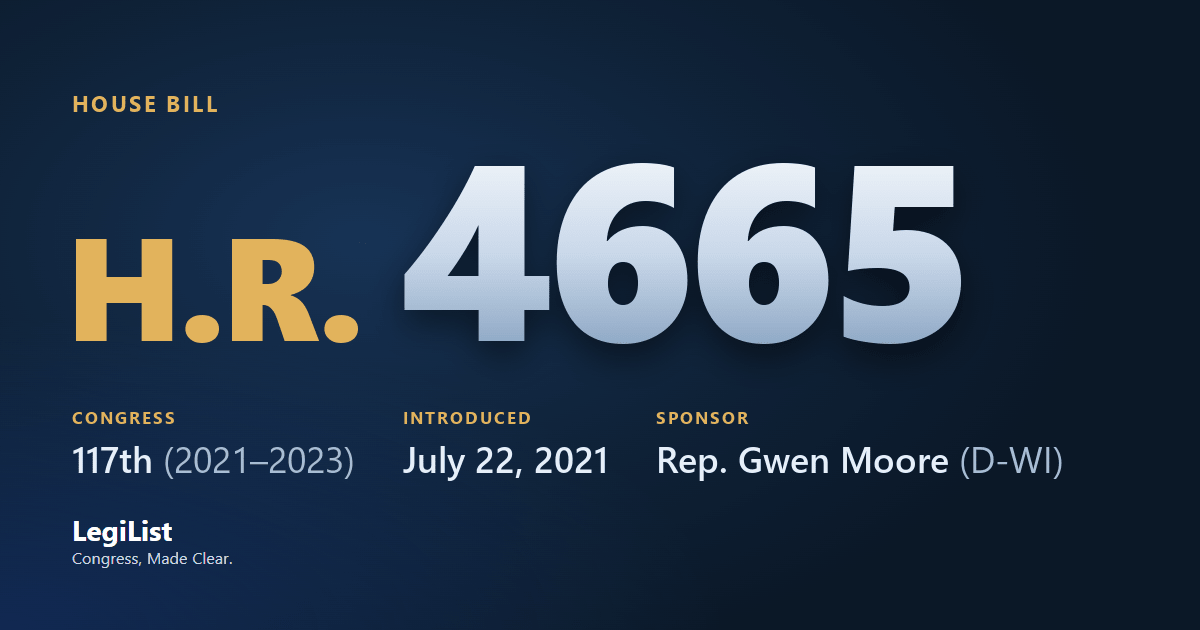
WRCR Act of 2021
Latest action · Jul 22, 2021 Referred to the House Committee on Ways and Means.
Progress
Where this bill reached, and when. A stage with no date was not reached; one that failed a vote and later carried shows the date it carried.
- IntroducedJul 22, 2021
- Passed HouseNot reached
- Passed SenateNot reached
- To the PresidentNot reached
- Became lawNot reached
Summary
Worker Relief and Credit Reform Act of 2021 or the WRCR Act of 2021
This bill modifies the earned income tax credit to (1) make the credit available to certain students, (2) modify the age requirement for the credit, (3) include care-giving and learning as compensated work for purposes of the credit, (4) revise the definition of qualifying dependents eligible for the credit, (5) increase the credit for certain unmarried individuals with two or more qualifying children, and (6) require the Internal Revenue Service (IRS) to establish a program for making direct advance monthly payments of the credit to eligible taxpayers.
The bill directs the IRS to establish a program to educate taxpayers about the availability of the earned income tax credit and the advance monthly payments of such credit.
Cosponsors 15
Members who signed on, in the order they did. Signatures ran from Jul 22, 2021 to Nov 12, 2021; 13 are original cosponsors, there from the day it was introduced.
| Seat | Cosponsor | Signed on | |
|---|---|---|---|
| D-MA | Ayanna Pressley | Original | Jul 22, 2021 |
| D-CA | Barbara Lee | Original | Jul 22, 2021 |
| D-ME | Chellie Pingree | Original | Jul 22, 2021 |
| D-PA | Dwight Evans | Original | Jul 22, 2021 |
| D-DC | Eleanor Holmes Norton | Original | Jul 22, 2021 |
| D-MN | Ilhan Omar | Original | Jul 22, 2021 |
| D-CA | Judy Chu | Original | Jul 22, 2021 |
| D-CA | Karen Bass | Original | Jul 22, 2021 |
| D-GU | Michael F. Q. San Nicolas | Original | Jul 22, 2021 |
| D-NY | Ritchie Torres | Original | Jul 22, 2021 |
| D-CA | Ro Khanna | Original | Jul 22, 2021 |
| D-TN | Steve Cohen | Original | Jul 22, 2021 |
| D-TX | Sylvia R. Garcia | Original | Jul 22, 2021 |
| D-TX | Sheila Jackson Lee | Aug 20, 2021 | |
| D-WA | Pramila Jayapal | Nov 12, 2021 |
Committees 1
Where it was sent and what each committee and subcommittee did with it, in order.
| Chamber | Committee | What it did |
|---|---|---|
| House | Ways and Means Committee | Referred Jul 22, 2021 |
Actions 2
Everything that happened, newest first.
- Jul 22, 2021Introduced in House
- Jul 22, 2021Referred to the House Committee on Ways and Means.
Research
What has been written about this bill: committee reports, cost estimates, the sponsor’s authority statement, printed hearings and the Congressional Research Service’s work.
Constitutional authority
The sponsor’s statement, as printed in the Congressional Record, vol. 167, no. 129, July 22, 2021, page H3846.
CRS reports 1
Congressional Research Service work that CRS links to this bill or the law it became, newest first.
Cite it 1
Products on other subjects that cite it, usually among other measures.
| Product | Title | Kind | Published |
|---|---|---|---|
| R47579 | Department of State, Foreign Operations, and Related Programs: FY2024 Budget and Appropriations | Report | Jul 16, 2024 |
Related bills 2
Companion bills and other measures the record links to this one.
| Bill | Title | Relationship | Latest action |
|---|---|---|---|
| HR 1468 | WRCR Act of 2023 | Reintroduced Bill | Mar 8, 2023 |
| HR 5271 | WRCR Act of 2019 | Reintroduction of | Nov 26, 2019 |
Titles 3
Every title it has carried, official and short, at each stage.
- Official Title as Introduced
- To amend the Internal Revenue Code of 1986 to expand and improve the earned income tax credit.
- Short Title(s) as Introduced
- WRCR Act of 2021
- Worker Relief and Credit Reform Act of 2021
Subjects
Assigned by the Library of Congress. Policy area: Taxation.
Text 1
Each version as it was printed, newest first.
- Jul 22, 2021Introduced in House
Support LegiList
This page is free, carries no paywall, and is built and maintained by one person. If the record here is useful to you, a few dollars keeps it going.
Everything here is as published by Congress: the summary is the Congressional Research Service's, the action wording is the clerks', and the subjects are the Library of Congress's. How far it got is read from the actions themselves, taking the most recent one of each kind, so a bill that failed a vote and later passed is shown as having passed. Records come from this bill on Congress.gov and govinfo.gov; cost estimates are the Congressional Budget Office's, and the hearings are the printed hearings GovInfo publishes, which can appear months after the hearing.