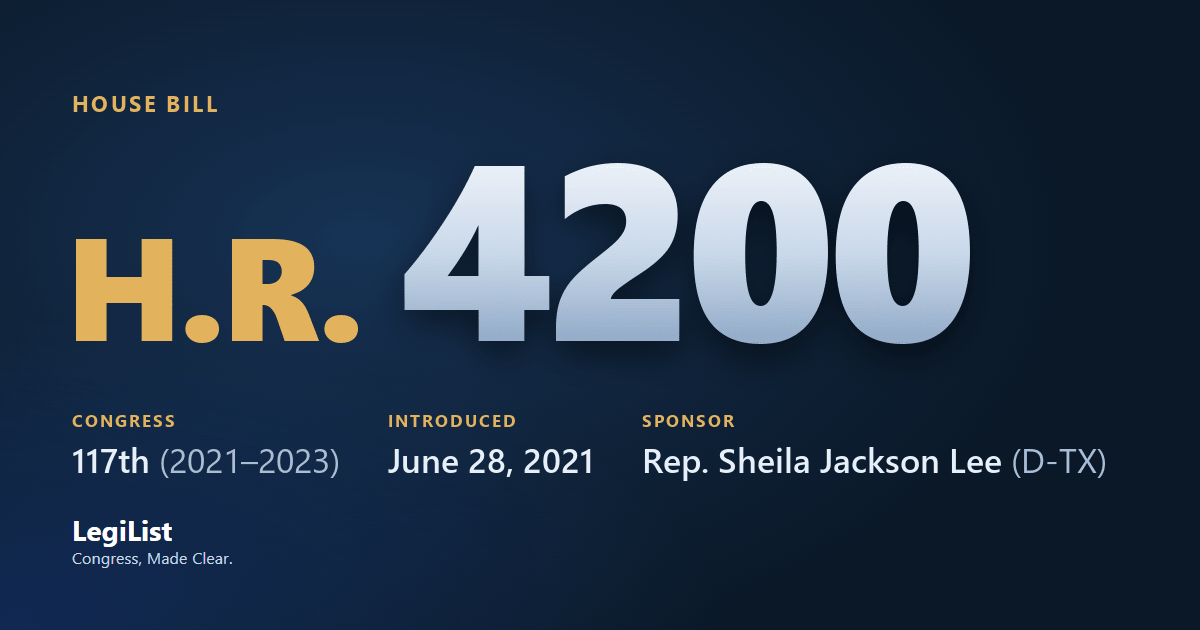
Residential Substance Use Disorder Treatment Act of 2021
Latest action · Nov 1, 2022 Referred to the Subcommittee on Crime, Terrorism, and Homeland Security.
Progress
Where this bill reached, and when. A stage with no date was not reached; one that failed a vote and later carried shows the date it carried.
- IntroducedJun 28, 2021
- Passed HouseNot reached
- Passed SenateNot reached
- To the PresidentNot reached
- Became lawNot reached
Summary
Residential Substance Use Disorder Treatment Act of 2021
This bill revises and reauthorizes through FY2026 grants for residential substance use disorder treatment programs at state and local correctional and detention facilities.
Among the revisions, the bill
- replaces statutory references to substance abuse with substance use disorder,
- specifies that the term residential substance use disorder treatment program includes a medication-assisted treatment program,
- requires the chief medical officer or other staff overseeing a program to complete training on the science of addiction and the latest research and clinical guidance on treating substance use disorders in criminal justice settings, and
- allows people who are awaiting trial or in pretrial detention to participate in the programs.
Cosponsors 9
Members who signed on, in the order they did. Signatures ran from Jun 28, 2021 to Nov 7, 2022; 1 is an original cosponsor, there from the day it was introduced.
| Seat | Cosponsor | Signed on | |
|---|---|---|---|
| D-NY | Hakeem S. Jeffries | Original | Jun 28, 2021 |
| R-FL | John H. Rutherford | Jul 19, 2021 | |
| D-MD | David J. Trone | Nov 30, 2021 | |
| R-NY | Elise M. Stefanik | Apr 18, 2022 | |
| R-TX | Troy E. Nehls | Apr 18, 2022 | |
| R-UT | Burgess Owens | May 12, 2022 | |
| R-AR | J. French Hill | Oct 14, 2022 | |
| R-MS | Michael Guest | Oct 25, 2022 | |
| R-KS | Jake LaTurner | Nov 7, 2022 |
Committees 1
Where it was sent and what each committee and subcommittee did with it, in order.
| Chamber | Committee | What it did |
|---|---|---|
| House | Judiciary Committee | Referred Jun 28, 2021 |
| Crime and Federal Government Surveillance Subcommittee | Referred Nov 1, 2022 |
Actions 3
Everything that happened, newest first.
- Nov 1, 2022Referred to the Subcommittee on Crime, Terrorism, and Homeland Security.
- Jun 28, 2021Introduced in House
- Jun 28, 2021Referred to the House Committee on the Judiciary.
Research
What has been written about this bill: committee reports, cost estimates, the sponsor’s authority statement, printed hearings and the Congressional Research Service’s work.
Constitutional authority
The sponsor’s statement, as printed in the Congressional Record, vol. 167, no. 112, June 28, 2021, page H3240.
Related bills 2
Companion bills and other measures the record links to this one.
| Bill | Title | Relationship | Latest action |
|---|---|---|---|
| HR 238 | Residential Substance Use Disorder Treatment Act of 2023 | Reintroduced Bill | Jan 10, 2023 |
| S 1046 | Residential Substance Use Disorder Treatment Act of 2021 | Identical bill | Aug 3, 2021 |
Titles 2
Every title it has carried, official and short, at each stage.
- Official Title as Introduced
- To amend the Omnibus Crime Control and Safe Streets Act of 1968 to reauthorize the residential substance use disorder treatment program, and for other purposes.
- Short Title(s) as Introduced
- Residential Substance Use Disorder Treatment Act of 2021
Subjects
Assigned by the Library of Congress. Policy area: Crime and Law Enforcement.
Text 1
Each version as it was printed, newest first.
- Jun 28, 2021Introduced in House
Support LegiList
This page is free, carries no paywall, and is built and maintained by one person. If the record here is useful to you, a few dollars keeps it going.
Everything here is as published by Congress: the summary is the Congressional Research Service's, the action wording is the clerks', and the subjects are the Library of Congress's. How far it got is read from the actions themselves, taking the most recent one of each kind, so a bill that failed a vote and later passed is shown as having passed. Records come from this bill on Congress.gov and govinfo.gov; cost estimates are the Congressional Budget Office's, and the hearings are the printed hearings GovInfo publishes, which can appear months after the hearing.