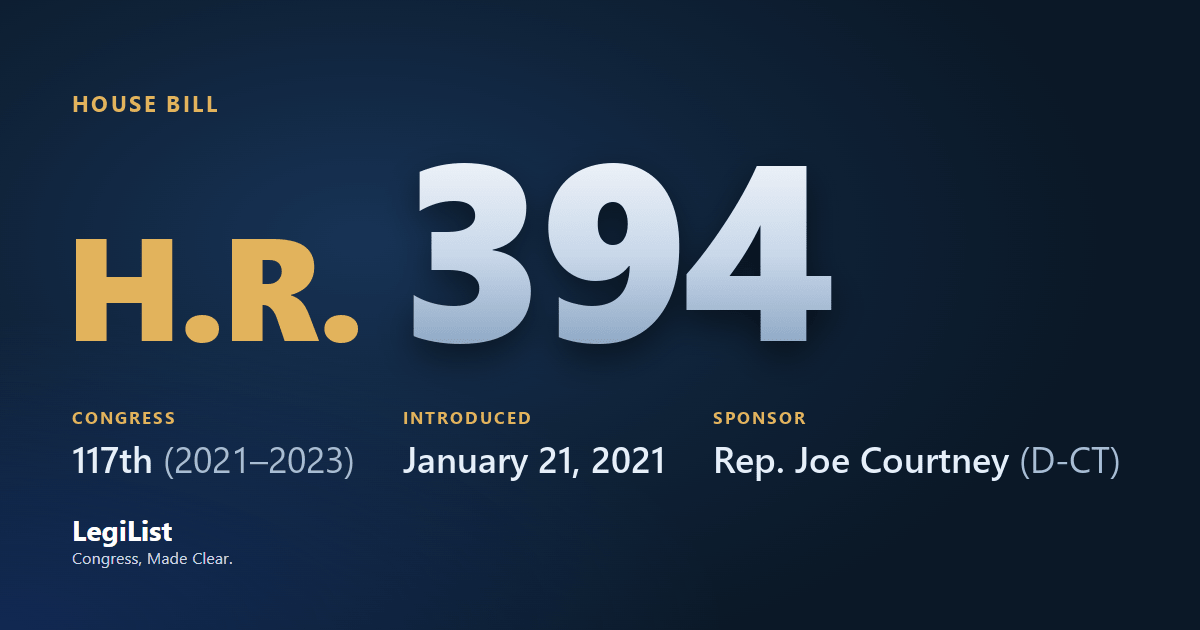
COVID–19 Student Loan Relief Extension Act
Latest action · Jan 21, 2021 Referred to the House Committee on Education and Labor.
Progress
Where this bill reached, and when. A stage with no date was not reached; one that failed a vote and later carried shows the date it carried.
- IntroducedJan 21, 2021
- Passed HouseNot reached
- Passed SenateNot reached
- To the PresidentNot reached
- Became lawNot reached
Summary
COVID-19 Student Loan Relief Extension Act
This bill extends certain temporary relief related to federal student loans and expands eligibility for such relief to additional types of loans.
Specifically, the bill extends the current suspension of payments due on federal student loans to 30 days after the end of the COVID-19 (i.e., coronavirus disease 2019) public health emergency. It also extends the suspension of interest due on these loans until the economy shows specified initial signs of recovery.
Further, the bill expands eligibility for temporary relief on federal student loans to include Federal Family Education Loans (FFELs) and Federal Perkins Loans that are not held by the Department of Education (ED) and certain health profession and nursing loans. (Currently, these temporary relief provisions are only applicable to certain Federal Direct Loans and FFELs that are held by ED.) Additionally, the bill makes this eligibility retroactive to March 13, 2020.
Finally, ED and the Department of Health and Human Services must carry out a program, beginning on August 1, 2021, to provide at least six notices to borrowers that normal payment obligations will resume.
Cosponsors 19
Members who signed on, in the order they did. Signatures ran from Jan 21, 2021 to Sep 10, 2021; 13 are original cosponsors, there from the day it was introduced.
| Seat | Cosponsor | Signed on | |
|---|---|---|---|
| D-WA | Derek Kilmer | Original | Jan 21, 2021 |
| D-CO | Ed Perlmutter | Original | Jan 21, 2021 |
| D-CA | Eric Swalwell | Original | Jan 21, 2021 |
| D-CT | Jahana Hayes | Original | Jan 21, 2021 |
| D-CT | James A. Himes | Original | Jan 21, 2021 |
| D-CT | John B. Larson | Original | Jan 21, 2021 |
| D-IL | Lauren Underwood | Original | Jan 21, 2021 |
| D-PA | Michael F. Doyle | Original | Jan 21, 2021 |
| D-GA | Nikema Williams | Original | Jan 21, 2021 |
| D-VT | Peter Welch | Original | Jan 21, 2021 |
| D-TN | Steve Cohen | Original | Jan 21, 2021 |
| D-PA | Susan Wild | Original | Jan 21, 2021 |
| D-WA | Suzan K. DelBene | Original | Jan 21, 2021 |
| D-WA | Adam Smith | Feb 1, 2021 | |
| D-MI | Daniel T. Kildee | Feb 1, 2021 | |
| D-WA | Marilyn Strickland | Feb 1, 2021 | |
| D-PA | Mary Gay Scanlon | Feb 1, 2021 | |
| D-CA | Scott H. Peters | Feb 1, 2021 | |
| D-CA | Ted Lieu | Sep 10, 2021 |
Committees 1
Where it was sent and what each committee and subcommittee did with it, in order.
| Chamber | Committee | What it did |
|---|---|---|
| House | Education and Workforce Committee | Referred Jan 21, 2021 |
Actions 2
Everything that happened, newest first.
- Jan 21, 2021Introduced in House
- Jan 21, 2021Referred to the House Committee on Education and Labor.
Research
What has been written about this bill: committee reports, cost estimates, the sponsor’s authority statement, printed hearings and the Congressional Research Service’s work.
Constitutional authority
The sponsor’s statement, as printed in the Congressional Record, vol. 167, no. 12, January 21, 2021, page H224.
Titles 2
Every title it has carried, official and short, at each stage.
- Official Title as Introduced
- To expand loan relief to all Federal student loan borrowers, and for other purposes.
- Short Title(s) as Introduced
- COVID–19 Student Loan Relief Extension Act
Subjects
Assigned by the Library of Congress. Policy area: Education.
- Cardiovascular and respiratory health
- Consumer credit
- Debt collection
- Education
- Education programs funding
- Emergency medical services and trauma care
- Government lending and loan guarantees
- Higher education
- Infectious and parasitic diseases
- Interest, dividends, interest rates
- Student aid and college costs
Text 1
Each version as it was printed, newest first.
- Jan 21, 2021Introduced in House
Support LegiList
This page is free, carries no paywall, and is built and maintained by one person. If the record here is useful to you, a few dollars keeps it going.
Everything here is as published by Congress: the summary is the Congressional Research Service's, the action wording is the clerks', and the subjects are the Library of Congress's. How far it got is read from the actions themselves, taking the most recent one of each kind, so a bill that failed a vote and later passed is shown as having passed. Records come from this bill on Congress.gov and govinfo.gov; cost estimates are the Congressional Budget Office's, and the hearings are the printed hearings GovInfo publishes, which can appear months after the hearing.