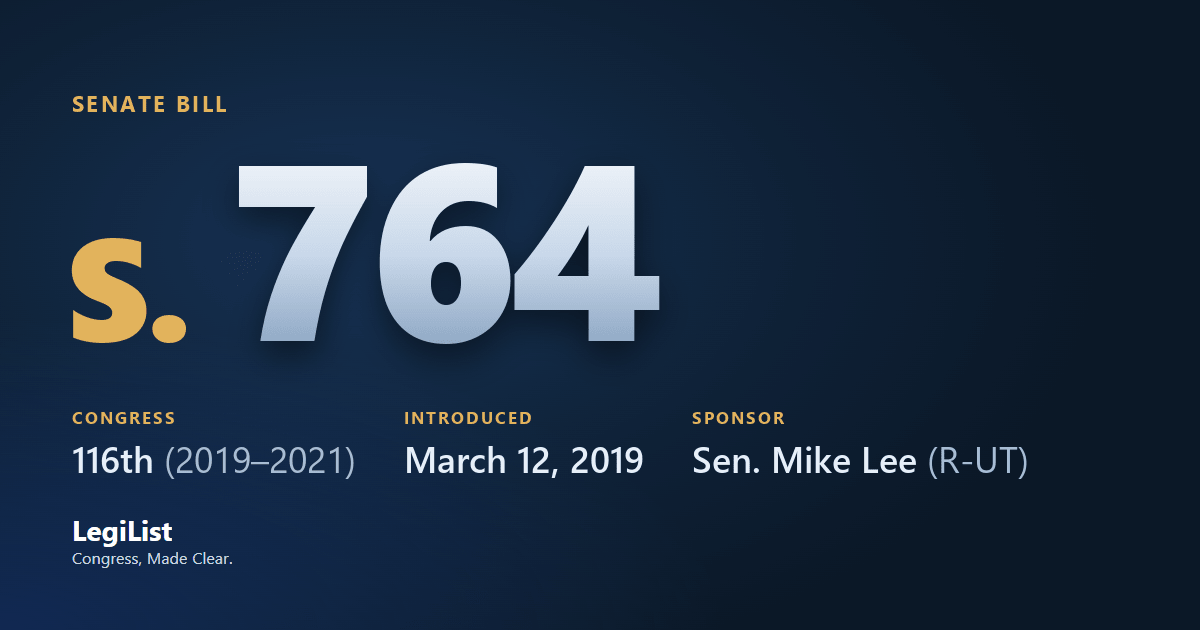
ARTICLE ONE Act
Latest action · Nov 18, 2019 Placed on Senate Legislative Calendar under General Orders. Calendar No. 307.
Progress
Where this bill reached, and when. A stage with no date was not reached; one that failed a vote and later carried shows the date it carried.
- IntroducedMar 12, 2019
- Passed SenateNot reached
- Passed HouseNot reached
- To the PresidentNot reached
- Became lawNot reached
Summary
Assuring that Robust, Thorough, and Informed Congressional Leadership is Exercised Over National Emergencies Act or the ARTICLE ONE Act
This bill sets forth procedures for a presidential declaration of a national emergency.
The President is authorized to declare a national emergency by proclamation. Such proclamation must be immediately transmitted to Congress and published in the Federal Register. The President must specify the emergency provisions of law being invoked.
If Congress does not approve the emergency declaration, the President may not declare an emergency with respect to the same circumstances for the remainder of the term of office.
A declaration of emergency shall remain in effect for 30 days from the issuance of the proclamation and shall terminate thereafter unless Congress enacts a joint resolution of approval. If Congress is unable to convene during the 30-day period, such period does not begin until the first day Congress convenes.
Unless otherwise terminated by the President or Congress, a declaration of national emergency shall terminate after one year unless it is renewed by the President and approved by a joint resolution of Congress.
The bill sets forth procedures for congressional review of declarations of national emergencies and excludes from such procedures certain national emergencies invoking the International Emergency Economic Powers Act (IEEPA).
The President shall (1) transmit specified information to Congress with any proclamation declaring or renewing a national emergency, including a description of the circumstances necessitating the declaration or renewal of a national emergency declaration and its estimated duration; and (2) report periodically on the status of the emergency.
The bill amends the IEEPA to prohibit the President from using any authorities of such Act to impose duties or tariff-rate quotas.
Cosponsors 19
Members who signed on, in the order they did. Signatures ran from Mar 12, 2019 to Sep 29, 2020; 14 are original cosponsors, there from the day it was introduced.
| Seat | Cosponsor | Signed on | |
|---|---|---|---|
| R-NE | Ben Sasse | Original | Mar 12, 2019 |
| R-IA | Chuck Grassley | Original | Mar 12, 2019 |
| R-KS | Jerry Moran | Original | Mar 12, 2019 |
| R-IA | Joni Ernst | Original | Mar 12, 2019 |
| R-TN | Lamar Alexander | Original | Mar 12, 2019 |
| R-UT | Mitt Romney | Original | Mar 12, 2019 |
| R-PA | Patrick J. Toomey | Original | Mar 12, 2019 |
| R-OH | Rob Portman | Original | Mar 12, 2019 |
| R-MS | Roger F. Wicker | Original | Mar 12, 2019 |
| R-WI | Ron Johnson | Original | Mar 12, 2019 |
| R-MO | Roy Blunt | Original | Mar 12, 2019 |
| R-TX | Ted Cruz | Original | Mar 12, 2019 |
| R-NC | Thom Tillis | Original | Mar 12, 2019 |
| R-IN | Todd Young | Original | Mar 12, 2019 |
| R-TX | John Cornyn | Mar 13, 2019 |
Committees 1
Where it was sent and what each committee and subcommittee did with it, in order.
| Chamber | Committee | What it did |
|---|---|---|
| Senate | Homeland Security and Governmental Affairs Committee | Referred Mar 12, 2019Markup Jul 24, 2019Reported Nov 18, 2019 |
Actions 5
Everything that happened, newest first.
- Nov 18, 2019Committee on Homeland Security and Governmental Affairs. Reported by Senator Johnson with an amendment in the nature of a substitute. With written report No. 116-159.
- Nov 18, 2019Placed on Senate Legislative Calendar under General Orders. Calendar No. 307.
- Jul 24, 2019Committee on Homeland Security and Governmental Affairs. Ordered to be reported with an amendment in the nature of a substitute favorably.
- Mar 12, 2019Introduced in Senate
- Mar 12, 2019Read twice and referred to the Committee on Homeland Security and Governmental Affairs.
In the Congressional Record 2
Days the Record’s own index lists this bill, newest first, with the pages and the members it names. Pages starting H are the House, S the Senate, E Extensions of Remarks.
| Where | In the Record | Members | Date |
|---|---|---|---|
| Senate | Debate and remarks S1863, S1868, S1879 | Chuck Grassley R-IA, John Cornyn R-TX, Patrick J. Leahy D-VT | Mar 14, 2019 |
| Senate | Debate and remarks S1815 | John Cornyn R-TX | Mar 13, 2019 |
Research
What has been written about this bill: committee reports, cost estimates, the sponsor’s authority statement, printed hearings and the Congressional Research Service’s work.
Committee report
Congressional Budget Office cost estimate
- Aug 16, 2019S. 764, ARTICLE ONE ActAs ordered reported by the Senate Committee on Homeland Security and Governmental Affairs on July 24, 2019
CRS reports 3
Congressional Research Service work that CRS links to this bill or the law it became, newest first.
Cite it 3
Products on other subjects that cite it, usually among other measures.
| Product | Title | Kind | Published |
|---|---|---|---|
| R45618 | The International Emergency Economic Powers Act: Origins, Evolution, and Use | Report | Sep 1, 2025 |
| IN11129 | The International Emergency Economic Powers Act (IEEPA), the National Emergencies Act (NEA), and Tariffs: Historical Background and Key Issues | Insight | Apr 7, 2025 |
| IN12488 | U.S. Petroleum Trade: Crude Oil Imports from Canada and Mexico and Potential Tariffs | Insight | Feb 3, 2025 |
Related bills 3
Companion bills and other measures the record links to this one.
| Bill | Title | Relationship | Latest action |
|---|---|---|---|
| S 241 | ARTICLE ONE Act | Reintroduced Bill | Feb 4, 2021 |
| HR 1755 | ARTICLE ONE Act | Identical bill | Mar 15, 2019 |
| S 1809 | REPUBLIC Act | Related bill | Jun 12, 2019 |
Titles 5
Every title it has carried, official and short, at each stage.
- Official Title as Introduced
- A bill to provide for congressional approval of national emergency declarations, and for other purposes.
- Short Title(s) as Introduced
- ARTICLE ONE Act
- Assuring that Robust, Thorough, and Informed Congressional Leadership is Exercised Over National Emergencies Act
- Short Title(s) as Reported to Senate
- ARTICLE ONE Act
- Assuring that Robust, Thorough, and Informed Congressional Leadership is Exercised Over National Emergencies Act
Subjects
Assigned by the Library of Congress. Policy area: Emergency Management.
Text 2
Each version as it was printed, newest first.
- Nov 18, 2019Reported to Senate
- Mar 12, 2019Introduced in Senate
Support LegiList
This page is free, carries no paywall, and is built and maintained by one person. If the record here is useful to you, a few dollars keeps it going.
Everything here is as published by Congress: the summary is the Congressional Research Service's, the action wording is the clerks', and the subjects are the Library of Congress's. How far it got is read from the actions themselves, taking the most recent one of each kind, so a bill that failed a vote and later passed is shown as having passed. Records come from this bill on Congress.gov and govinfo.gov; cost estimates are the Congressional Budget Office's, and the hearings are the printed hearings GovInfo publishes, which can appear months after the hearing.