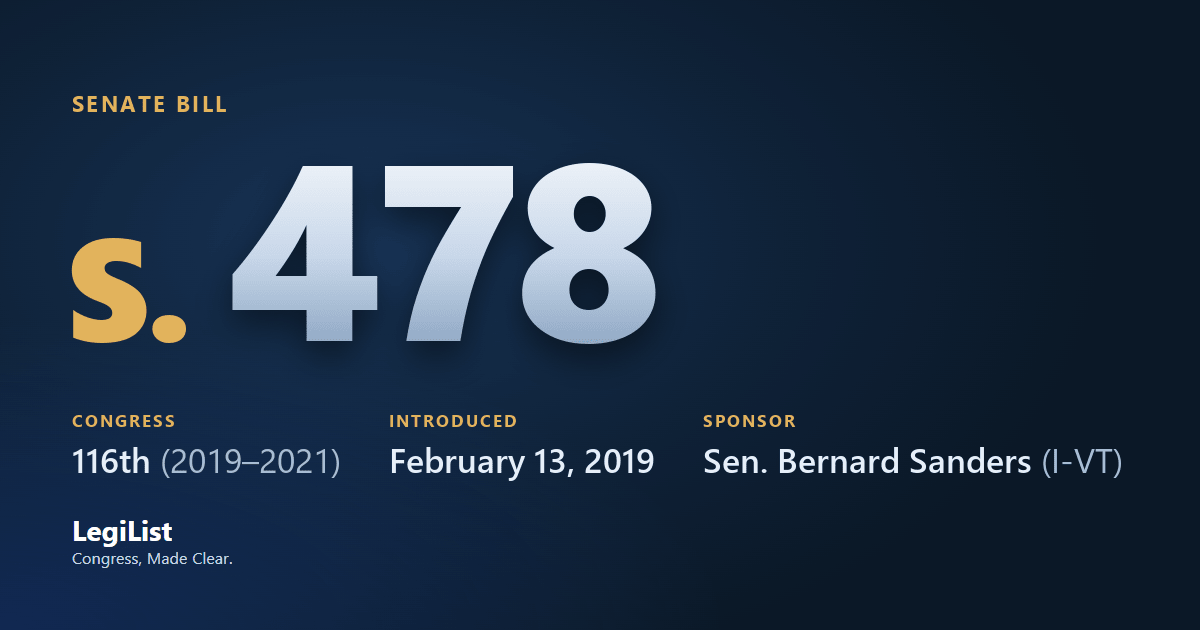
Social Security Expansion Act
Latest action · Feb 13, 2019 Read twice and referred to the Committee on Finance.
Progress
Where this bill reached, and when. A stage with no date was not reached; one that failed a vote and later carried shows the date it carried.
- IntroducedFeb 13, 2019
- Passed SenateNot reached
- Passed HouseNot reached
- To the PresidentNot reached
- Became lawNot reached
Summary
Social Security Expansion Act
This bill increases benefits and certain taxes related to Old-Age, Survivors, and Disability Insurance.
Changes to benefits include (1) increasing the primary insurance amount for certain beneficiaries; (2) revising the method of calculating cost-of-living adjustments; (3) establishing a new minimum benefit for certain low earners; and (4) allowing certain children of retired, deceased, or disabled workers to receive benefits until age 22 if they are a full-time students.
Changes to taxes include increasing the net investment income tax for certain taxpayers and extending payroll taxes on wages, salaries, and self-employment earnings to income above $250,000. Under current law, the maximum amount subject to the Social Security payroll tax is $132,900 for 2019.
The bill also combines the existing Federal Old-Age and Survivors Insurance Trust Fund and the Federal Disability Insurance Trust Fund into a single Social Security Trust Fund.
Cosponsors 4
Members who signed on, in the order they did. All signed on Feb 13, 2019.
| Seat | Cosponsor | Signed on | |
|---|---|---|---|
| D-NJ | Cory A. Booker | Original | Feb 13, 2019 |
| D-OR | Jeff Merkley | Original | Feb 13, 2019 |
| D-CA | Kamala D. Harris | Original | Feb 13, 2019 |
| D-NY | Kirsten E. Gillibrand | Original | Feb 13, 2019 |
Committees 1
Where it was sent and what each committee and subcommittee did with it, in order.
| Chamber | Committee | What it did |
|---|---|---|
| Senate | Finance Committee | Referred Feb 13, 2019 |
Actions 2
Everything that happened, newest first.
- Feb 13, 2019Introduced in Senate
- Feb 13, 2019Read twice and referred to the Committee on Finance.
Research
What has been written about this bill: committee reports, cost estimates, the sponsor’s authority statement, printed hearings and the Congressional Research Service’s work.
CRS reports 1
Congressional Research Service work that CRS links to this bill or the law it became, newest first.
Cite it 1
Products on other subjects that cite it, usually among other measures.
| Product | Title | Kind | Published |
|---|---|---|---|
| R46819 | Social Security: The Effects of Wage and Price Indexing on Benefits | Report | Jun 16, 2021 |
Related bills 2
Companion bills and other measures the record links to this one.
| Bill | Title | Relationship | Latest action |
|---|---|---|---|
| HR 1170 | Social Security Expansion Act | Related bill | Feb 14, 2019 |
| S 1950 | Strengthen Social Security by Taxing Dynastic Wealth Act | Related bill | Jun 25, 2019 |
Titles 2
Every title it has carried, official and short, at each stage.
- Official Title as Introduced
- A bill to enhance Social Security benefits and ensure the long-term solvency of the Social Security program.
- Short Title(s) as Introduced
- Social Security Expansion Act
Subjects
Assigned by the Library of Congress. Policy area: Social Welfare.
- Accounting and auditing
- Congressional oversight
- Disability assistance
- Elementary and secondary education
- Employment taxes
- Financial services and investments
- Government trust funds
- Higher education
- Income tax rates
- Inflation and prices
- Railroads
- Self-employed
- Social security and elderly assistance
- Social Welfare
- Transportation employees
Text 1
Each version as it was printed, newest first.
- Feb 13, 2019Introduced in Senate
Everything here is as published by Congress: the summary is the Congressional Research Service's, the action wording is the clerks', and the subjects are the Library of Congress's. How far it got is read from the actions themselves, taking the most recent one of each kind, so a bill that failed a vote and later passed is shown as having passed. Records come from this bill on Congress.gov and govinfo.gov; cost estimates are the Congressional Budget Office's, and the hearings are the printed hearings GovInfo publishes, which can appear months after the hearing.