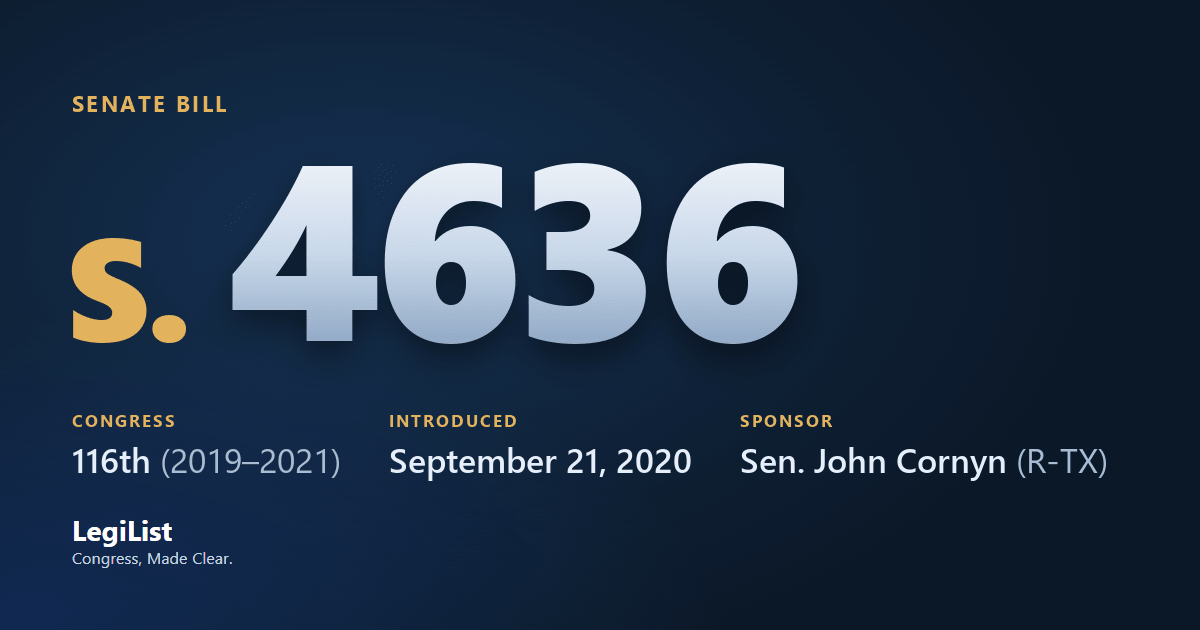
GRACE Act
Latest action · Sep 21, 2020 Read twice and referred to the Committee on Banking, Housing, and Urban Affairs.
Progress
Where this bill reached, and when. A stage with no date was not reached; one that failed a vote and later carried shows the date it carried.
- IntroducedSep 21, 2020
- Passed SenateNot reached
- Passed HouseNot reached
- To the PresidentNot reached
- Became lawNot reached
Summary
Giving Relief to American Communities in Emergencies Act or the GRACE Act
This bill extends authority through FY2022 for the Department of Transportation (DOT) to distribute formula funding for certain programs using the 2000 Census for areas that lost their urbanized area designation because their population fell below 50,000 after the 2000 census as a result of a major disaster.
Upon request by a state in which an urbanized area that experiences a disaster-related population decrease is located, DOT may elect for purposes of the public transportation emergency relief program to (1) use the population of such area, as determined in the decennial census before the most recent decennial census; and (2) continue to treat the area as an urbanized area.
Cosponsors 2
Members who signed on, in the order they did. All signed on Sep 21, 2020.
| Seat | Cosponsor | Signed on | |
|---|---|---|---|
| D-VA | Mark R. Warner | Original | Sep 21, 2020 |
| D-VA | Tim Kaine | Original | Sep 21, 2020 |
Actions 2
Everything that happened, newest first.
- Sep 21, 2020Introduced in Senate
- Sep 21, 2020Read twice and referred to the Committee on Banking, Housing, and Urban Affairs.
Subjects
Assigned by the Library of Congress. Policy area: Transportation and Public Works.
Text 1
Each version as it was printed, newest first.
- Sep 21, 2020Introduced in Senate
Everything here is as published by Congress: the summary is the Congressional Research Service's, the action wording is the clerks', and the subjects are the Library of Congress's. How far it got is read from the actions themselves, taking the most recent one of each kind, so a bill that failed a vote and later passed is shown as having passed. Records come from this bill on Congress.gov and govinfo.gov.