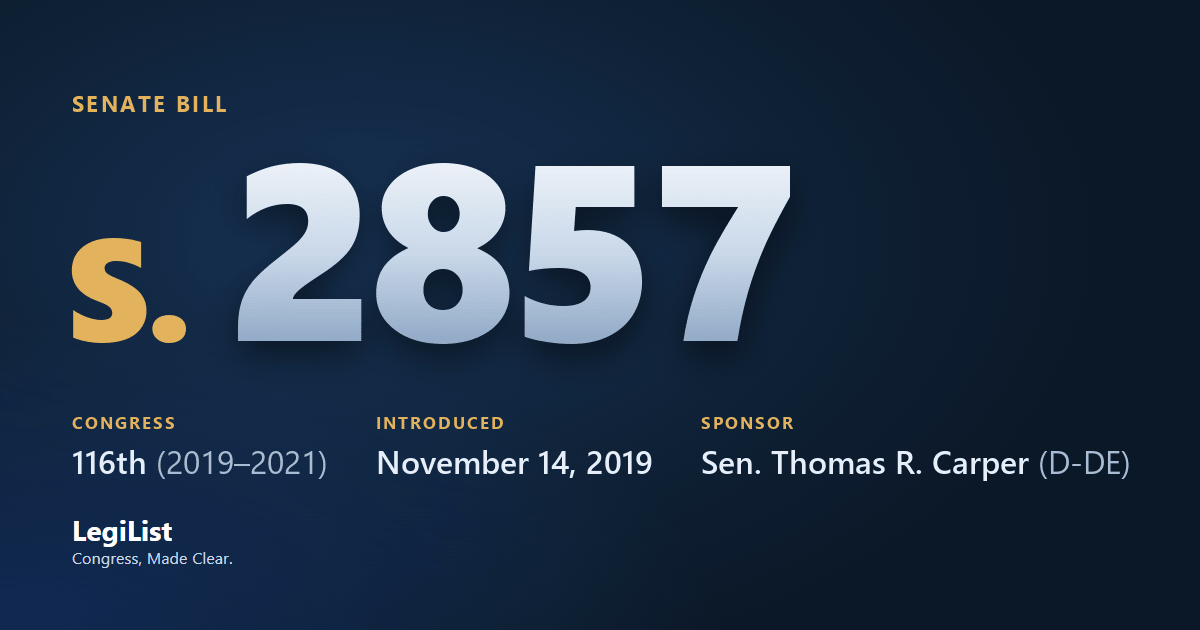
Protect Veterans' Education and Taxpayer Spending Act of 2019
Latest action · Nov 14, 2019 Read twice and referred to the Committee on Health, Education, Labor, and Pensions.
Progress
Where this bill reached, and when. A stage with no date was not reached; one that failed a vote and later carried shows the date it carried.
- IntroducedNov 14, 2019
- Passed SenateNot reached
- Passed HouseNot reached
- To the PresidentNot reached
- Became lawNot reached
Summary
Protect Veterans' Education and Taxpayer Spending Act of 2019
This bill designates certain educational assistance funds as federal educational assistance for the purpose of determining a for-profit institution's revenue sources.
Under current law, a for-profit institution must receive at least 10% of its revenue from non-federal sources (known as the 90/10 Rule). Certain federal educational assistance funds provided to students who are servicemembers or veterans are not currently counted as federal sources, which enables a for-profit institution to count those funds towards its 10% requirement.
This bill designates such educational assistance funds as federal educational assistance, prohibiting a for-profit institution from counting such funds towards its 10% requirement. In addition, the bill establishes a tiered system of penalties for a school that violates the 90/10 Rule, but it also provides an appeal process that allows a for-profit institution to seek temporary relief from such penalties upon a showing that it meets certain conditions (e.g., offering high-quality academic or job-training programs and placing veterans and servicemembers in jobs after graduation).
The bill also requires disclosure—on the Department of Education's College Navigator website and the Department of Veterans Affairs' GI Bill Comparison Tool website—of any for-profit institution that is not in compliance, as well as the applicable sanction on such institution.
Lastly, any for-profit institution that converts to nonprofit status shall be subject to the 90/10 Rule for the two-year period after the date of conversion.
Cosponsors 5
Members who signed on, in the order they did. Signatures ran from Nov 14, 2019 to Dec 3, 2019; 3 are original cosponsors, there from the day it was introduced.
| Seat | Cosponsor | Signed on | |
|---|---|---|---|
| R-LA | Bill Cassidy | Original | Nov 14, 2019 |
| R-OK | James Lankford | Original | Nov 14, 2019 |
| D-MT | Jon Tester | Original | Nov 14, 2019 |
| D-CT | Richard Blumenthal | Dec 3, 2019 | |
| R-OH | Rob Portman | Dec 3, 2019 |
Committees 1
Where it was sent and what each committee and subcommittee did with it, in order.
| Chamber | Committee | What it did |
|---|---|---|
| Senate | Health, Education, Labor, and Pensions Committee | Referred Nov 14, 2019 |
Actions 2
Everything that happened, newest first.
- Nov 14, 2019Introduced in Senate
- Nov 14, 2019Read twice and referred to the Committee on Health, Education, Labor, and Pensions.
Research
What has been written about this bill: committee reports, cost estimates, the sponsor’s authority statement, printed hearings and the Congressional Research Service’s work.
Printed hearings 1
Hearings whose printed record names this bill, newest first: hearings on it, and wider hearings where it came up.
| Number | Hearing | Committee | Held |
|---|---|---|---|
| Serial No. 116-54 | PENDING LEGISLATION71 pages | Veterans' Affairs Committee | Feb 6, 2020 |
Titles 2
Every title it has carried, official and short, at each stage.
- Official Title as Introduced
- A bill to amend the Higher Education Act of 1965 to count military and veterans education benefits as Federal educational assistance, and for other purposes.
- Short Title(s) as Introduced
- Protect Veterans' Education and Taxpayer Spending Act of 2019
Subjects
Assigned by the Library of Congress. Policy area: Education.
- Administrative remedies
- Congressional oversight
- Consumer affairs
- Department of Education
- Education
- Education programs funding
- Government information and archives
- Higher education
- Medical education
- Military personnel and dependents
- National Guard and reserves
- School administration
- Student aid and college costs
- Veterans' education, employment, rehabilitation
Text 1
Each version as it was printed, newest first.
- Nov 14, 2019Introduced in Senate
Support LegiList
This page is free, carries no paywall, and is built and maintained by one person. If the record here is useful to you, a few dollars keeps it going.
Everything here is as published by Congress: the summary is the Congressional Research Service's, the action wording is the clerks', and the subjects are the Library of Congress's. How far it got is read from the actions themselves, taking the most recent one of each kind, so a bill that failed a vote and later passed is shown as having passed. Records come from this bill on Congress.gov and govinfo.gov; cost estimates are the Congressional Budget Office's, and the hearings are the printed hearings GovInfo publishes, which can appear months after the hearing.