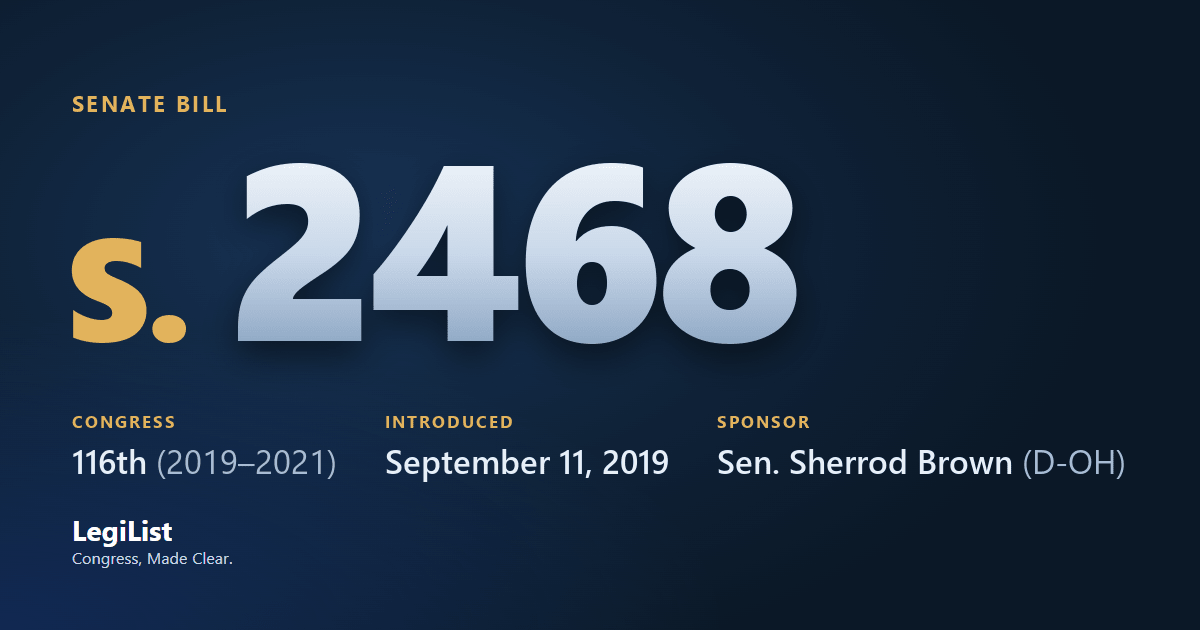
Workers' Right to Training Act
Latest action · Sep 11, 2019 Read twice and referred to the Committee on Finance.
Progress
Where this bill reached, and when. A stage with no date was not reached; one that failed a vote and later carried shows the date it carried.
- IntroducedSep 11, 2019
- Passed SenateNot reached
- Passed HouseNot reached
- To the PresidentNot reached
- Became lawNot reached
Summary
Workers' Right to Training Act
This bill requires employers implementing new technology that is expected to result in the loss of, or changes to, employment positions to notify affected employees about the new technology, negotiate with affected employees about how the new technology can incorporate their skills and roles, and provide affected employees with relevant on-the-job training.
Cosponsors
Members who signed on, in the order they did.
Committees 1
Where it was sent and what each committee and subcommittee did with it, in order.
| Chamber | Committee | What it did |
|---|---|---|
| Senate | Finance Committee | Referred Sep 11, 2019 |
Actions 2
Everything that happened, newest first.
- Sep 11, 2019Introduced in Senate
- Sep 11, 2019Read twice and referred to the Committee on Finance.
Related bills 1
Companion bills and other measures the record links to this one.
| Bill | Title | Relationship | Latest action |
|---|---|---|---|
| HR 8977 | Workers' Right to Training Act | Identical bill | Dec 16, 2020 |
Titles 2
Every title it has carried, official and short, at each stage.
- Official Title as Introduced
- A bill to require employers to provide training to employees whose jobs are in danger of being changed or replaced due to technology, and for other purposes.
- Short Title(s) as Introduced
- Workers' Right to Training Act
Subjects
Assigned by the Library of Congress. Policy area: Labor and Employment.
- Advanced technology and technological innovations
- Civil actions and liability
- Commuting
- Employee benefits and pensions
- Employee hiring
- Employment and training programs
- Higher education
- Industrial policy and productivity
- Labor and Employment
- Labor standards
- Labor-management relations
- Legal fees and court costs
- Licensing and registrations
- Unemployment
- Wages and earnings
Text 1
Each version as it was printed, newest first.
- Sep 11, 2019Introduced in Senate
Everything here is as published by Congress: the summary is the Congressional Research Service's, the action wording is the clerks', and the subjects are the Library of Congress's. How far it got is read from the actions themselves, taking the most recent one of each kind, so a bill that failed a vote and later passed is shown as having passed. Records come from this bill on Congress.gov and govinfo.gov; cost estimates are the Congressional Budget Office's, and the hearings are the printed hearings GovInfo publishes, which can appear months after the hearing.