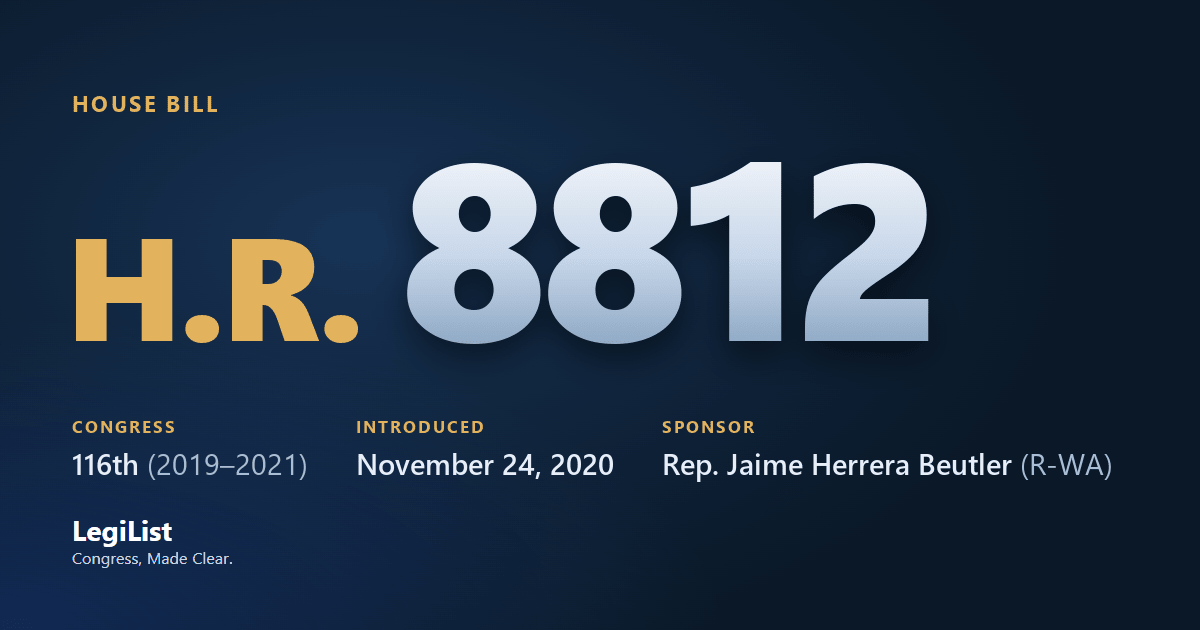
Relief for Working Families Act of 2020
Latest action · Nov 24, 2020 Referred to the House Committee on Ways and Means.
Progress
Where this bill reached, and when. A stage with no date was not reached; one that failed a vote and later carried shows the date it carried.
- IntroducedNov 24, 2020
- Passed HouseNot reached
- Passed SenateNot reached
- To the PresidentNot reached
- Became lawNot reached
Summary
Relief for Working Families Act of 2020
This bill directs a state to require a recipient of Pandemic Unemployment Assistance to repay any overpayment of such assistance to the state agency unless the overpayment of such assistance was without fault on the part of any such individual, and such repayment would be contrary to equity and good conscience.
Cosponsors 12
Members who signed on, in the order they did. Signatures ran from Nov 24, 2020 to Dec 17, 2020; 1 is an original cosponsor, there from the day it was introduced.
| Seat | Cosponsor | Signed on | |
|---|---|---|---|
| D-FL | Stephanie N. Murphy | Original | Nov 24, 2020 |
| D-FL | Alcee L. Hastings | Dec 4, 2020 | |
| D-WA | Kim Schrier | Dec 7, 2020 | |
| D-NV | Steven Horsford | Dec 9, 2020 | |
| D-OH | Tim Ryan | Dec 9, 2020 | |
| D-WA | Derek Kilmer | Dec 10, 2020 | |
| D-WA | Adam Smith | Dec 16, 2020 | |
| D-IL | Bradley Scott Schneider | Dec 16, 2020 | |
| D-AZ | Raúl M. Grijalva | Dec 16, 2020 | |
| D-TN | Steve Cohen | Dec 16, 2020 | |
| D-PA | Susan Wild | Dec 16, 2020 | |
| D-DC | Eleanor Holmes Norton | Dec 17, 2020 |
Committees 1
Where it was sent and what each committee and subcommittee did with it, in order.
| Chamber | Committee | What it did |
|---|---|---|
| House | Ways and Means Committee | Referred Nov 24, 2020 |
Actions 2
Everything that happened, newest first.
- Nov 24, 2020Introduced in House
- Nov 24, 2020Referred to the House Committee on Ways and Means.
Research
What has been written about this bill: committee reports, cost estimates, the sponsor’s authority statement, printed hearings and the Congressional Research Service’s work.
Constitutional authority
The sponsor’s statement, as printed in the Congressional Record, vol. 166, no. 199, November 24, 2020, page H6019.
CRS reports 1
Congressional Research Service work that CRS links to this bill or the law it became, newest first.
Cite it 1
Products on other subjects that cite it, usually among other measures.
| Product | Title | Kind | Published |
|---|---|---|---|
| R45478 | Unemployment Insurance: Legislative Issues in the 116th Congress | Report | Mar 8, 2021 |
Related bills 8
Companion bills and other measures the record links to this one.
| Bill | Title | Relationship | Latest action |
|---|---|---|---|
| HR 133 | Consolidated Appropriations Act, 2021 | Related bill | Dec 27, 2020 |
| HR 925 | The Heroes Act | Related bill | Oct 1, 2020 |
| S 4771 | Continued Assistance to Unemployed Workers Act of 2020 | Related bill | Sep 30, 2020 |
| S 4800 | The Heroes Act | Related bill | Nov 9, 2020 |
| S 4935 | American Worker Holiday Relief Act of 2020 | Related bill | Dec 1, 2020 |
| S 5037 | Relief for Working Families Act of 2020 | Related bill | Dec 16, 2020 |
| HR 7762 | Back on Your Feet Act of 2020 | Related bill | Jul 23, 2020 |
| HR 8406 | Making emergency supplemental appropriations for the fiscal year ending September 30, 2021, and for other purposes. | Related bill | Sep 29, 2020 |
Titles 2
Every title it has carried, official and short, at each stage.
- Official Title as Introduced
- To amend subtitle A of title II of division A of the CARES Act to provide a hardship waiver for certain overpayments of Pandemic Unemployment Assistance.
- Short Title(s) as Introduced
- Relief for Working Families Act of 2020
Subjects
Assigned by the Library of Congress. Policy area: Labor and Employment.
Text 1
Each version as it was printed, newest first.
- Nov 24, 2020Introduced in House
Everything here is as published by Congress: the summary is the Congressional Research Service's, the action wording is the clerks', and the subjects are the Library of Congress's. How far it got is read from the actions themselves, taking the most recent one of each kind, so a bill that failed a vote and later passed is shown as having passed. Records come from this bill on Congress.gov and govinfo.gov; cost estimates are the Congressional Budget Office's, and the hearings are the printed hearings GovInfo publishes, which can appear months after the hearing.