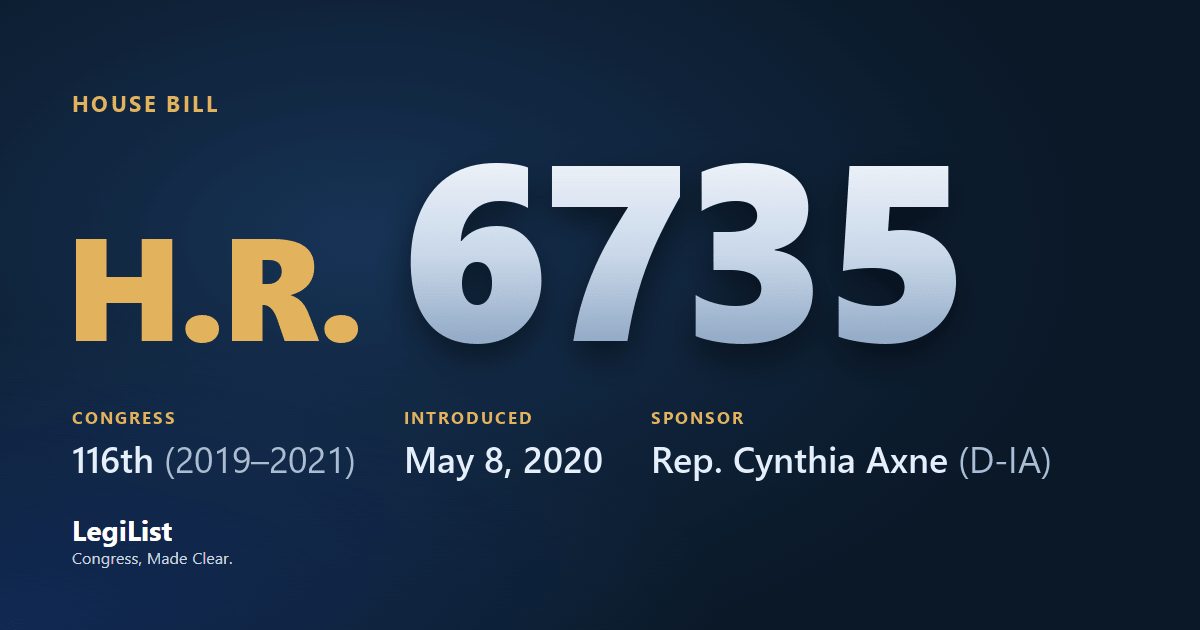
COVID–19 Fraud Prevention Act
Latest action · Sep 22, 2020 Received in the Senate and Read twice and referred to the Committee on Banking, Housing, and Urban Affairs.
Progress
Where this bill reached, and when. A stage with no date was not reached; one that failed a vote and later carried shows the date it carried.
- IntroducedMay 8, 2020
- Passed HouseSep 21, 2020
- Passed SenateNot reached
- To the PresidentNot reached
- Became lawNot reached
Summary
COVID-19 Fraud Prevention Act
This bill establishes the Consumer and Investor Fraud Working Group to prevent fraud during the COVID-19 (i.e., coronavirus disease 2019) pandemic. The working group must report quarterly regarding resources available to consumers, public enforcement actions, and related consumer complaints.
Cosponsors 1
Members who signed on, in the order they did. All signed on May 8, 2020.
| Seat | Cosponsor | Signed on | |
|---|---|---|---|
| D-CA | Maxine Waters | Original | May 8, 2020 |
Committees 2
Where it was sent and what each committee and subcommittee did with it, in order.
| Chamber | Committee | What it did |
|---|---|---|
| House | Financial Services Committee | Referred May 8, 2020 |
| Senate | Banking, Housing, and Urban Affairs Committee | Referred Sep 22, 2020 |
Actions 8
Everything that happened, newest first.
- Sep 22, 2020Received in the Senate and Read twice and referred to the Committee on Banking, Housing, and Urban Affairs.
- Sep 21, 2020Mr. Sherman moved to suspend the rules and pass the bill, as amended.
- Sep 21, 2020Considered under suspension of the rules. (consideration: CR H4605-4606)
- Sep 21, 2020DEBATE - The House proceeded with forty minutes of debate on H.R. 6735.
- Sep 21, 2020Passed/agreed to in House: On motion to suspend the rules and pass the bill, as amended Agreed to by voice vote. (text: CR H4605)
In the Congressional Record 2
Days the Record’s own index lists this bill, newest first, with the pages and the members it names. Pages starting H are the House, S the Senate, E Extensions of Remarks.
| Where | In the Record | Members | Date |
|---|---|---|---|
| House | Debate and remarks H4605, H4606Text printed H4605Notices H4639Estimated budget effects of H.R. 6735, COVID–19 Fraud Prevention Act | Brad Sherman D-CA, John A. Yarmuth D-KY, William R. Timmons IV R-SC | Sep 21, 2020 |
| House | Lists H1985–H1987H.R. 6735–6798 | — | May 8, 2020 |
Research
What has been written about this bill: committee reports, cost estimates, the sponsor’s authority statement, printed hearings and the Congressional Research Service’s work.
Constitutional authority
The sponsor’s statement, as printed in the Congressional Record, vol. 166, no. 87, May 8, 2020, page H1985.
Titles 4
Every title it has carried, official and short, at each stage.
- Official Title as Introduced
- To establish the Consumer and Investor Fraud Working Group to help protect consumers and investors from fraud during the COVID-19 pandemic, to assist consumers and investors affected by such fraud, and for other purposes.
- Short Title(s) as Introduced
- COVID–19 Fraud Prevention Act
- Short Title(s) as Passed House
- COVID–19 Fraud Prevention Act
- Short Titles from RFS (Referred to Senate) bill text
- COVID–19 Fraud Prevention Act
Subjects
Assigned by the Library of Congress. Policy area: Finance and Financial Sector.
- Cardiovascular and respiratory health
- Congressional oversight
- Consumer affairs
- Consumer Financial Protection Bureau
- Emergency medical services and trauma care
- Executive agency funding and structure
- Finance and Financial Sector
- Financial services and investments
- Fraud offenses and financial crimes
- Government information and archives
- Infectious and parasitic diseases
- Lawyers and legal services
- Securities and Exchange Commission (SEC)
Text 3
Each version as it was printed, newest first.
- Sep 22, 2020Referred in Senate
- Sep 21, 2020Engrossed in House
- May 8, 2020Introduced in House
Support LegiList
This page is free, carries no paywall, and is built and maintained by one person. If the record here is useful to you, a few dollars keeps it going.
Everything here is as published by Congress: the summary is the Congressional Research Service's, the action wording is the clerks', and the subjects are the Library of Congress's. How far it got is read from the actions themselves, taking the most recent one of each kind, so a bill that failed a vote and later passed is shown as having passed. Records come from this bill on Congress.gov and govinfo.gov; cost estimates are the Congressional Budget Office's, and the hearings are the printed hearings GovInfo publishes, which can appear months after the hearing.