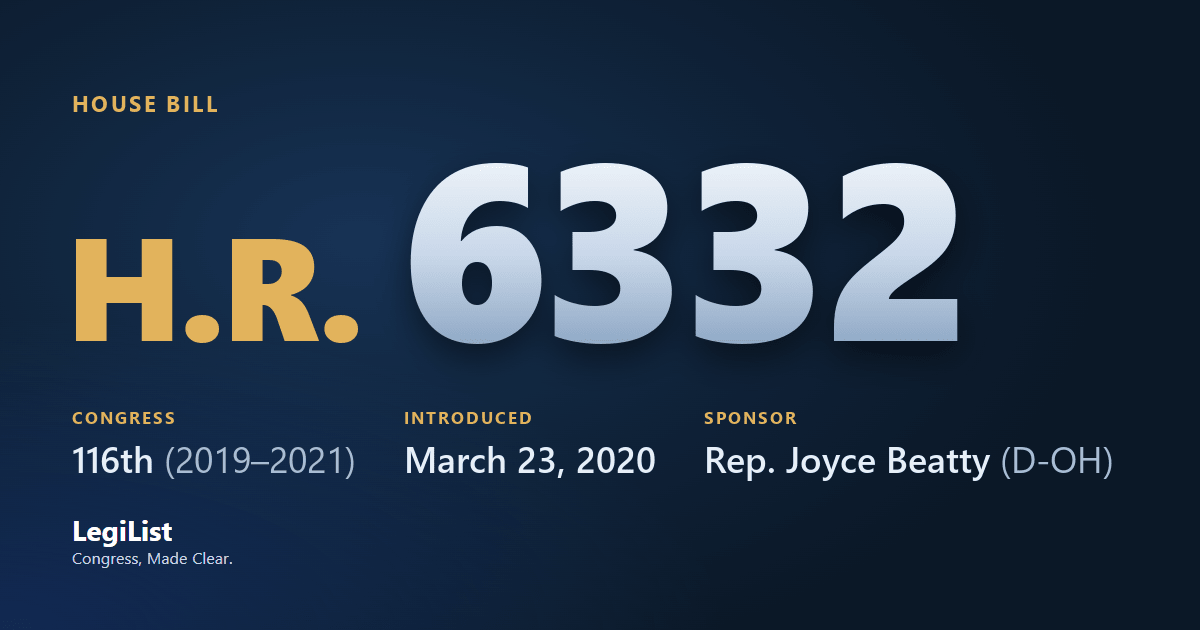
Relief for Consumers During COVID–19 Act of 2020
Latest action · Mar 23, 2020 Referred to the House Committee on Financial Services.
Progress
Where this bill reached, and when. A stage with no date was not reached; one that failed a vote and later carried shows the date it carried.
- IntroducedMar 23, 2020
- Passed HouseNot reached
- Passed SenateNot reached
- To the PresidentNot reached
- Became lawNot reached
Summary
Relief for Consumers During COVID-19 Act of 2020
This bill places restrictions on the collection of consumer debts during the COVID-19 (i.e., coronavirus disease 2019) emergency period. Among other things, debt collectors may not during such a period
- enforce a security interest through a repossession or foreclosure,
- commence or continue litigation to collect a debt,
- terminate utility service,
- seize assets,
- commence or continue an eviction, or
- charge fees or apply a higher interest rate as a result of nonpayment.
After such a period, debt collectors must provide certain repayment options including extending the repayment period for debts.
Violations of these provisions are subject to civil enforcement.
The Federal Reserve Board must establish a facility to compensate financial institutions for losses caused by the suspension of payments.
Cosponsors 1
Members who signed on, in the order they did. All signed on May 5, 2020.
| Seat | Cosponsor | Signed on | |
|---|---|---|---|
| D-CA | Maxine Waters | May 5, 2020 |
Committees 1
Where it was sent and what each committee and subcommittee did with it, in order.
| Chamber | Committee | What it did |
|---|---|---|
| House | Financial Services Committee | Referred Mar 23, 2020 |
Actions 2
Everything that happened, newest first.
- Mar 23, 2020Introduced in House
- Mar 23, 2020Referred to the House Committee on Financial Services.
Research
What has been written about this bill: committee reports, cost estimates, the sponsor’s authority statement, printed hearings and the Congressional Research Service’s work.
Constitutional authority
The sponsor’s statement, as printed in the Congressional Record, vol. 166, no. 57, March 23, 2020, page H1717.
Related bills 3
Companion bills and other measures the record links to this one.
| Bill | Title | Relationship | Latest action |
|---|---|---|---|
| HR 6321 | Financial Protections and Assistance for America’s Consumers, States, Businesses, and Vulnerable Populations Act | Related bill | Mar 23, 2020 |
| HR 6361 | Relief for Small Businesses and Nonprofits Act | Related bill | Mar 23, 2020 |
| HR 6379 | Workforce Emergency Response Act of 2020 | Related bill | Mar 23, 2020 |
Titles 2
Every title it has carried, official and short, at each stage.
- Official Title as Introduced
- To suspend payments on certain consumer loans during the COVID-19 emergency, and for other purposes.
- Short Title(s) as Introduced
- Relief for Consumers During COVID–19 Act of 2020
Subjects
Assigned by the Library of Congress. Policy area: Finance and Financial Sector.
- Alternative dispute resolution, mediation, arbitration
- Bank accounts, deposits, capital
- Cardiovascular and respiratory health
- Civil actions and liability
- Consumer credit
- Debt collection
- Emergency medical services and trauma care
- Executive agency funding and structure
- Federal Reserve System
- Finance and Financial Sector
- Foreign language and bilingual programs
- Infectious and parasitic diseases
- Interest, dividends, interest rates
- Landlord and tenant
- Postal service
- Public utilities and utility rates
- Telephone and wireless communication
- Wages and earnings
Text 1
Each version as it was printed, newest first.
- Mar 23, 2020Introduced in House
Support LegiList
This page is free, carries no paywall, and is built and maintained by one person. If the record here is useful to you, a few dollars keeps it going.
Everything here is as published by Congress: the summary is the Congressional Research Service's, the action wording is the clerks', and the subjects are the Library of Congress's. How far it got is read from the actions themselves, taking the most recent one of each kind, so a bill that failed a vote and later passed is shown as having passed. Records come from this bill on Congress.gov and govinfo.gov; cost estimates are the Congressional Budget Office's, and the hearings are the printed hearings GovInfo publishes, which can appear months after the hearing.