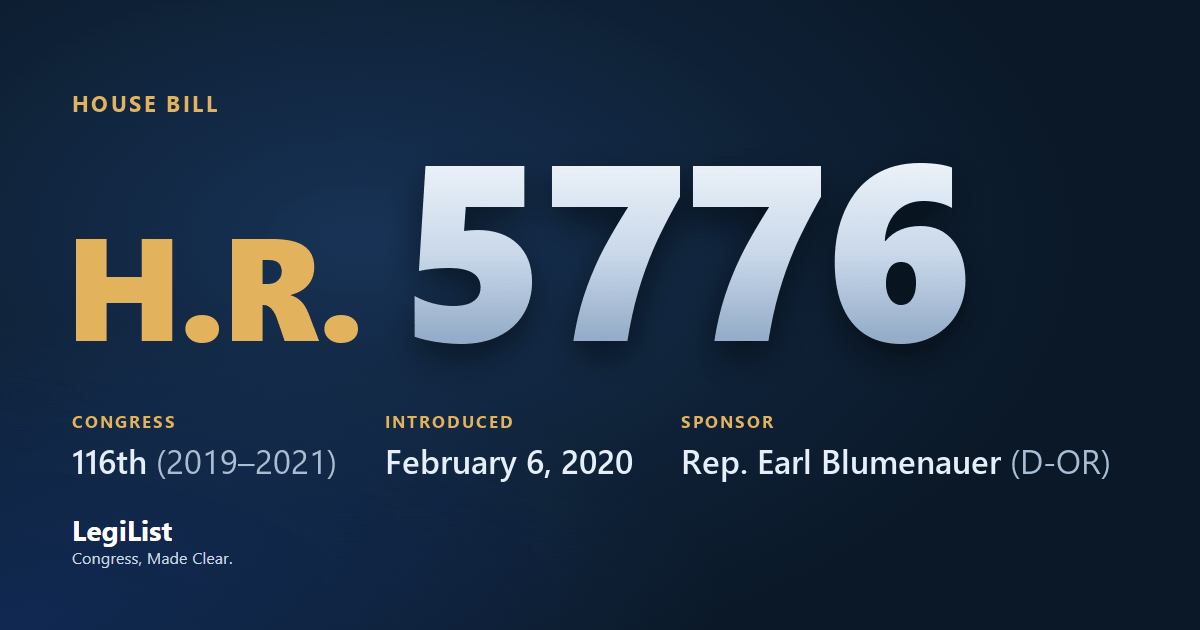
Repeatedly Flooded Communities Preparation Act
Latest action · Feb 6, 2020 Referred to the House Committee on Financial Services.
Progress
Where this bill reached, and when. A stage with no date was not reached; one that failed a vote and later carried shows the date it carried.
- IntroducedFeb 6, 2020
- Passed HouseNot reached
- Passed SenateNot reached
- To the PresidentNot reached
- Became lawNot reached
Summary
Repeatedly Flooded Communities Preparation Act
This bill requires a community that participates in the National Flood Insurance Program and has been repeatedly flooded, as specified by the bill, to (1) assess the continuing risks to community areas repeatedly damaged by floods; and (2) develop and implement a publicly available, community-specific plan for mitigating continuing flood risks to such areas.
The Federal Emergency Management Agency (FEMA) must, upon request, provide a community with appropriate data to assist in preparation of the required plan.
In making decisions with respect to awarding flood risk mitigation grants, FEMA may consider the extent to which a community has complied with these requirements and is working to remedy problems with repeatedly flooded areas.
A community that does not comply with these requirements may be subject to appropriate sanctions.
Cosponsors 9
Members who signed on, in the order they did. Signatures ran from Feb 6, 2020 to Aug 14, 2020; 3 are original cosponsors, there from the day it was introduced.
| Seat | Cosponsor | Signed on | |
|---|---|---|---|
| R-MO | Ann Wagner | Original | Feb 6, 2020 |
| D-UT | Ben McAdams | Original | Feb 6, 2020 |
| R-TN | David Kustoff | Original | Feb 6, 2020 |
| R-PA | Brian K. Fitzpatrick | Feb 26, 2020 | |
| R-SC | Joe Wilson | Feb 27, 2020 | |
| R-TN | John W. Rose | Feb 27, 2020 | |
| D-CA | Scott H. Peters | Mar 2, 2020 | |
| D-WI | Ron Kind | May 15, 2020 | |
| R-MN | Tom Emmer | Aug 14, 2020 |
Committees 1
Where it was sent and what each committee and subcommittee did with it, in order.
| Chamber | Committee | What it did |
|---|---|---|
| House | Financial Services Committee | Referred Feb 6, 2020 |
Actions 2
Everything that happened, newest first.
- Feb 6, 2020Introduced in House
- Feb 6, 2020Referred to the House Committee on Financial Services.
Research
What has been written about this bill: committee reports, cost estimates, the sponsor’s authority statement, printed hearings and the Congressional Research Service’s work.
Constitutional authority
The sponsor’s statement, as printed in the Congressional Record, vol. 166, no. 25, February 6, 2020, page H936.
Related bills 2
Companion bills and other measures the record links to this one.
| Bill | Title | Relationship | Latest action |
|---|---|---|---|
| HR 1797 | Repeatedly Flooded Communities Preparation Act | Reintroduced Bill | Mar 11, 2021 |
| S 2088 | Repeatedly Flooded Communities Preparation Act | Related bill | Jul 11, 2019 |
Titles 2
Every title it has carried, official and short, at each stage.
- Official Title as Introduced
- To amend the National Flood Insurance Act of 1968 to ensure community accountability for areas repetitively damaged by floods, and for other purposes.
- Short Title(s) as Introduced
- Repeatedly Flooded Communities Preparation Act
Subjects
Assigned by the Library of Congress. Policy area: Finance and Financial Sector.
- Administrative law and regulatory procedures
- Congressional oversight
- Department of Homeland Security
- Disaster relief and insurance
- Emergency planning and evacuation
- Federal Emergency Management Agency (FEMA)
- Finance and Financial Sector
- Floods and storm protection
- Government information and archives
Text 1
Each version as it was printed, newest first.
- Feb 6, 2020Introduced in House
Support LegiList
This page is free, carries no paywall, and is built and maintained by one person. If the record here is useful to you, a few dollars keeps it going.
Everything here is as published by Congress: the summary is the Congressional Research Service's, the action wording is the clerks', and the subjects are the Library of Congress's. How far it got is read from the actions themselves, taking the most recent one of each kind, so a bill that failed a vote and later passed is shown as having passed. Records come from this bill on Congress.gov and govinfo.gov; cost estimates are the Congressional Budget Office's, and the hearings are the printed hearings GovInfo publishes, which can appear months after the hearing.