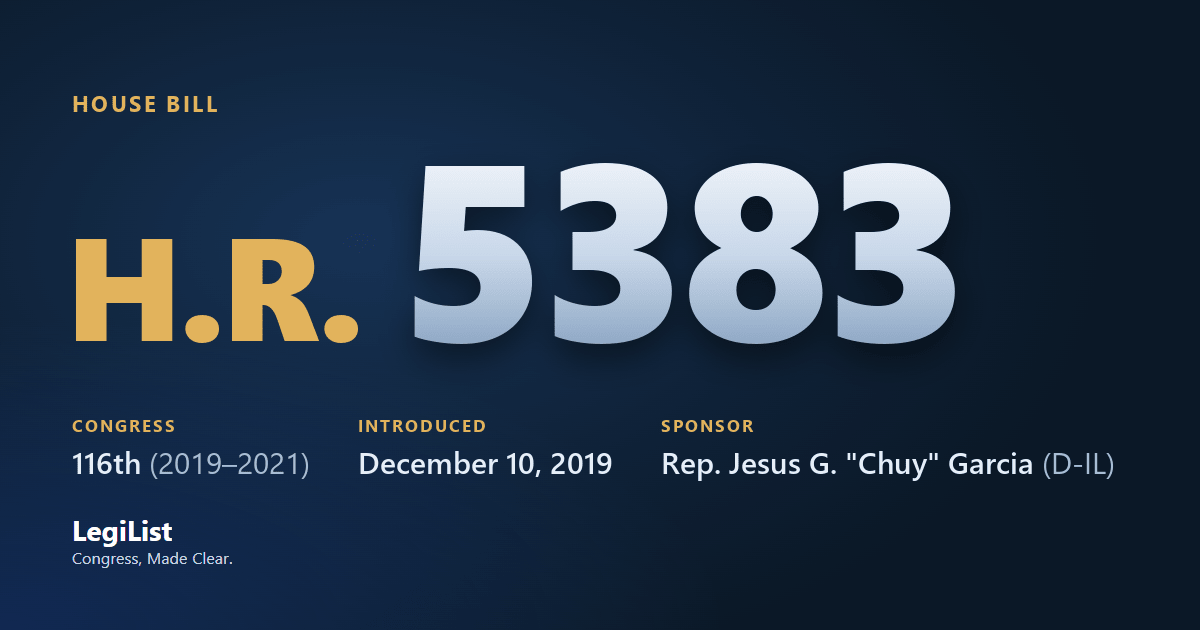
New Way Forward Act
Latest action · Jan 30, 2020 Referred to the Subcommittee on Immigration and Citizenship.
Progress
Where this bill reached, and when. A stage with no date was not reached; one that failed a vote and later carried shows the date it carried.
- IntroducedDec 10, 2019
- Passed HouseNot reached
- Passed SenateNot reached
- To the PresidentNot reached
- Became lawNot reached
Summary
New Way Forward Act
This bill makes changes to immigration enforcement, including ending mandatory detention in certain cases.
The Department of Homeland Security (DHS) shall not enter into or extend any contract with any public or private for-profit entity to own or operate a facility to detain aliens in DHS custody.
The bill provides for various protections related to detaining aliens, such as (1) requiring DHS to make an initial custody determination and establish probable cause within 48 hours of taking an alien into custody, (2) establishing in hearings related to such determinations a presumption that the alien be released, and (3) requiring immigration judges to impose the least restrictive detention conditions necessary.
A DHS officer may not interrogate a person as to immigration status based on factors such as the person's race, religion, sexual orientation, or spoken language.
The bill removes mandatory detention requirements for certain aliens, such as asylum seekers with a credible fear of persecution.
Removal proceedings against certain aliens previously admitted into the United States must commence within five years of the alien becoming deportable or inadmissible. The bill also removes certain crime-related grounds of inadmissibility and deportability.
The bill gives immigration judges discretion to provide relief from removal if the removal is not based on certain crime-related grounds.
State or local officers are prohibited from performing certain immigration enforcement functions, such as apprehending aliens. The National Crime Information Center database shall not contain an alien's immigration information.
The bill repeals provisions providing criminal penalties for improper entry or reentry into the United States.
Cosponsors 44
Members who signed on, in the order they did. Signatures ran from Dec 10, 2019 to Feb 10, 2020; 34 are original cosponsors, there from the day it was introduced.
| Seat | Cosponsor | Signed on | |
|---|---|---|---|
| D-NY | Adriano Espaillat | Original | Dec 10, 2019 |
| D-NY | Alexandria Ocasio-Cortez | Original | Dec 10, 2019 |
| D-MD | Anthony G. Brown | Original | Dec 10, 2019 |
| D-MA | Ayanna Pressley | Original | Dec 10, 2019 |
| D-CA | Barbara Lee | Original | Dec 10, 2019 |
| D-IL | Bobby L. Rush | Original | Dec 10, 2019 |
| D-NJ | Bonnie Watson Coleman | Original | Dec 10, 2019 |
| D-IL | Danny K. Davis | Original | Dec 10, 2019 |
| D-NM | Debra A. Haaland | Original | Dec 10, 2019 |
| D-OR | Earl Blumenauer | Original | Dec 10, 2019 |
| D-DC | Eleanor Holmes Norton | Original | Dec 10, 2019 |
| D-FL | Frederica S. Wilson | Original | Dec 10, 2019 |
| D-CA | Grace F. Napolitano | Original | Dec 10, 2019 |
| D-NY | Grace Meng | Original | Dec 10, 2019 |
| D-NY | Gregory W. Meeks | Original | Dec 10, 2019 |
Committees 1
Where it was sent and what each committee and subcommittee did with it, in order.
| Chamber | Committee | What it did |
|---|---|---|
| House | Judiciary Committee | Referred Dec 10, 2019 |
| Immigration Integrity, Security, and Enforcement Subcommittee | Referred Jan 30, 2020 |
Actions 4
Everything that happened, newest first.
- Jan 30, 2020Referred to the Subcommittee on Immigration and Citizenship.
- Dec 10, 2019Introduced in House
- Dec 10, 2019Sponsor introductory remarks on measure. (CR E1571-1572)
- Dec 10, 2019Referred to the House Committee on the Judiciary.
In the Congressional Record 4
Days the Record’s own index lists this bill, newest first, with the pages and the members it names. Pages starting H are the House, S the Senate, E Extensions of Remarks.
| Where | In the Record | Members | Date |
|---|---|---|---|
| House | Debate and remarks H1445 | James Comer R-KY | Mar 3, 2020 |
| House | Debate and remarks H1114 | Michael Guest R-MS | Feb 12, 2020 |
| House | Debate and remarks H1020 | Ted Budd R-NC | Feb 11, 2020 |
| Extensions | Debate and remarks E1571 | Jesús G. "Chuy" García D-IL | Dec 10, 2019 |
Research
What has been written about this bill: committee reports, cost estimates, the sponsor’s authority statement, printed hearings and the Congressional Research Service’s work.
Constitutional authority
The sponsor’s statement, as printed in the Congressional Record, vol. 165, no. 197, December 10, 2019, page H10016.
CRS reports 1
Congressional Research Service work that CRS links to this bill or the law it became, newest first.
Cite it 1
Products on other subjects that cite it, usually among other measures.
| Product | Title | Kind | Published |
|---|---|---|---|
| LSB10375 | Immigration Detainers: Background and Recent Legal Developments | Insight | Oct 9, 2020 |
Related bills 1
Companion bills and other measures the record links to this one.
| Bill | Title | Relationship | Latest action |
|---|---|---|---|
| HR 536 | New Way Forward Act | Reintroduced Bill | Mar 5, 2021 |
Titles 2
Every title it has carried, official and short, at each stage.
- Official Title as Introduced
- To reform the process for enforcing the immigration laws of the United States, and for other purposes.
- Short Title(s) as Introduced
- New Way Forward Act
Subjects
Assigned by the Library of Congress. Policy area: Immigration.
- Administrative remedies
- Border security and unlawful immigration
- Child safety and welfare
- Correctional facilities and imprisonment
- Crime victims
- Criminal investigation, prosecution, interrogation
- Criminal justice information and records
- Criminal procedure and sentencing
- Department of Homeland Security
- Detention of persons
- Disability and paralysis
- Due process and equal protection
- Evidence and witnesses
- Government information and archives
- Immigrant health and welfare
- Immigration
- Immigration status and procedures
- Intergovernmental relations
- Judges
- Judicial procedure and administration
- Judicial review and appeals
- Law enforcement administration and funding
- Law enforcement officers
- Mental health
- Public contracts and procurement
- Refugees, asylum, displaced persons
- Sex, gender, sexual orientation discrimination
- State and local government operations
Text 1
Each version as it was printed, newest first.
- Dec 10, 2019Introduced in House
Support LegiList
This page is free, carries no paywall, and is built and maintained by one person. If the record here is useful to you, a few dollars keeps it going.
Everything here is as published by Congress: the summary is the Congressional Research Service's, the action wording is the clerks', and the subjects are the Library of Congress's. How far it got is read from the actions themselves, taking the most recent one of each kind, so a bill that failed a vote and later passed is shown as having passed. Records come from this bill on Congress.gov and govinfo.gov; cost estimates are the Congressional Budget Office's, and the hearings are the printed hearings GovInfo publishes, which can appear months after the hearing.