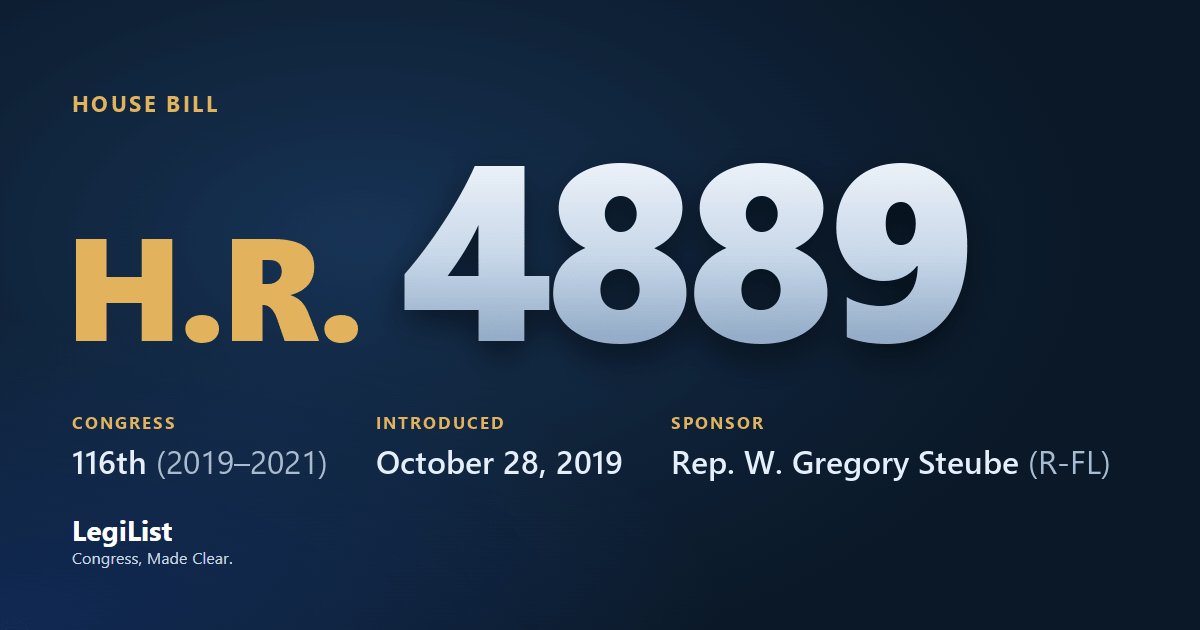
Threat Information Protocol for Sharing Act of 2019
Latest action · Dec 18, 2019 Referred to the Subcommittee on Crime, Terrorism, and Homeland Security.
Progress
Where this bill reached, and when. A stage with no date was not reached; one that failed a vote and later carried shows the date it carried.
- IntroducedOct 28, 2019
- Passed HouseNot reached
- Passed SenateNot reached
- To the PresidentNot reached
- Became lawNot reached
Summary
Threat Information Protocol for Sharing Act of 2019
This bill establishes several new reporting requirements related to information received by the Federal Bureau of Investigation (FBI) through the national tip line relating to an individual or threat.
Specifically, the FBI must submit the following:
- monthly reports to state law enforcement agencies and fusion centers on all information received by the national tip line relating to an individual or threat in the state during the preceding month,
- annual reports to Congress on total reports received by the tip line and the total number submitted to state law enforcement agencies and fusion centers, and
- annual reports to Congress on criminal events involving an individual or threat that had been the subject of a report received through the tip line prior to the criminal event.
Additionally, the Government Accountability Office must review and report on the operating processes and procedures of the tip line.
Cosponsors 7
Members who signed on, in the order they did. Signatures ran from Oct 28, 2019 to Nov 20, 2019; 6 are original cosponsors, there from the day it was introduced.
| Seat | Cosponsor | Signed on | |
|---|---|---|---|
| D-CA | Gilbert Ray Cisneros, Jr. | Original | Oct 28, 2019 |
| R-FL | Mario Diaz-Balart | Original | Oct 28, 2019 |
| R-FL | Matt Gaetz | Original | Oct 28, 2019 |
| R-OH | Michael R. Turner | Original | Oct 28, 2019 |
| R-FL | Ted S. Yoho | Original | Oct 28, 2019 |
| R-OH | Troy Balderson | Original | Oct 28, 2019 |
| R-PR | Jenniffer González-Colón | Nov 20, 2019 |
Committees 1
Where it was sent and what each committee and subcommittee did with it, in order.
| Chamber | Committee | What it did |
|---|---|---|
| House | Judiciary Committee | Referred Oct 28, 2019 |
| Crime and Federal Government Surveillance Subcommittee | Referred Dec 18, 2019 |
Actions 3
Everything that happened, newest first.
- Dec 18, 2019Referred to the Subcommittee on Crime, Terrorism, and Homeland Security.
- Oct 28, 2019Introduced in House
- Oct 28, 2019Referred to the House Committee on the Judiciary.
Research
What has been written about this bill: committee reports, cost estimates, the sponsor’s authority statement, printed hearings and the Congressional Research Service’s work.
Constitutional authority
The sponsor’s statement, as printed in the Congressional Record, vol. 165, no. 170, October 28, 2019, page H8540.
Related bills 1
Companion bills and other measures the record links to this one.
| Bill | Title | Relationship | Latest action |
|---|---|---|---|
| S 2708 | Threat Information Protocol for Sharing Act of 2019 | Identical bill | Oct 24, 2019 |
Titles 2
Every title it has carried, official and short, at each stage.
- Official Title as Introduced
- To improve communication between the Federal Bureau of Investigation and State law enforcement agencies.
- Short Title(s) as Introduced
- Threat Information Protocol for Sharing Act of 2019
Subjects
Assigned by the Library of Congress. Policy area: Crime and Law Enforcement.
Text 1
Each version as it was printed, newest first.
- Oct 28, 2019Introduced in House
Everything here is as published by Congress: the summary is the Congressional Research Service's, the action wording is the clerks', and the subjects are the Library of Congress's. How far it got is read from the actions themselves, taking the most recent one of each kind, so a bill that failed a vote and later passed is shown as having passed. Records come from this bill on Congress.gov and govinfo.gov; cost estimates are the Congressional Budget Office's, and the hearings are the printed hearings GovInfo publishes, which can appear months after the hearing.