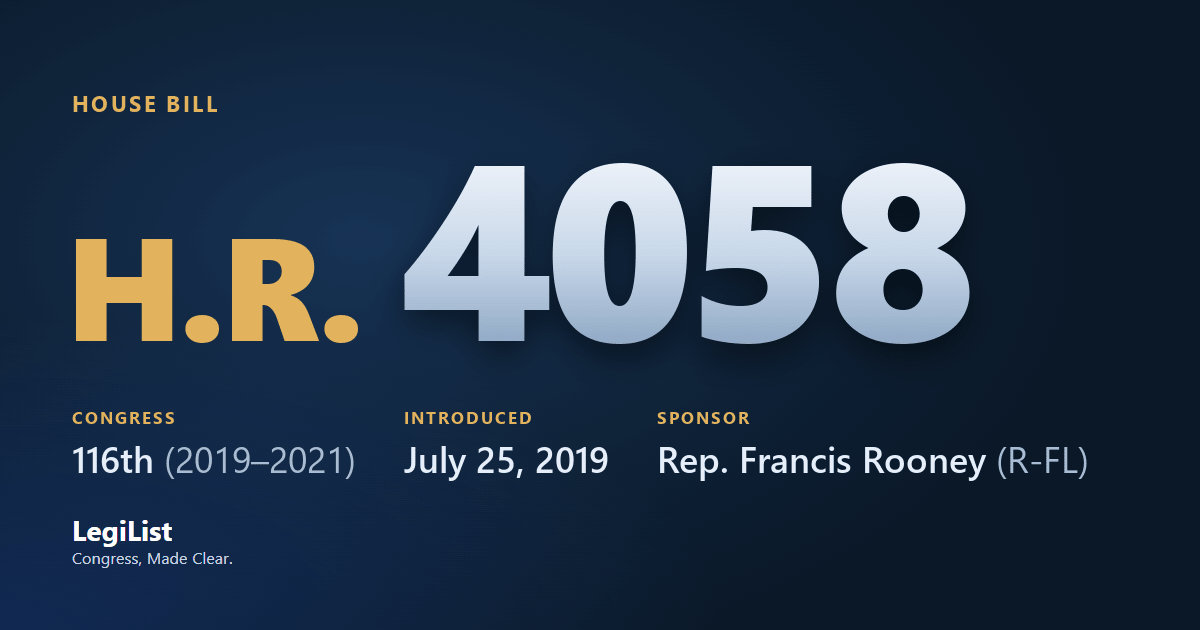
SWAP Act
Latest action · Jul 26, 2019 Referred to the Subcommittee on Consumer Protection and Commerce.
Progress
Where this bill reached, and when. A stage with no date was not reached; one that failed a vote and later carried shows the date it carried.
- IntroducedJul 25, 2019
- Passed HouseNot reached
- Passed SenateNot reached
- To the PresidentNot reached
- Became lawNot reached
Summary
Stemming Warming and Augmenting Pay Act of 2019 or the SWAP Act.
This bill imposes a tax on combusted fossil fuel greenhouse gas emissions. The tax is equal to $30 per metric ton of carbon dioxide equivalent emissions beginning in 2021. The tax increases by 5% plus inflation each year and increases by $3 per ton every two years if the previous year's emission goals are not met.
The revenue from such tax is divided (1) 70% for the reduction of payroll taxes; (2) 10% for additional payments to Social Security beneficiaries, and (3) 20% to establish a carbon trust fund for block grants to offset higher energy costs for low-income households, climate adaptation, energy efficiency, carbon sequestration, and research and development programs.
The bill also amends the Clean Air Act to impose a 12-year moratorium on regulations that limit greenhouse gas emissions. This moratorium may be lifted if certain emission targets are not met.
Cosponsors 1
Members who signed on, in the order they did. All signed on Jul 25, 2019.
| Seat | Cosponsor | Signed on | |
|---|---|---|---|
| D-IL | Daniel Lipinski | Original | Jul 25, 2019 |
Committees 3
Where it was sent and what each committee and subcommittee did with it, in order.
| Chamber | Committee | What it did |
|---|---|---|
| House | Ways and Means Committee | Referred Jul 25, 2019 |
| House | Energy and Commerce Committee | Referred Jul 25, 2019 |
| Commerce, Manufacturing, and Trade Subcommittee | Referred Jul 26, 2019 | |
| House | Science, Space, and Technology Committee | Referred Jul 25, 2019 |
Actions 3
Everything that happened, newest first.
- Jul 26, 2019Referred to the Subcommittee on Consumer Protection and Commerce.
- Jul 25, 2019Introduced in House
- Jul 25, 2019Referred to the Committee on Ways and Means, and in addition to the Committees on Energy and Commerce, and Science, Space, and Technology, for a period to be subsequently determined by the Speaker, in each case for consideration of such provisions as fall within the jurisdiction of the committee concerned.
Research
What has been written about this bill: committee reports, cost estimates, the sponsor’s authority statement, printed hearings and the Congressional Research Service’s work.
Constitutional authority
The sponsor’s statement, as printed in the Congressional Record, vol. 165, no. 126, July 25, 2019, page H7471.
Printed hearings 1
Hearings whose printed record names this bill, newest first: hearings on it, and wider hearings where it came up.
| Number | Hearing | Committee | Held |
|---|---|---|---|
| Serial No. 116-1 | THE STATE OF THE RURAL ECONOMY100 pages | Agriculture Committee | Feb 27, 2019 |
CRS reports 2
Congressional Research Service work that CRS links to this bill or the law it became, newest first.
Cite it 2
Products on other subjects that cite it, usually among other measures.
| Product | Title | Kind | Published |
|---|---|---|---|
| R45472 | Market-Based Greenhouse Gas Emission Reduction Legislation: 108th Through 118th Congresses Archived | Report | Dec 4, 2024 |
| IF11815 | Climate Change: Selected Federal Economic Development Tools and Policy Considerations | Resource | Apr 22, 2021 |
Related bills 1
Companion bills and other measures the record links to this one.
| Bill | Title | Relationship | Latest action |
|---|---|---|---|
| HR 4520 | MARKET CHOICE Act | Related bill | Oct 18, 2019 |
Titles 3
Every title it has carried, official and short, at each stage.
- Official Title as Introduced
- To amend the Internal Revenue Code of 1986 to impose a tax on greenhouse gas emissions, accordingly reduce tax rates on payroll, and for other purposes.
- Short Title(s) as Introduced
- SWAP Act
- Stemming Warming and Augmenting Pay Act of 2019
Subjects
Assigned by the Library of Congress. Policy area: Taxation.
- Administrative law and regulatory procedures
- Air quality
- Aviation and airports
- Climate change and greenhouse gases
- Coal
- Electric power generation and transmission
- Employment taxes
- Environmental Protection Agency (EPA)
- Environmental regulatory procedures
- Government trust funds
- Industrial facilities
- International organizations and cooperation
- Manufacturing
- Metals
- Mining
- Motor vehicles
- Oil and gas
- Sales and excise taxes
- Tax administration and collection, taxpayers
- Taxation
Text 1
Each version as it was printed, newest first.
- Jul 25, 2019Introduced in House
Support LegiList
This page is free, carries no paywall, and is built and maintained by one person. If the record here is useful to you, a few dollars keeps it going.
Everything here is as published by Congress: the summary is the Congressional Research Service's, the action wording is the clerks', and the subjects are the Library of Congress's. How far it got is read from the actions themselves, taking the most recent one of each kind, so a bill that failed a vote and later passed is shown as having passed. Records come from this bill on Congress.gov and govinfo.gov; cost estimates are the Congressional Budget Office's, and the hearings are the printed hearings GovInfo publishes, which can appear months after the hearing.