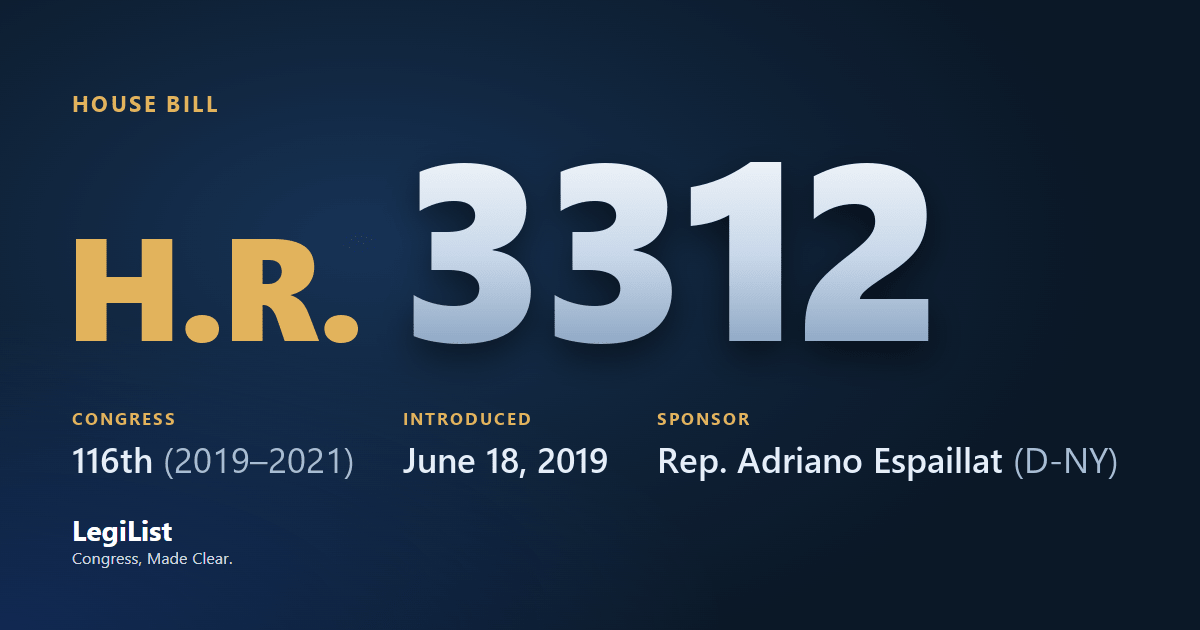
Family Reunification Act of 2019
Latest action · Jul 30, 2019 Referred to the Subcommittee on Immigration and Citizenship.
Progress
Where this bill reached, and when. A stage with no date was not reached; one that failed a vote and later carried shows the date it carried.
- IntroducedJun 18, 2019
- Passed HouseNot reached
- Passed SenateNot reached
- To the PresidentNot reached
- Became lawNot reached
Summary
Family Reunification Act of 2019
This bill revives an expired program that allows qualified aliens with certain familial or employment ties to the United States to apply for lawful permanent resident status. The deadline for applying for such status shall be five years after the enactment of this bill, where the deadline under current law was April 30, 2001. (Generally, a qualifying alien under the program must be one who (1) entered the United States without inspection or falls into other specified categories, (2) is the beneficiary of a petition for lawful permanent status based on family sponsorship or for performing certain labor where there are not sufficient workers available for such labor, and (3) was physically present in the United States on December 21, 2000.)
The bill also prohibits the removal of an alien who (1) has a pending petition for lawful permanent status based on being the spouse or child of a U.S. citizen, and (2) is prima facie eligible for lawful permanent status.
Cosponsors 8
Members who signed on, in the order they did. Signatures ran from Jun 18, 2019 to Jan 8, 2020; 1 is an original cosponsor, there from the day it was introduced.
| Seat | Cosponsor | Signed on | |
|---|---|---|---|
| D-CA | Juan Vargas | Original | Jun 18, 2019 |
| D-DC | Eleanor Holmes Norton | Jun 24, 2019 | |
| D-IL | Janice D. Schakowsky | Jun 24, 2019 | |
| D-NY | Nydia M. Velázquez | Jun 24, 2019 | |
| D-MA | James P. McGovern | Jun 25, 2019 | |
| D-AZ | Ann Kirkpatrick | Jul 9, 2019 | |
| D-IL | Jesús G. "Chuy" García | Sep 11, 2019 | |
| D-TX | Sylvia R. Garcia | Jan 8, 2020 |
Committees 1
Where it was sent and what each committee and subcommittee did with it, in order.
| Chamber | Committee | What it did |
|---|---|---|
| House | Judiciary Committee | Referred Jun 18, 2019 |
| Immigration Integrity, Security, and Enforcement Subcommittee | Referred Jul 30, 2019 |
Actions 3
Everything that happened, newest first.
- Jul 30, 2019Referred to the Subcommittee on Immigration and Citizenship.
- Jun 18, 2019Introduced in House
- Jun 18, 2019Referred to the House Committee on the Judiciary.
Research
What has been written about this bill: committee reports, cost estimates, the sponsor’s authority statement, printed hearings and the Congressional Research Service’s work.
Constitutional authority
The sponsor’s statement, as printed in the Congressional Record, vol. 165, no. 102, June 18, 2019, page H4771.
CRS reports 1
Congressional Research Service work that CRS links to this bill or the law it became, newest first.
Cite it 1
Products on other subjects that cite it, usually among other measures.
| Product | Title | Kind | Published |
|---|---|---|---|
| R45993 | Legalization Framework Under the Immigration and Nationality Act (INA) Archived | Report | Nov 5, 2019 |
Titles 2
Every title it has carried, official and short, at each stage.
- Official Title as Introduced
- To amend the Immigration and Nationality Act to provide for an extension of the application period for certain aliens present in the United States for adjustment of status.
- Short Title(s) as Introduced
- Family Reunification Act of 2019
Subjects
Assigned by the Library of Congress. Policy area: Immigration.
Text 1
Each version as it was printed, newest first.
- Jun 18, 2019Introduced in House
Everything here is as published by Congress: the summary is the Congressional Research Service's, the action wording is the clerks', and the subjects are the Library of Congress's. How far it got is read from the actions themselves, taking the most recent one of each kind, so a bill that failed a vote and later passed is shown as having passed. Records come from this bill on Congress.gov and govinfo.gov; cost estimates are the Congressional Budget Office's, and the hearings are the printed hearings GovInfo publishes, which can appear months after the hearing.