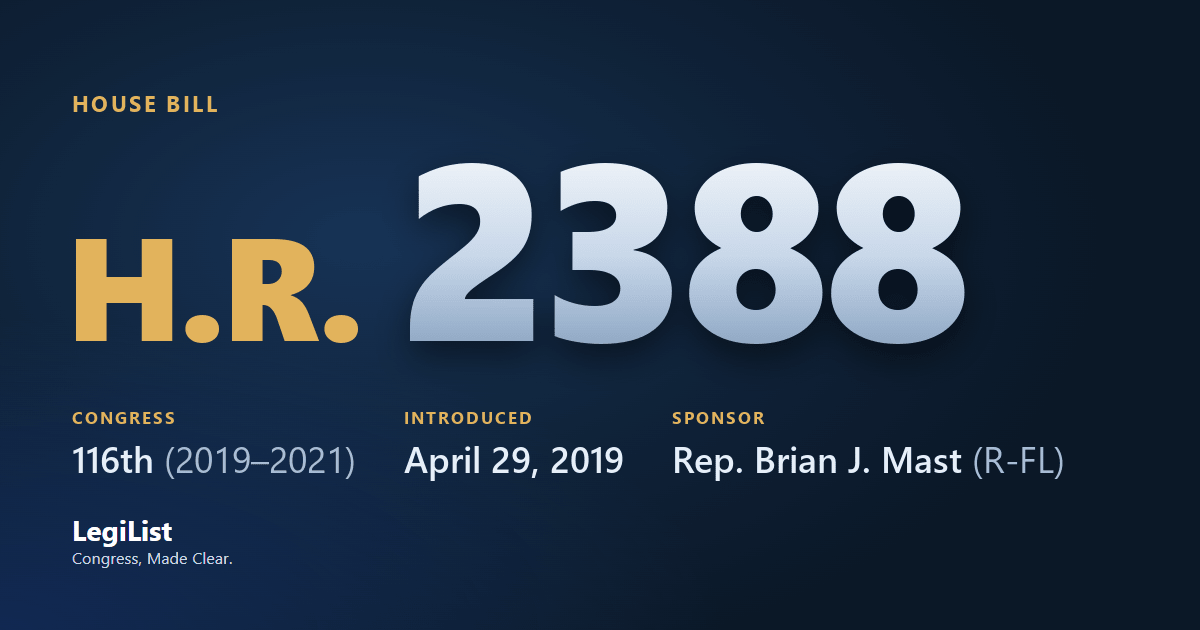
Harmony’s Law
Latest action · Apr 30, 2019 Referred to the Subcommittee on Military Personnel.
Progress
Where this bill reached, and when. A stage with no date was not reached; one that failed a vote and later carried shows the date it carried.
- IntroducedApr 29, 2019
- Passed HouseNot reached
- Passed SenateNot reached
- To the PresidentNot reached
- Became lawNot reached
Summary
Harmony's Law
This bill eliminates the statute of limitations under the Uniform Code of Military Justice for a child abuse offense.
Currently, such charges must be received during the life of the child or within 10 years of the commission of the offense, whichever is longer.
The bill retroactively applies to offenses for which the current statute of limitations has not yet lapsed.
The Office of General Counsel of the House of Representatives is authorized to file legal briefs supporting the position that prosecution for a rape or sexual assault should not be time-barred, notwithstanding the opinion of the U.S. Court of Appeals for the Armed Forces in United States v. Mangahas, No. 17-0434-AF.
Cosponsors 28
Members who signed on, in the order they did. Signatures ran from Apr 29, 2019 to Dec 16, 2019; 10 are original cosponsors, there from the day it was introduced.
| Seat | Cosponsor | Signed on | |
|---|---|---|---|
| D-NH | Ann M. Kuster | Original | Apr 29, 2019 |
| R-FL | Bill Posey | Original | Apr 29, 2019 |
| D-FL | Darren Soto | Original | Apr 29, 2019 |
| D-CA | Gilbert Ray Cisneros, Jr. | Original | Apr 29, 2019 |
| R-FL | Gus M. Bilirakis | Original | Apr 29, 2019 |
| D-MI | Haley M. Stevens | Original | Apr 29, 2019 |
| D-FL | Kathy Castor | Original | Apr 29, 2019 |
| R-FL | Mario Diaz-Balart | Original | Apr 29, 2019 |
| R-FL | Matt Gaetz | Original | Apr 29, 2019 |
| D-FL | Val Butler Demings | Original | Apr 29, 2019 |
| D-HI | Tulsi Gabbard | May 1, 2019 | |
| R-FL | John H. Rutherford | May 3, 2019 | |
| R-FL | Ross Spano | May 3, 2019 | |
| R-IN | James R. Baird | May 7, 2019 | |
| R-FL | Ted S. Yoho | May 7, 2019 |
Committees 2
Where it was sent and what each committee and subcommittee did with it, in order.
| Chamber | Committee | What it did |
|---|---|---|
| House | Armed Services Committee | Referred Apr 29, 2019 |
| Military Personnel Subcommittee | Referred Apr 30, 2019 | |
| House | Rules Committee | Referred Apr 29, 2019 |
Actions 3
Everything that happened, newest first.
- Apr 30, 2019Referred to the Subcommittee on Military Personnel.
- Apr 29, 2019Introduced in House
- Apr 29, 2019Referred to the Committee on Armed Services, and in addition to the Committee on Rules, for a period to be subsequently determined by the Speaker, in each case for consideration of such provisions as fall within the jurisdiction of the committee concerned.
In the Congressional Record 1
Days the Record’s own index lists this bill, newest first, with the pages and the members it names. Pages starting H are the House, S the Senate, E Extensions of Remarks.
| Where | In the Record | Members | Date |
|---|---|---|---|
| House | Debate and remarks H7225 | Brian J. Mast R-FL | Dec 16, 2020 |
Research
What has been written about this bill: committee reports, cost estimates, the sponsor’s authority statement, printed hearings and the Congressional Research Service’s work.
Constitutional authority
The sponsor’s statement, as printed in the Congressional Record, vol. 165, no. 69, April 29, 2019, page H3304.
Titles 2
Every title it has carried, official and short, at each stage.
- Official Title as Introduced
- To amend the Uniform Code of Military Justice to eliminate the statute of limitations for child abuse offenses, and for other purposes.
- Short Title(s) as Introduced
- Harmony’s Law
Subjects
Assigned by the Library of Congress. Policy area: Armed Forces and National Security.
- Armed Forces and National Security
- Child safety and welfare
- Crimes against children
- Criminal investigation, prosecution, interrogation
- Criminal procedure and sentencing
- Domestic violence and child abuse
- House of Representatives
- Judicial review and appeals
- Military law
- Military personnel and dependents
- Sex offenses
Text 1
Each version as it was printed, newest first.
- Apr 29, 2019Introduced in House
Support LegiList
This page is free, carries no paywall, and is built and maintained by one person. If the record here is useful to you, a few dollars keeps it going.
Everything here is as published by Congress: the summary is the Congressional Research Service's, the action wording is the clerks', and the subjects are the Library of Congress's. How far it got is read from the actions themselves, taking the most recent one of each kind, so a bill that failed a vote and later passed is shown as having passed. Records come from this bill on Congress.gov and govinfo.gov; cost estimates are the Congressional Budget Office's, and the hearings are the printed hearings GovInfo publishes, which can appear months after the hearing.