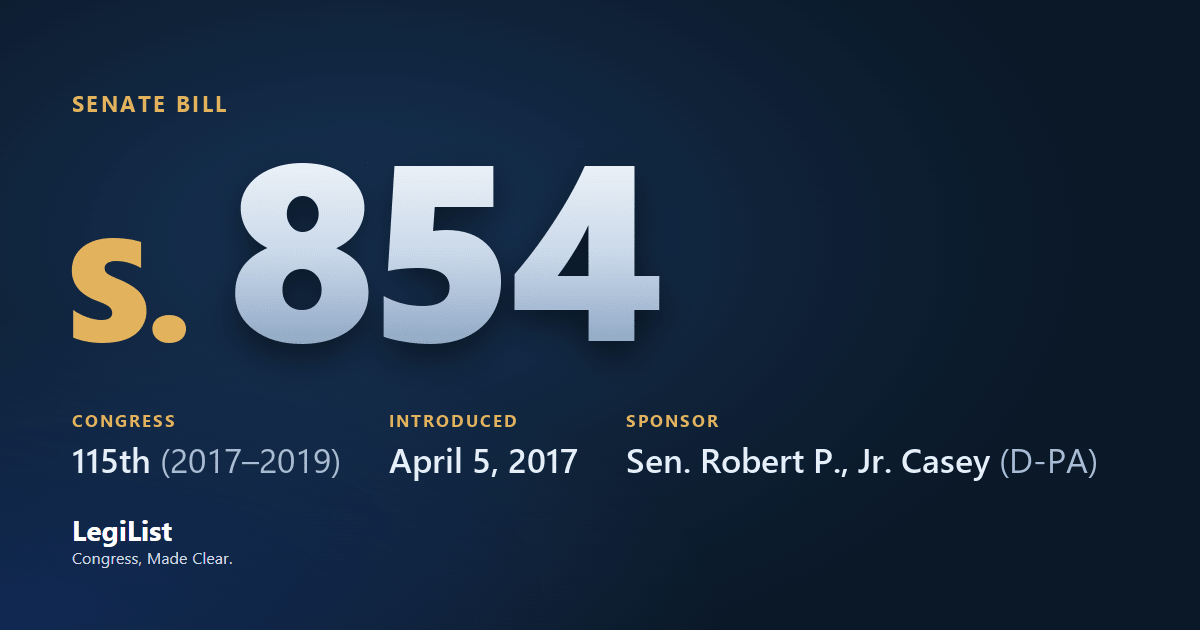
Robert C. Byrd Mine Safety Protection Act of 2017
Latest action · Apr 5, 2017 Read twice and referred to the Committee on Health, Education, Labor, and Pensions.
Progress
Where this bill reached, and when. A stage with no date was not reached; one that failed a vote and later carried shows the date it carried.
- IntroducedApr 5, 2017
- Passed SenateNot reached
- Passed HouseNot reached
- To the PresidentNot reached
- Became lawNot reached
Summary
Robert C. Byrd Mine Safety Protection Act of 2017
This bill amends the Federal Mine Safety and Health Act of 1977 to revise requirements governing: (1) investigations of mine accidents, (2) miners' rights and protections (e.g., whistle-blower rights and protections), (3) mine health and safety standards, (4) underground coal mines, and (5) health and safety training for miners.
The Department of Labor, when investigating coal or other mines, must: (1) determine why an accident occurred and whether there were violations of law, mandatory health and safety standards, or other requirements; (2) refer to the Department of Justice cases involving violations of federal criminal law; and (3) make recommendations to avoid a recurrence of an accident.
The bill expands Labor's enforcement authority, including by requiring Labor to: (1) revoke the approval of mine operators' plans or programs based on certain criteria, and (2) order mine operators to withdraw all persons from a mine until Labor approves a new plan. The bill revises civil and criminal penalties, including by subjecting a mine operator who knowingly violates health or safety standards to a felony punishable by up to five years in prison and a $1 million fine.
Underground coal mines operators must implement a communication program to brief miners of current mine conditions and install atmospheric monitoring systems.
The bill amends the Occupational Safety and Health Act of 1970 (OSH Act) to expand its coverage to government employees and increase civil and criminal penalties for violations of the Act. The bill also expands whistle-blower rights and protections against retaliation under the OSH Act, establishes employee rights with respect to work-related bodily injuries or death, and establishes procedures for correcting serious, willful or repeated violations of occupational safety and health standards.
Cosponsors 2
Members who signed on, in the order they did. All signed on Apr 5, 2017.
| Seat | Cosponsor | Signed on | |
|---|---|---|---|
| D-WV | Joe Manchin III | Original | Apr 5, 2017 |
| D-OH | Sherrod Brown | Original | Apr 5, 2017 |
Committees 1
Where it was sent and what each committee and subcommittee did with it, in order.
| Chamber | Committee | What it did |
|---|---|---|
| Senate | Health, Education, Labor, and Pensions Committee | Referred Apr 5, 2017 |
Actions 2
Everything that happened, newest first.
- Apr 5, 2017Introduced in Senate
- Apr 5, 2017Read twice and referred to the Committee on Health, Education, Labor, and Pensions.
Related bills 2
Companion bills and other measures the record links to this one.
| Bill | Title | Relationship | Latest action |
|---|---|---|---|
| S 1145 | Robert C. Byrd Mine Safety Protection Act of 2015 | Reintroduction of | Apr 30, 2015 |
| HR 1903 | Robert C. Byrd Mine Safety Protection Act of 2017 | Related bill | Apr 5, 2017 |
Titles 2
Every title it has carried, official and short, at each stage.
- Official Title as Introduced
- A bill to improve compliance with mine safety and health laws, empower miners to raise safety concerns, prevent future mine tragedies, and for other purposes.
- Short Titles as Introduced
- Robert C. Byrd Mine Safety Protection Act of 2017
Subjects
Assigned by the Library of Congress. Policy area: Labor and Employment.
- Accidents
- Administrative law and regulatory procedures
- Administrative remedies
- Air quality
- Business records
- Cardiovascular and respiratory health
- Civil actions and liability
- Coal
- Congressional oversight
- Criminal investigation, prosecution, interrogation
- Criminal procedure and sentencing
- Department of Labor
- Employment and training programs
- Employment discrimination and employee rights
- Environmental assessment, monitoring, research
- Evidence and witnesses
- Family services
- Government employee pay, benefits, personnel management
- Government studies and investigations
- Labor and Employment
- Labor standards
- Lawyers and legal services
- Medical tests and diagnostic methods
- Mining
- State and local government operations
- Wages and earnings
- Worker safety and health
Text 1
Each version as it was printed, newest first.
- Apr 5, 2017Introduced in Senate
Support LegiList
This page is free, carries no paywall, and is built and maintained by one person. If the record here is useful to you, a few dollars keeps it going.
Everything here is as published by Congress: the summary is the Congressional Research Service's, the action wording is the clerks', and the subjects are the Library of Congress's. How far it got is read from the actions themselves, taking the most recent one of each kind, so a bill that failed a vote and later passed is shown as having passed. Records come from this bill on Congress.gov and govinfo.gov; cost estimates are the Congressional Budget Office's, and the hearings are the printed hearings GovInfo publishes, which can appear months after the hearing.