NEST Act
Latest action · May 17, 2017 Committee on Indian Affairs. Ordered to be reported with an amendment in the nature of a substitute favorably.
Progress
Where this bill reached, and when. A stage with no date was not reached; one that failed a vote and later carried shows the date it carried.
- IntroducedFeb 27, 2017
- Passed SenateNot reached
- Passed HouseNot reached
- To the PresidentNot reached
- Became lawNot reached
Summary
Native Educator Support and Training Act or the NEST Act
This bill amends the Higher Education Act of 1965 to establish scholarships, loan forgiveness plans, and training programs for educators who commit to teaching in Native American or Bureau of Indian Education (BIE) schools.
This bill establishes three scholarship programs for students who are seeking degrees in education or school administration at institutions of higher education and commit to teaching in Native American or BIE schools:
- the Indian Student Educator Scholarship Program for students seeking degrees,
- the Indian Educator Scholarship Program for Indian students seeking degrees, and
- the Indian Educator Graduate Fellowship Program for Indian students seeking graduate degrees.
Recipients of the scholarships must commit to working for a BIE school, a school serving Native Americans, or other specified schools and agencies for the greater of three years or the number of school years that the scholarship funded.
The bill establishes loan forgiveness programs for educators and Native Americans who have taught for at least five consecutive years at BIE schools or local educational agencies with high percentages of Native American students.
The bill extends the federal Perkins Loan Cancellation Program to educators teaching in BIE schools or in Native American language immersion programs.
The bill authorizes professional development grants for native-serving elementary and secondary schools. It also establishes the Native American Language Teacher Training Program to provide grants for institutions of higher education to develop training programs for Native American immersion and language teachers.
Cosponsors 2
Members who signed on, in the order they did. All signed on Feb 27, 2017.
| Seat | Cosponsor | Signed on | |
|---|---|---|---|
| D-MN | Al Franken | Original | Feb 27, 2017 |
| D-NM | Tom Udall | Original | Feb 27, 2017 |
Committees 1
Where it was sent and what each committee and subcommittee did with it, in order.
| Chamber | Committee | What it did |
|---|---|---|
| Senate | Indian Affairs Committee | Referred Feb 27, 2017Markup May 17, 2017 |
Actions 3
Everything that happened, newest first.
- May 17, 2017Committee on Indian Affairs. Ordered to be reported with an amendment in the nature of a substitute favorably.
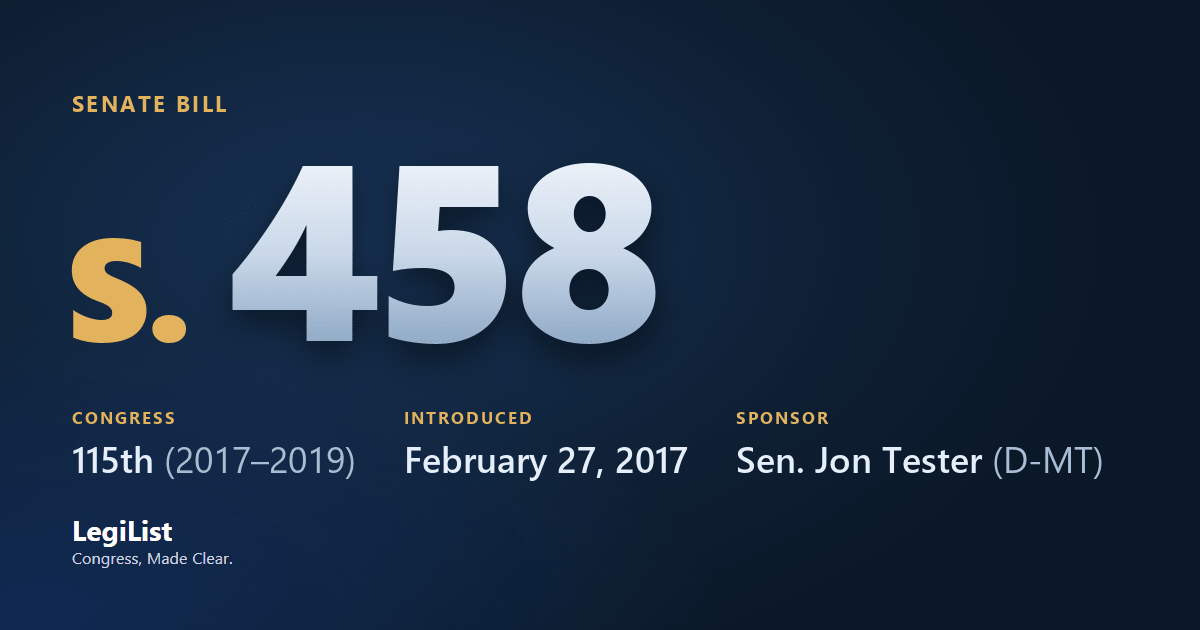
- Feb 27, 2017Introduced in Senate
- Feb 27, 2017Read twice and referred to the Committee on Indian Affairs.
Research
What has been written about this bill: committee reports, cost estimates, the sponsor’s authority statement, printed hearings and the Congressional Research Service’s work.
Congressional Budget Office cost estimate
- Jun 23, 2017S. 458, Native Educator Support and Training ActAs ordered reported by the Senate Committee on Indian Affairs on May 17, 2017
Printed hearings 1
Hearings whose printed record names this bill, newest first: hearings on it, and wider hearings where it came up.
| Number | Hearing | Committee | Held |
|---|---|---|---|
| S. Hrg. 115-367 | EXAMINING EFFORTS TO MAINTAIN AND REVITALIZE NATIVE LANGUAGES FOR FUTURE GENERATIONS88 pages | Indian Affairs Committee | Aug 22, 2018 |
Related bills 2
Companion bills and other measures the record links to this one.
Titles 3
Every title it has carried, official and short, at each stage.
- Official Title as Introduced
- A bill to support the education of Indian children.
- Short Titles as Introduced
- NEST Act
- Native Educator Support and Training Act
Subjects
Assigned by the Library of Congress. Policy area: Native Americans.
Text 1
Each version as it was printed, newest first.
- Feb 27, 2017Introduced in Senate
Support LegiList
This page is free, carries no paywall, and is built and maintained by one person. If the record here is useful to you, a few dollars keeps it going.
Everything here is as published by Congress: the summary is the Congressional Research Service's, the action wording is the clerks', and the subjects are the Library of Congress's. How far it got is read from the actions themselves, taking the most recent one of each kind, so a bill that failed a vote and later passed is shown as having passed. Records come from this bill on Congress.gov and govinfo.gov; cost estimates are the Congressional Budget Office's, and the hearings are the printed hearings GovInfo publishes, which can appear months after the hearing.