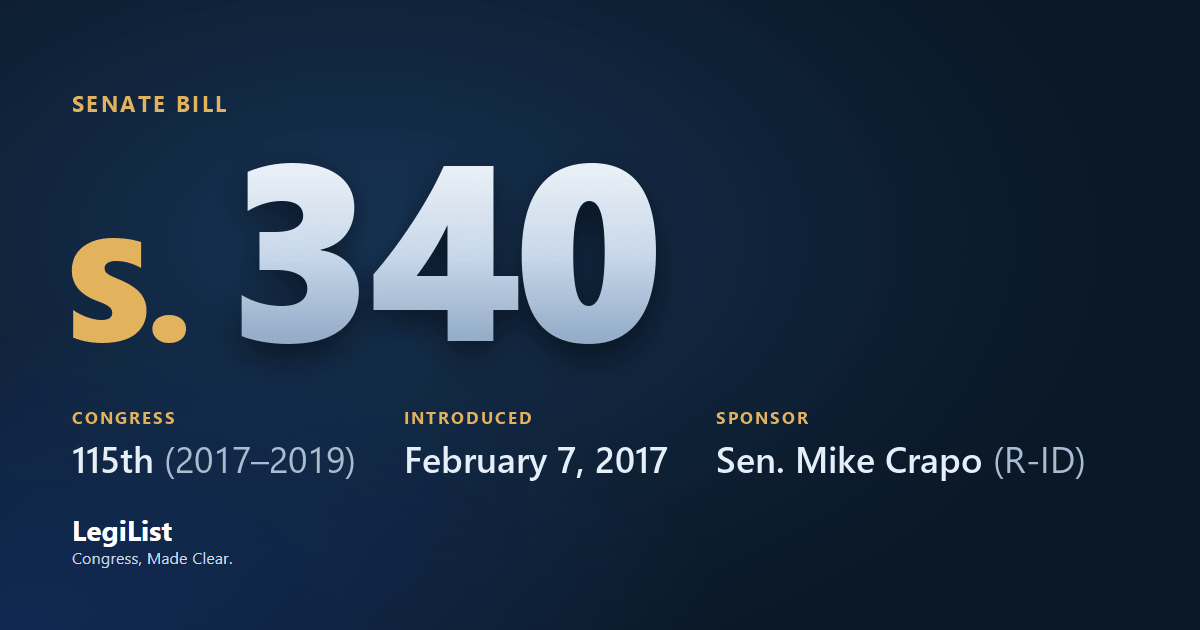
Sensible Environmental Protection Act of 2017
Latest action · Feb 7, 2017 Read twice and referred to the Committee on Environment and Public Works.
Progress
Where this bill reached, and when. A stage with no date was not reached; one that failed a vote and later carried shows the date it carried.
- IntroducedFeb 7, 2017
- Passed SenateNot reached
- Passed HouseNot reached
- To the PresidentNot reached
- Became lawNot reached
Summary
Sensible Environmental Protection Act of 2017
This bill amends the Federal Insecticide, Fungicide, and Rodenticide Act (FIFRA) and the Federal Water Pollution Control Act (commonly known as the Clean Water Act) to prohibit the Environmental Protection Agency or a state from requiring a permit under the National Pollutant Discharge Elimination System (NPDES) for a discharge of a pesticide from a point source into navigable waters if the discharge is approved under FIFRA. Point source pollution is waste discharged from a distinct place, such as a pipe, channel, or tunnel. The bill establishes exemptions from this prohibition.
Cosponsors 18
Members who signed on, in the order they did. Signatures ran from Feb 7, 2017 to Jun 21, 2017; 15 are original cosponsors, there from the day it was introduced.
| Seat | Cosponsor | Signed on | |
|---|---|---|---|
| D-MO | Claire McCaskill | Original | Feb 7, 2017 |
| R-NE | Deb Fischer | Original | Feb 7, 2017 |
| D-ND | Heidi Heitkamp | Original | Feb 7, 2017 |
| R-ID | James E. Risch | Original | Feb 7, 2017 |
| R-OK | James M. Inhofe | Original | Feb 7, 2017 |
| R-AZ | Jeff Flake | Original | Feb 7, 2017 |
| R-KS | Jerry Moran | Original | Feb 7, 2017 |
| D-IN | Joe Donnelly | Original | Feb 7, 2017 |
| R-WY | John Barrasso | Original | Feb 7, 2017 |
| R-AR | John Boozman | Original | Feb 7, 2017 |
| R-SD | John Thune | Original | Feb 7, 2017 |
| R-IA | Joni Ernst | Original | Feb 7, 2017 |
| R-WY | Michael B. Enzi | Original | Feb 7, 2017 |
| R-KS | Pat Roberts | Original | Feb 7, 2017 |
| R-MO | Roy Blunt | Original | Feb 7, 2017 |
Committees 1
Where it was sent and what each committee and subcommittee did with it, in order.
| Chamber | Committee | What it did |
|---|---|---|
| Senate | Environment and Public Works Committee | Referred Feb 8, 2017 |
Actions 2
Everything that happened, newest first.
- Feb 7, 2017Introduced in Senate
- Feb 7, 2017Read twice and referred to the Committee on Environment and Public Works.
Research
What has been written about this bill: committee reports, cost estimates, the sponsor’s authority statement, printed hearings and the Congressional Research Service’s work.
Printed hearings 1
Hearings whose printed record names this bill, newest first: hearings on it, and wider hearings where it came up.
| Number | Hearing | Committee | Held |
|---|---|---|---|
| S. Hrg. 115-267 | HEARING TO EXAMINE S.2663, THE AGRICULTURE CREATES REAL EMPLOYMENT (ACRE) ACT166 pages | Environment and Public Works Committee | Mar 14, 2018 |
CRS reports 1
Congressional Research Service work that CRS links to this bill or the law it became, newest first.
Cite it 1
Products on other subjects that cite it, usually among other measures.
| Product | Title | Kind | Published |
|---|---|---|---|
| IF10598 | Water Quality Issues in the 115th Congress: A Brief Overview Archived | Resource | Aug 15, 2017 |
Related bills 3
Companion bills and other measures the record links to this one.
| Bill | Title | Relationship | Latest action |
|---|---|---|---|
| HR 953 | Reducing Regulatory Burdens Act of 2017 | Related bill | May 25, 2017 |
| S 1500 | Sensible Environmental Protection Act of 2015 | Reintroduction of | Oct 29, 2015 |
| S 2663 | ACRE Act | Related bill | Apr 12, 2018 |
Titles 2
Every title it has carried, official and short, at each stage.
- Official Title as Introduced
- A bill to clarify Congressional intent regarding the regulation of the use of pesticides in or near navigable waters, and for other purposes.
- Short Titles as Introduced
- Sensible Environmental Protection Act of 2017
Subjects
Assigned by the Library of Congress. Policy area: Environmental Protection.
Text 1
Each version as it was printed, newest first.
- Feb 7, 2017Introduced in Senate
Support LegiList
This page is free, carries no paywall, and is built and maintained by one person. If the record here is useful to you, a few dollars keeps it going.
Everything here is as published by Congress: the summary is the Congressional Research Service's, the action wording is the clerks', and the subjects are the Library of Congress's. How far it got is read from the actions themselves, taking the most recent one of each kind, so a bill that failed a vote and later passed is shown as having passed. Records come from this bill on Congress.gov and govinfo.gov; cost estimates are the Congressional Budget Office's, and the hearings are the printed hearings GovInfo publishes, which can appear months after the hearing.