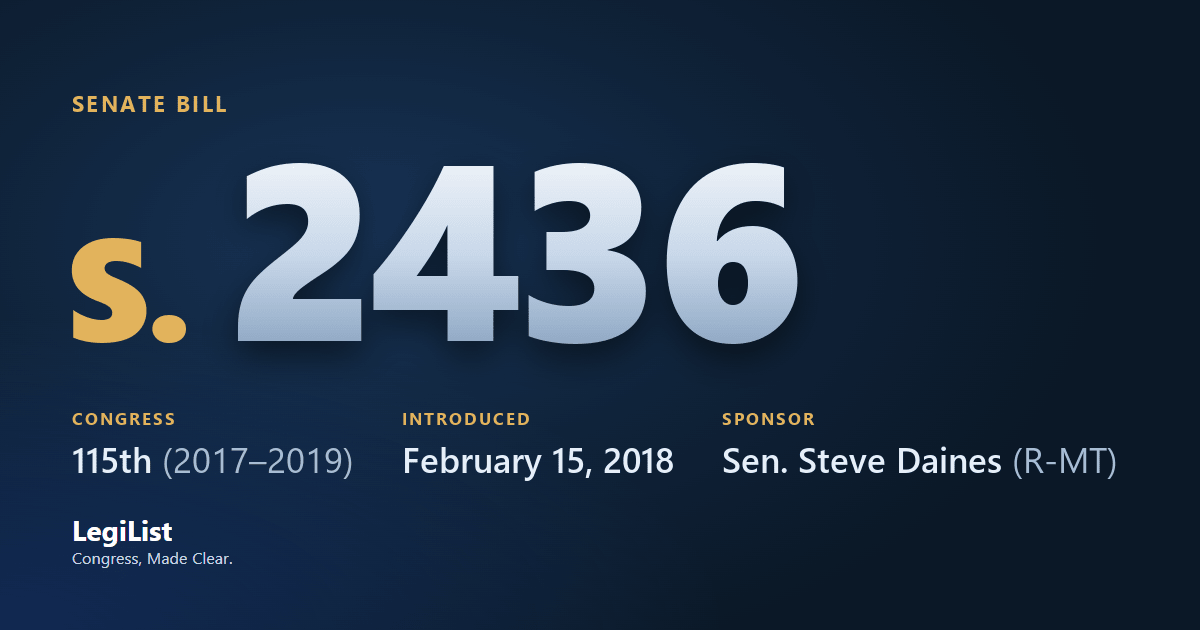
Charitable Conservation Easement Program Integrity Act of 2018
Latest action · Feb 15, 2018 Read twice and referred to the Committee on Finance. (text of measure as introduced: CR S1166)
Progress
Where this bill reached, and when. A stage with no date was not reached; one that failed a vote and later carried shows the date it carried.
- IntroducedFeb 15, 2018
- Passed SenateNot reached
- Passed HouseNot reached
- To the PresidentNot reached
- Became lawNot reached
Summary
Charitable Conservation Easement Program Integrity Act of 2018
This bill amends the Internal Revenue Code to limit the aggregate amount of a partner's annual tax deductions for qualified conservation contributions of a partnership to 2.5 times the partner's adjusted basis in the partnership. (Under current law, a "qualified conservation contribution" is the contribution of a qualified real property interest to a qualified organization exclusively for conservation purposes.)
The limitation applies for the first five years after the individual becomes a partner in the partnership. It does not apply to certain family partnerships.
Cosponsors 3
Members who signed on, in the order they did. Signatures ran from Feb 15, 2018 to Jul 9, 2018; 1 is an original cosponsor, there from the day it was introduced.
| Seat | Cosponsor | Signed on | |
|---|---|---|---|
| D-MI | Debbie Stabenow | Original | Feb 15, 2018 |
| D-MT | Jon Tester | Apr 23, 2018 | |
| D-IL | Tammy Duckworth | Jul 9, 2018 |
Committees 1
Where it was sent and what each committee and subcommittee did with it, in order.
| Chamber | Committee | What it did |
|---|---|---|
| Senate | Finance Committee | Referred Feb 15, 2018 |
Actions 2
Everything that happened, newest first.
- Feb 15, 2018Introduced in Senate
- Feb 15, 2018Read twice and referred to the Committee on Finance. (text of measure as introduced: CR S1166)
In the Congressional Record 1
Days the Record’s own index lists this bill, newest first, with the pages and the members it names. Pages starting H are the House, S the Senate, E Extensions of Remarks.
| Where | In the Record | Members | Date |
|---|---|---|---|
| Senate | Text printed S1166 | Steve Daines R-MT (text) | Feb 15, 2018 |
Research
What has been written about this bill: committee reports, cost estimates, the sponsor’s authority statement, printed hearings and the Congressional Research Service’s work.
Printed hearings 1
Hearings whose printed record names this bill, newest first: hearings on it, and wider hearings where it came up.
| Number | Hearing | Committee | Held |
|---|---|---|---|
| S. Hrg. 115-474 | PRESIDENT'S FISCAL YEAR 2019 BUDGET73 pages | Finance Committee | Feb 14, 2018 |
Related bills 2
Companion bills and other measures the record links to this one.
| Bill | Title | Relationship | Latest action |
|---|---|---|---|
| S 170 | Charitable Conservation Easement Program Integrity Act of 2019 | Reintroduced Bill | Jan 16, 2019 |
| HR 4459 | Charitable Conservation Easement Program Integrity Act of 2017 | Related bill | Nov 28, 2017 |
Titles 2
Every title it has carried, official and short, at each stage.
- Official Title as Introduced
- A bill to amend the Internal Revenue Code of 1986 to limit the amount of certain qualified conservation contributions.
- Short Titles as Introduced
- Charitable Conservation Easement Program Integrity Act of 2018
Subjects
Assigned by the Library of Congress. Policy area: Taxation.
Text 1
Each version as it was printed, newest first.
- Feb 15, 2018Introduced in Senate
Support LegiList
This page is free, carries no paywall, and is built and maintained by one person. If the record here is useful to you, a few dollars keeps it going.
Everything here is as published by Congress: the summary is the Congressional Research Service's, the action wording is the clerks', and the subjects are the Library of Congress's. How far it got is read from the actions themselves, taking the most recent one of each kind, so a bill that failed a vote and later passed is shown as having passed. Records come from this bill on Congress.gov and govinfo.gov; cost estimates are the Congressional Budget Office's, and the hearings are the printed hearings GovInfo publishes, which can appear months after the hearing.