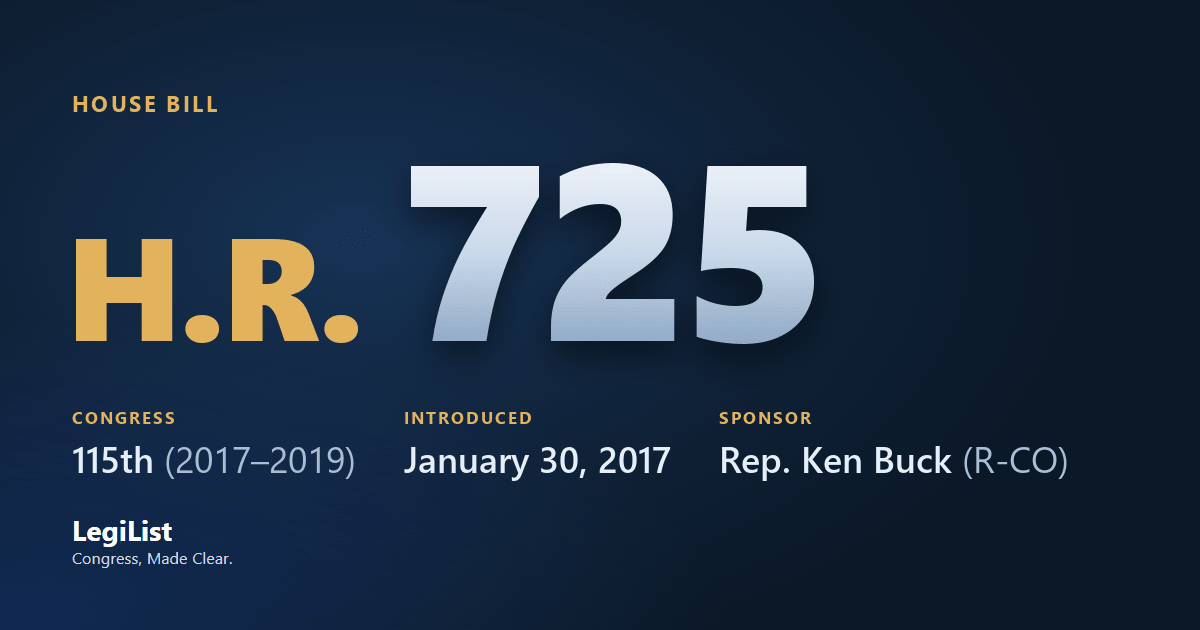
Innocent Party Protection Act
Latest action · Mar 13, 2017 Received in the Senate and Read twice and referred to the Committee on the Judiciary.
Progress
Where this bill reached, and when. A stage with no date was not reached; one that failed a vote and later carried shows the date it carried.
- IntroducedJan 30, 2017
- Passed HouseMar 9, 2017
- Passed SenateNot reached
- To the PresidentNot reached
- Became lawNot reached
Summary
(This measure has not been amended since it was introduced. The expanded summary of the House reported version is repeated here.)
Innocent Party Protection Act
(Sec. 2) This bill amends procedures under which federal courts determine whether a case that was removed from a state court to a federal court on the basis of a diversity of citizenship among the parties may be remanded back to state court upon a motion opposed on fraudulent joinder grounds that: (1) one or more defendants are citizens of the same state as one or more plaintiffs, or (2) one or more defendants properly joined and served are citizens of the state in which the action was brought.Joinder of such a defendant is fraudulent if the court finds:
- actual fraud in the pleading of jurisdictional facts with respect to that defendant,
- state law would not plausibly impose liability on that defendant,
- state or federal law bars all claims in the complaint against that defendant, or
- no good faith intention to prosecute the action against that defendant or to seek a joint judgment including that defendant.
In determining whether to grant or deny such a motion for remand, the court: (1) may permit pleadings to be amended; and (2) must consider the pleadings, affidavits, and other evidence submitted by the parties.
A federal court finding that all such defendants have been fraudulently joined must: (1) dismiss without prejudice the claims against those defendants, and (2) deny the motion for remand.
Recorded votes 4
Newest first. Open one to see how every member voted.
| Roll call | Question | Result | Date |
|---|---|---|---|
| House 152 | On Passage | Passed224–194 | Mar 9, 2017 |
| House 151 | On Motion to Recommit with Instructions | Failed187–233 | Mar 9, 2017 |
| House 150 | On Agreeing to the Amendment | Failed187–229 | Mar 9, 2017 |
| House 149 | On Agreeing to the Amendment | Failed189–233 | Mar 9, 2017 |
Cosponsors 5
Members who signed on, in the order they did. Signatures ran from Jan 30, 2017 to Feb 14, 2017; 4 are original cosponsors, there from the day it was introduced.
| Seat | Cosponsor | Signed on | |
|---|---|---|---|
| R-TX | Blake Farenthold | Original | Jan 30, 2017 |
| R-VA | Bob Goodlatte | Original | Jan 30, 2017 |
| R-TX | Lamar Smith | Original | Jan 30, 2017 |
| R-AZ | Trent Franks | Original | Jan 30, 2017 |
| R-TX | Pete Sessions | Feb 14, 2017 |
Committees 2
Where it was sent and what each committee and subcommittee did with it, in order.
| Chamber | Committee | What it did |
|---|---|---|
| House | Judiciary Committee | Referred Jan 30, 2017Reported Feb 24, 2017 |
| Constitution and Limited Government Subcommittee | Referred Jan 31, 2017 | |
| Senate | Judiciary Committee | Referred Mar 13, 2017 |
Actions 31
Everything that happened, newest first.
- Mar 13, 2017Received in the Senate and Read twice and referred to the Committee on the Judiciary.
- Mar 9, 2017Considered under the provisions of rule H. Res. 175. (consideration: CR H1968-1974; text of measure as reported in House: CR H1972)
- Mar 9, 2017Previous question shall be considered as ordered without intervening motions except motion to recommit with or without instructions. Rule providing for consideration of H.R. 725
- Mar 9, 2017House resolved itself into the Committee of the Whole House on the state of the Union pursuant to H. Res. 175 and Rule XVIII.
- Mar 9, 2017The Speaker designated the Honorable Jody B. Hice to act as Chairman of the Committee.
In the Congressional Record 5
Days the Record’s own index lists this bill, newest first, with the pages and the members it names. Pages starting H are the House, S the Senate, E Extensions of Remarks.
| Where | In the Record | Members | Date |
|---|---|---|---|
| Extensions | Debate and remarks E313 | Sheila Jackson Lee D-TX | Mar 10, 2017 |
| House | Debate and remarks H1968–H1974, H2002Text printed H1972Amendments H1972, H1973Motions H2002Recorded votes H2000, H2001, H2002, H2003Cartwright amendment (create an exception from fraudulent joinder regulations for plantiffs seeking compensation resulting in bad faith of an insurer)enactKuster motion to recommit (create an exception from fraudulent joinder regulations for any civil action relative to government ethics)Soto amendment (create an exception from fraudulent joinder regulations for instances involving public health risks, including byproducts of hydraulic fracturing, or any water contamination) | Ann M. Kuster D-NH (motion), Blake Farenthold R-TX, Bob Goodlatte R-VA, Darren Soto D-FL (amendment), Henry C. "Hank" Johnson, Jr. D-GA, Jamie Raskin D-MD, Jerrold Nadler D-NY, Matt Cartwright D-PA (amendment) | Mar 9, 2017 |
| House | Debate and remarks H1611–H1617Text printed H1611Amendments H1616Recorded votes H1616, H1617consideration (H. Res. 175), previous question | Alcee L. Hastings D-FL (amendment), Ken Buck R-CO, Pete Sessions R-TX, Steve King R-IA | Mar 8, 2017 |
| House | Debate and remarks H1484 | Kevin McCarthy R-CA | Mar 2, 2017 |
| House | Debate and remarks H1420 | Pete Sessions R-TX | Mar 1, 2017 |
Research
What has been written about this bill: committee reports, cost estimates, the sponsor’s authority statement, printed hearings and the Congressional Research Service’s work.
Committee report
Congressional Budget Office cost estimate
- Feb 10, 2017H.R. 725, Innocent Party Protection ActAs ordered reported by the House Committee on the Judiciary on February 2, 2017
Constitutional authority
The sponsor’s statement, as printed in the Congressional Record, vol. 163, no. 15, January 30, 2017, page H745.
Amendments 2
Amendments offered to this bill.
| Amendment | Description | Offered by | Status |
|---|---|---|---|
| HAmdt 66 | Amendment sought to create an exception for instances of public health risks, including byproducts of hydraulic fracturing, well stimulation, or any water contamination. | Darren Soto D-FL | On agreeing to the Soto amendment (A001) Failed by recorded vote: 189 - 233 (Roll no. 149). |
| HAmdt 67 | An amendment numbered 2 printed in House Report 115-27 to create a separate exception for plaintiffs seeking compensation resulting from the bad faith of an insurer. | Matt Cartwright D-PA | On agreeing to the Cartwright amendment (A002) Failed by recorded vote: 187 - 229 (Roll no. 150). |
Related bills 2
Companion bills and other measures the record links to this one.
| Bill | Title | Relationship | Latest action |
|---|---|---|---|
| HRES 175 | Providing for consideration of the bill (H.R. 725) to amend title 28, United States Code, to prevent fraudulent joinder. | Procedurally related | Mar 8, 2017 |
| HR 5345 | Innocent Party Protection Act | Reintroduced Bill | Jan 30, 2020 |
Titles 4
Every title it has carried, official and short, at each stage.
- Official Title as Introduced
- To amend title 28, United States Code, to prevent fraudulent joinder.
- Short Titles as Introduced
- Innocent Party Protection Act
- Short Titles as Reported to House
- Innocent Party Protection Act
- Short Titles as Passed House
- Innocent Party Protection Act
Subjects
Assigned by the Library of Congress. Policy area: Law.
Text 4
Each version as it was printed, newest first.
- Mar 13, 2017Referred in Senate
- Mar 9, 2017Engrossed in House
- Feb 24, 2017Reported in House
- Jan 30, 2017Introduced in House
Everything here is as published by Congress: the summary is the Congressional Research Service's, the action wording is the clerks', and the subjects are the Library of Congress's. How far it got is read from the actions themselves, taking the most recent one of each kind, so a bill that failed a vote and later passed is shown as having passed. Records come from this bill on Congress.gov and govinfo.gov; cost estimates are the Congressional Budget Office's, and the hearings are the printed hearings GovInfo publishes, which can appear months after the hearing.