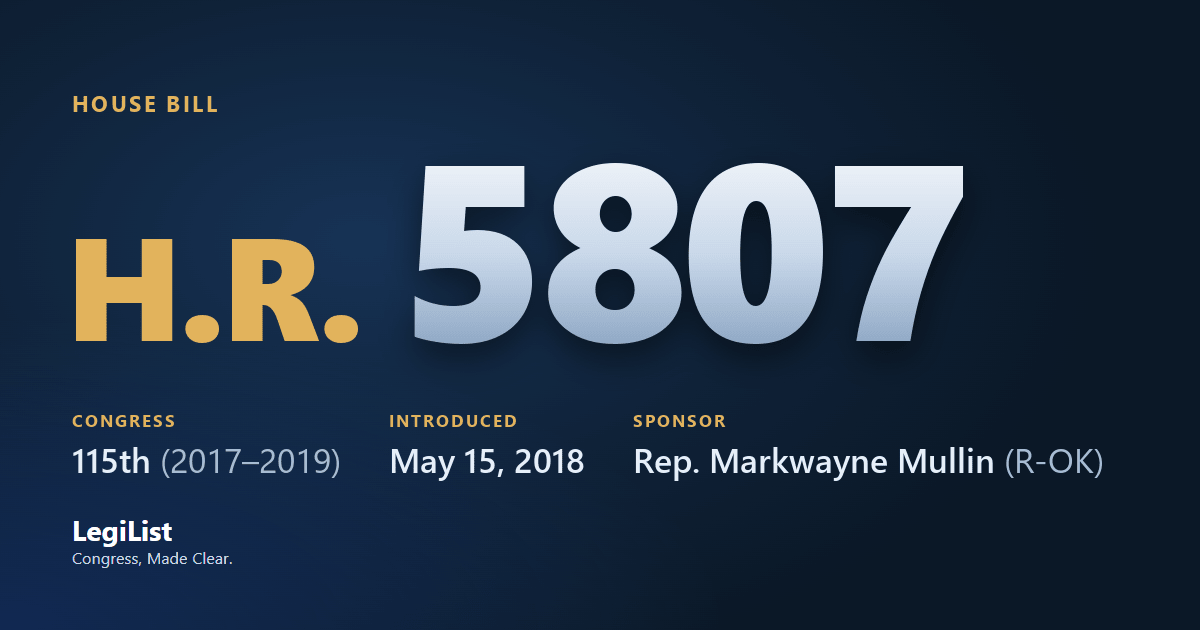
SUD CARE Act
Latest action · Jul 24, 2018 Referred to the Subcommittee on Crime, Terrorism, Homeland Security, and Investigations.
Progress
Where this bill reached, and when. A stage with no date was not reached; one that failed a vote and later carried shows the date it carried.
- IntroducedMay 15, 2018
- Passed HouseNot reached
- Passed SenateNot reached
- To the PresidentNot reached
- Became lawNot reached
Summary
Substance Use Disorder Coordination, Access, Recovery Enhancement Act of 2018 or the SUD CARE Act
This bill increases the maximum number of patients that health care practitioners may initially treat with medication-assisted treatment (i.e., under a buprenorphine waiver), and also aligns federal privacy standards for substance use disorder patient records more closely with standards under the Health Insurance Portability and Accountability Act.
Cosponsors 2
Members who signed on, in the order they did. Signatures ran from May 15, 2018 to May 24, 2018; 1 is an original cosponsor, there from the day it was introduced.
| Seat | Cosponsor | Signed on | |
|---|---|---|---|
| D-OR | Earl Blumenauer | Original | May 15, 2018 |
| R-OR | Greg Walden | May 24, 2018 |
Committees 2
Where it was sent and what each committee and subcommittee did with it, in order.
| Chamber | Committee | What it did |
|---|---|---|
| House | Energy and Commerce Committee | Referred May 15, 2018 |
| House | Judiciary Committee | Referred May 15, 2018 |
| Crime and Federal Government Surveillance Subcommittee | Referred Jul 24, 2018 |
Actions 3
Everything that happened, newest first.
- Jul 24, 2018Referred to the Subcommittee on Crime, Terrorism, Homeland Security, and Investigations.
- May 15, 2018Introduced in House
- May 15, 2018Referred to the Committee on Energy and Commerce, and in addition to the Committee on the Judiciary, for a period to be subsequently determined by the Speaker, in each case for consideration of such provisions as fall within the jurisdiction of the committee concerned.
Research
What has been written about this bill: committee reports, cost estimates, the sponsor’s authority statement, printed hearings and the Congressional Research Service’s work.
Constitutional authority
The sponsor’s statement, as printed in the Congressional Record, vol. 164, no. 79, May 15, 2018, page H3978.
Related bills 2
Companion bills and other measures the record links to this one.
| Bill | Title | Relationship | Latest action |
|---|---|---|---|
| HR 5795 | Overdose Prevention and Patient Safety Act | Related bill | Jun 12, 2018 |
| HR 6082 | Overdose Prevention and Patient Safety Act | Related bill | Jun 21, 2018 |
Titles 3
Every title it has carried, official and short, at each stage.
- Official Title as Introduced
- To amend the Controlled Substances Act to allow for more flexibility with respect to medication-assisted treatment for opioid use disorders and to amend the Public Health Service Act to protect the confidentiality of substance use disorder patient records.
- Short Titles as Introduced
- SUD CARE Act
- Substance Use Disorder Coordination, Access, Recovery Enhancement Act of 2018
Subjects
Assigned by the Library of Congress. Policy area: Health.
- Administrative law and regulatory procedures
- Criminal investigation, prosecution, interrogation
- Department of Health and Human Services
- Disability and health-based discrimination
- Drug, alcohol, tobacco use
- Employment discrimination and employee rights
- Evidence and witnesses
- Health
- Health information and medical records
- Health personnel
- Health programs administration and funding
- Housing discrimination
- Medical education
- Prescription drugs
- Right of privacy
Text 1
Each version as it was printed, newest first.
- May 15, 2018Introduced in House
Everything here is as published by Congress: the summary is the Congressional Research Service's, the action wording is the clerks', and the subjects are the Library of Congress's. How far it got is read from the actions themselves, taking the most recent one of each kind, so a bill that failed a vote and later passed is shown as having passed. Records come from this bill on Congress.gov and govinfo.gov; cost estimates are the Congressional Budget Office's, and the hearings are the printed hearings GovInfo publishes, which can appear months after the hearing.