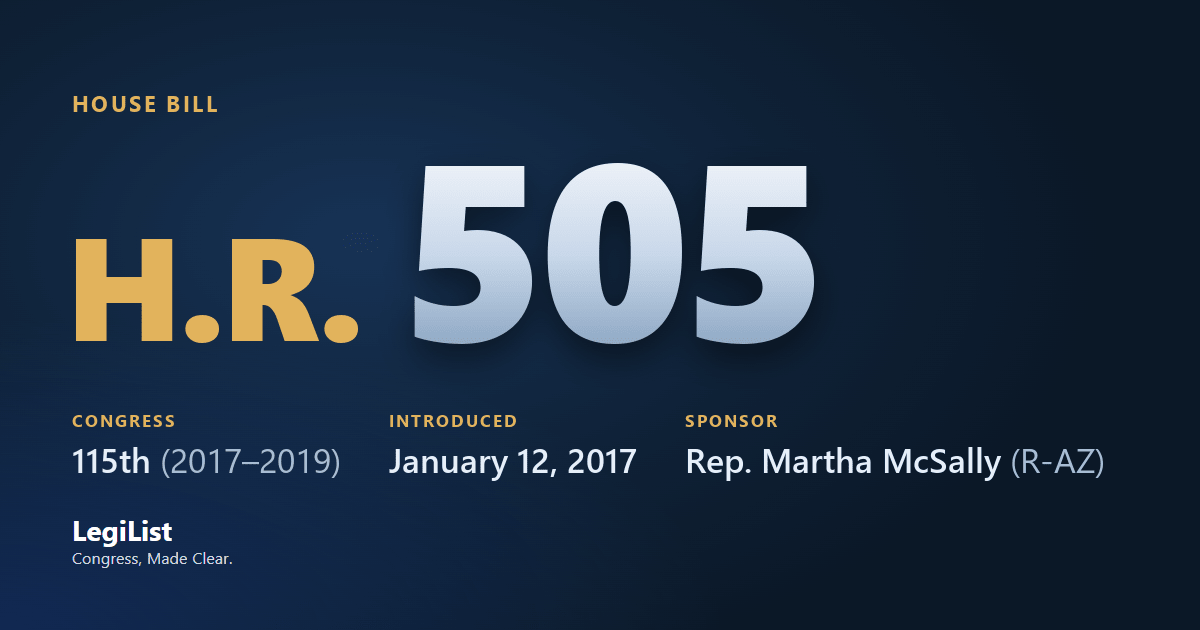
Border Security Technology Accountability Act of 2017
Latest action · Feb 1, 2017 Received in the Senate and Read twice and referred to the Committee on Homeland Security and Governmental Affairs.
Progress
Where this bill reached, and when. A stage with no date was not reached; one that failed a vote and later carried shows the date it carried.
- IntroducedJan 12, 2017
- Passed HouseJan 31, 2017
- Passed SenateNot reached
- To the PresidentNot reached
- Became lawNot reached
Summary
Border Security Technology Accountability Act of 2017
(Sec. 2) This bill amends the Homeland Security Act of 2002 to require the Department of Homeland Security (DHS) to: (1) ensure that each border security technology acquisition program that is determined to be a major acquisition program has an acquisition program baseline approved by the relevant acquisition decision authority; (2) document that each such program is meeting the cost, schedule, and performance thresholds specified in such baseline in compliance with relevant departmental acquisition policies and the Federal Acquisition Regulation; and (3) have a plan for each such program to meet program implementation objectives by managing contractor performance. "Major acquisition program" means a DHS acquisition program that is estimated by DHS to require an eventual total expenditure of at least $300 million over its life cycle cost.
DHS must ensure that border security technology acquisition program managers adhere to relevant internal control standards identified by the Government Accountability Office.
DHS shall submit a plan for testing and evaluation, as well as for the use of independent verification and validation resources, for border security technology so that new border security technologies are evaluated through a series of assessments, processes, and audits to ensure compliance with relevant departmental acquisition policies and the Federal Acquisition Regulation and the effectiveness of taxpayer dollars.
Cosponsors 20
Members who signed on, in the order they did. Signatures ran from Jan 12, 2017 to Jan 31, 2017; 14 are original cosponsors, there from the day it was introduced.
| Seat | Cosponsor | Signed on | |
|---|---|---|---|
| R-AZ | Andy Biggs | Original | Jan 12, 2017 |
| R-VA | Barbara Comstock | Original | Jan 12, 2017 |
| R-TX | Blake Farenthold | Original | Jan 12, 2017 |
| R-NY | Daniel M. Donovan, Jr. | Original | Jan 12, 2017 |
| R-TX | Jeb Hensarling | Original | Jan 12, 2017 |
| R-NY | John Katko | Original | Jan 12, 2017 |
| I-AZ | Kyrsten Sinema | Original | Jan 12, 2017 |
| R-TX | Michael T. McCaul | Original | Jan 12, 2017 |
| R-AL | Mike Rogers | Original | Jan 12, 2017 |
| R-AZ | Paul A. Gosar | Original | Jan 12, 2017 |
| R-NY | Peter T. King | Original | Jan 12, 2017 |
| R-OK | Steve Russell | Original | Jan 12, 2017 |
| R-AZ | Trent Franks | Original | Jan 12, 2017 |
| R-TX | Will Hurd | Original | Jan 12, 2017 |
| R-PA | Brian K. Fitzpatrick | Jan 13, 2017 |
Committees 2
Where it was sent and what each committee and subcommittee did with it, in order.
| Chamber | Committee | What it did |
|---|---|---|
| House | Homeland Security Committee | Referred Jan 12, 2017 |
| Senate | Homeland Security and Governmental Affairs Committee | Referred Feb 1, 2017 |
Actions 8
Everything that happened, newest first.
- Feb 1, 2017Received in the Senate and Read twice and referred to the Committee on Homeland Security and Governmental Affairs.
- Jan 31, 2017Ms. McSally moved to suspend the rules and pass the bill, as amended.
- Jan 31, 2017Considered under suspension of the rules. (consideration: CR H784-785)
- Jan 31, 2017DEBATE - The House proceeded with forty minutes of debate on H.R. 505.
- Jan 31, 2017Passed/agreed to in House: On motion to suspend the rules and pass the bill, as amended Agreed to by voice vote. (text: CR H784)
In the Congressional Record 1
Days the Record’s own index lists this bill, newest first, with the pages and the members it names. Pages starting H are the House, S the Senate, E Extensions of Remarks.
| Where | In the Record | Members | Date |
|---|---|---|---|
| House | Debate and remarks H784, H785Text printed H784 | Martha McSally R-AZ, William R. Keating D-MA | Jan 31, 2017 |
Research
What has been written about this bill: committee reports, cost estimates, the sponsor’s authority statement, printed hearings and the Congressional Research Service’s work.
Constitutional authority
The sponsor’s statement, as printed in the Congressional Record, vol. 163, no. 8, January 12, 2017, page H473.
Related bills 6
Companion bills and other measures the record links to this one.
| Bill | Title | Relationship | Latest action |
|---|---|---|---|
| S 146 | Border Security Technology Accountability Act of 2017 | Related bill | Apr 16, 2018 |
| S 1757 | Building America's Trust Act | Related bill | Sep 5, 2017 |
| S 3478 | FAMILIES Act | Related bill | Sep 18, 2018 |
| HR 3548 | Border Security for America Act of 2017 | Related bill | Mar 23, 2018 |
| HR 4760 | Securing America's Future Act of 2018 | Related bill | Jun 21, 2018 |
Titles 3
Every title it has carried, official and short, at each stage.
- Official Title as Introduced
- To amend the Homeland Security Act of 2002 to strengthen accountability for deployment of border security technology at the Department of Homeland Security, and for other purposes.
- Short Titles as Introduced
- Border Security Technology Accountability Act of 2017
- Short Titles as Passed House
- Border Security Technology Accountability Act of 2017
Subjects
Assigned by the Library of Congress. Policy area: Immigration.
Text 3
Each version as it was printed, newest first.
- Feb 1, 2017Referred in Senate
- Jan 31, 2017Engrossed in House
- Jan 12, 2017Introduced in House
Support LegiList
This page is free, carries no paywall, and is built and maintained by one person. If the record here is useful to you, a few dollars keeps it going.
Everything here is as published by Congress: the summary is the Congressional Research Service's, the action wording is the clerks', and the subjects are the Library of Congress's. How far it got is read from the actions themselves, taking the most recent one of each kind, so a bill that failed a vote and later passed is shown as having passed. Records come from this bill on Congress.gov and govinfo.gov; cost estimates are the Congressional Budget Office's, and the hearings are the printed hearings GovInfo publishes, which can appear months after the hearing.