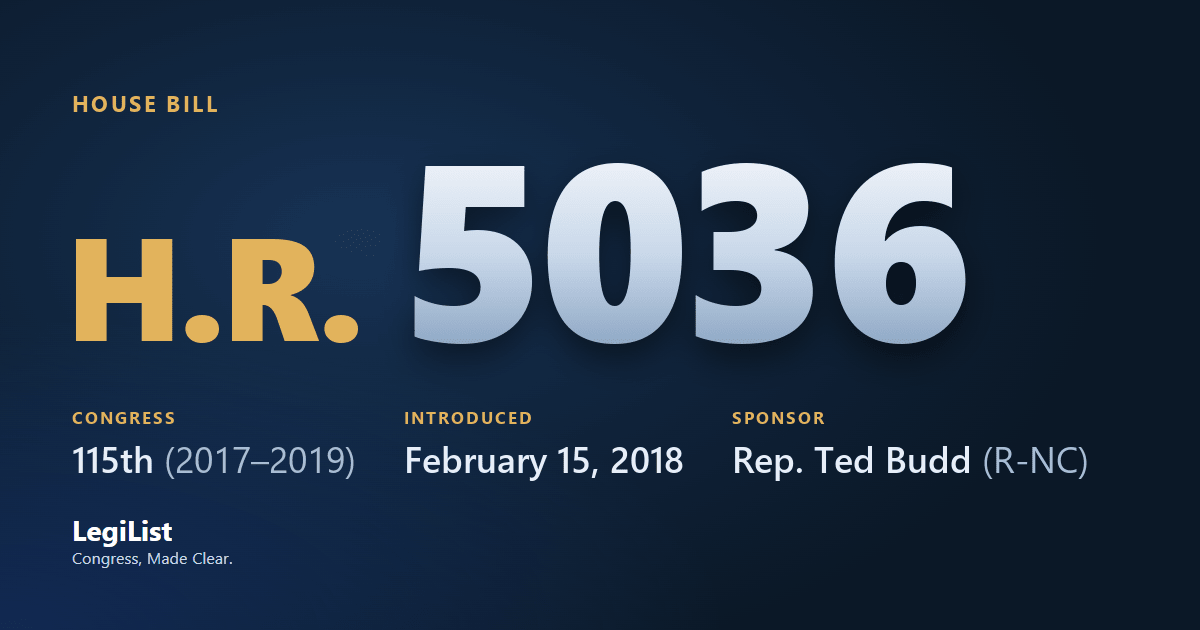
Financial Technology Protection Act
Latest action · Sep 27, 2018 Received in the Senate and Read twice and referred to the Committee on Banking, Housing, and Urban Affairs.
Progress
Where this bill reached, and when. A stage with no date was not reached; one that failed a vote and later carried shows the date it carried.
- IntroducedFeb 15, 2018
- Passed HouseSep 26, 2018
- Passed SenateNot reached
- To the PresidentNot reached
- Became lawNot reached
Summary
Financial Technology Protection Act
This bill provides for the investigation of new financial technologies (e.g., digital currencies) and their use in terrorism and other illicit activities.
(Sec. 3) The bill establishes the Independent Financial Technology Task Force, which must research terrorist and illicit use of new financial technologies and issue an annual report.
(Sec. 4) The bill directs the Department of the Treasury to provide a reward for a person who provides information leading to the conviction of an individual involved with terrorist use of digital currencies.
(Sec. 5) The bill establishes the FinTech Leadership in Innovation Program to support the development of tools and programs to detect terrorist and illicit use of digital currencies.
Cosponsors 2
Members who signed on, in the order they did. Signatures ran from Feb 15, 2018 to Jun 8, 2018; 1 is an original cosponsor, there from the day it was introduced.
| Seat | Cosponsor | Signed on | |
|---|---|---|---|
| D-MA | Stephen F. Lynch | Original | Feb 15, 2018 |
| I-AZ | Kyrsten Sinema | Jun 8, 2018 |
Committees 2
Where it was sent and what each committee and subcommittee did with it, in order.
| Chamber | Committee | What it did |
|---|---|---|
| House | Financial Services Committee | Referred Feb 15, 2018Markup Jul 24, 2018Reported Sep 26, 2018 |
| Senate | Banking, Housing, and Urban Affairs Committee | Referred Sep 27, 2018 |
Actions 12
Everything that happened, newest first.
- Sep 27, 2018Received in the Senate and Read twice and referred to the Committee on Banking, Housing, and Urban Affairs.
- Sep 26, 2018Reported (Amended) by the Committee on Financial Services. H. Rept. 115-984.
- Sep 26, 2018Placed on the Union Calendar, Calendar No. 769.
- Sep 26, 2018Mr. Tipton moved to suspend the rules and pass the bill, as amended.
- Sep 26, 2018Considered under suspension of the rules. (consideration: CR H9060-9062)
- Sep 26, 2018DEBATE - The House proceeded with forty minutes of debate on H.R. 5036.
- Sep 26, 2018Passed/agreed to in House: On motion to suspend the rules and pass the bill, as amended Agreed to by voice vote. (text: CR H9060-9061)
- Sep 26, 2018Motion to reconsider laid on the table Agreed to without objection.
- Jul 24, 2018Committee Consideration and Mark-up Session Held.
- Jul 24, 2018Ordered to be Reported (Amended) by the Yeas and Nays: 57 - 0.
- Feb 15, 2018Introduced in House
- Feb 15, 2018Referred to the House Committee on Financial Services.
In the Congressional Record 1
Days the Record’s own index lists this bill, newest first, with the pages and the members it names. Pages starting H are the House, S the Senate, E Extensions of Remarks.
| Where | In the Record | Members | Date |
|---|---|---|---|
| House | Debate and remarks H9060–H9062Text printed H9060 | Ruben J. Kihuen D-NV, Scott R. Tipton R-CO, Stephen F. Lynch D-MA, Ted Budd R-NC | Sep 26, 2018 |
Research
What has been written about this bill: committee reports, cost estimates, the sponsor’s authority statement, printed hearings and the Congressional Research Service’s work.
Committee report
Congressional Budget Office cost estimate
- Sep 7, 2018H.R. 5036, Financial Technology Protection ActAs reported by the House Committee on Financial Services on July 24, 2018
Constitutional authority
The sponsor’s statement, as printed in the Congressional Record, vol. 164, no. 30, February 15, 2018, page H1213.
Printed hearings 1
Hearings whose printed record names this bill, newest first: hearings on it, and wider hearings where it came up.
| Number | Hearing | Committee | Held |
|---|---|---|---|
| Serial No. 115-108 | COUNTERING THE FINANCIAL NETWORKS OF WEAPONS PROLIFERATION119 pages | Financial Services Committee | Jul 12, 2018 |
Related bills 2
Companion bills and other measures the record links to this one.
| Bill | Title | Relationship | Latest action |
|---|---|---|---|
| HR 4752 | Financial Technology Innovation and Defense Act | Related bill | Jan 10, 2018 |
| HR 5227 | Preventing Rogue and Foreign Actors From Evading Sanctions Act | Related bill | Mar 8, 2018 |
Titles 4
Every title it has carried, official and short, at each stage.
- Official Title as Introduced
- To establish an Independent Financial Technology Task Force, to provide rewards for information leading to convictions related to terrorist use of digital currencies, to establish a FinTech Leadership in Innovation Program to encourage the development of tools and programs to combat terrorist and illicit use of digital currencies, and for other purposes.
- Short Titles as Introduced
- Financial Technology Protection Act
- Short Titles as Reported to House
- Financial Technology Protection Act
- Short Titles as Passed House
- Financial Technology Protection Act
Subjects
Assigned by the Library of Congress. Policy area: Finance and Financial Sector.
- Advanced technology and technological innovations
- Computer security and identity theft
- Computers and information technology
- Congressional oversight
- Crime prevention
- Criminal investigation, prosecution, interrogation
- Currency
- Finance and Financial Sector
- Fraud offenses and financial crimes
- Government trust funds
- Research administration and funding
- Research and development
- Terrorism
Text 4
Each version as it was printed, newest first.
- Sep 27, 2018Referred in Senate
- Sep 26, 2018Engrossed in House
- Sep 26, 2018Reported in House
- Feb 15, 2018Introduced in House
Everything here is as published by Congress: the summary is the Congressional Research Service's, the action wording is the clerks', and the subjects are the Library of Congress's. How far it got is read from the actions themselves, taking the most recent one of each kind, so a bill that failed a vote and later passed is shown as having passed. Records come from this bill on Congress.gov and govinfo.gov; cost estimates are the Congressional Budget Office's, and the hearings are the printed hearings GovInfo publishes, which can appear months after the hearing.