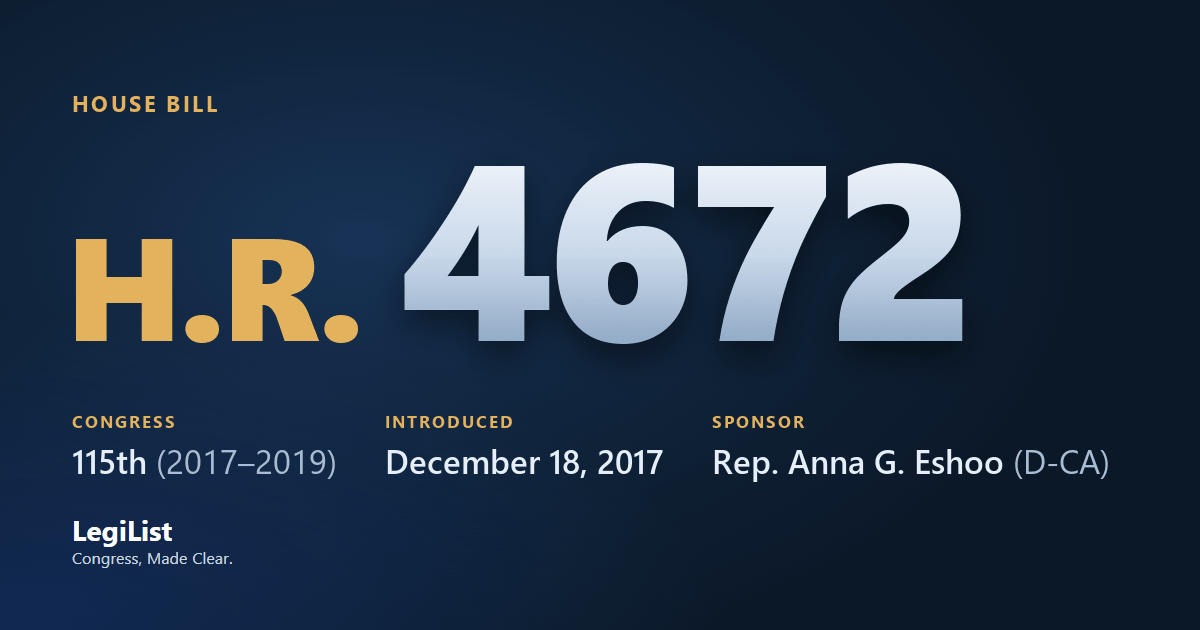
Next Generation 9-1-1 Act of 2017
Latest action · May 22, 2018 Referred to the Subcommittee on Research and Technology.
Progress
Where this bill reached, and when. A stage with no date was not reached; one that failed a vote and later carried shows the date it carried.
- IntroducedDec 18, 2017
- Passed HouseNot reached
- Passed SenateNot reached
- To the PresidentNot reached
- Became lawNot reached
Summary
Next Generation 9-1-1 Act of 2017
This bill amends the National Telecommunications and Information Administration Organization Act to require that the 911 Implementation Coordination Office (Office) assist and encourage federal, state, regional, and local entities to implement Next Generation 911 services. The bill eliminates the October 1, 2022, sunset date for the Office.
The Advisory Board for Next Generation 911 Interoperability is established within the Office to recommend updates to the definition of Next Generation 911 services.
The bill adds requirements for entities seeking federal grants to implement Next Generation 911 services and requires that the Department of Commerce and the National Highway Traffic Safety Administration issue new regulations accordingly. The bill authorizes additional appropriations for these grants through FY2022.
The Office shall provide support to entities in addressing cybersecurity issues related to Next Generation 911 services. The National Institute of Standards and Technology must identify cybersecurity vulnerabilities unique to implementing Next Generation 911 services, recommend best practices and assistance that the federal government can provide, and report its recommendations for protecting such services.
The Federal Communications Commission (FCC) must report about the adoption and adherence by: (1) telecommunications carriers to the FCC's network reliability best practices, and (2) public safety answering points to the public safety answering point best practices for cybersecurity as recommended by the Task Force on Optimal Public Safety Answering Point Architecture. (A public safety answering point is a facility designated to receive emergency calls and route the calls to emergency service personnel.)
The Government Accountability Office must report about the resiliency, reliability, and survivability of public safety answering points during natural disasters and other catastrophes.
Cosponsors 2
Members who signed on, in the order they did. All signed on Dec 18, 2017.
| Seat | Cosponsor | Signed on | |
|---|---|---|---|
| D-NJ | Frank Pallone, Jr. | Original | Dec 18, 2017 |
| D-CA | Norma J. Torres | Original | Dec 18, 2017 |
Committees 2
Where it was sent and what each committee and subcommittee did with it, in order.
| Chamber | Committee | What it did |
|---|---|---|
| House | Energy and Commerce Committee | Referred Dec 18, 2017 |
| Communications and Technology Subcommittee | Referred Dec 22, 2017 | |
| House | Science, Space, and Technology Committee | Referred Dec 18, 2017 |
| Research and Technology Subcommittee | Referred May 22, 2018 |
Actions 4
Everything that happened, newest first.
- May 22, 2018Referred to the Subcommittee on Research and Technology.
- Dec 22, 2017Referred to the Subcommittee on Communications and Technology.
- Dec 18, 2017Introduced in House
- Dec 18, 2017Referred to the Committee on Energy and Commerce, and in addition to the Committee on Science, Space, and Technology, for a period to be subsequently determined by the Speaker, in each case for consideration of such provisions as fall within the jurisdiction of the committee concerned.
Research
What has been written about this bill: committee reports, cost estimates, the sponsor’s authority statement, printed hearings and the Congressional Research Service’s work.
Constitutional authority
The sponsor’s statement, as printed in the Congressional Record, vol. 163, no. 206, December 18, 2017, page H10180.
Titles 2
Every title it has carried, official and short, at each stage.
- Official Title as Introduced
- To further deployment of Next Generation 9-1-1 services to enhance and upgrade the Nation's 9-1-1 systems, and for other purposes.
- Short Titles as Introduced
- Next Generation 9-1-1 Act of 2017
Subjects
Assigned by the Library of Congress. Policy area: Science, Technology, Communications.
- Computer security and identity theft
- Emergency communications systems
- Government information and archives
- Government studies and investigations
- Intergovernmental relations
- Internet and video services
- Internet, web applications, social media
- Science, Technology, Communications
- Telephone and wireless communication
Text 1
Each version as it was printed, newest first.
- Dec 18, 2017Introduced in House
Support LegiList
This page is free, carries no paywall, and is built and maintained by one person. If the record here is useful to you, a few dollars keeps it going.
Everything here is as published by Congress: the summary is the Congressional Research Service's, the action wording is the clerks', and the subjects are the Library of Congress's. How far it got is read from the actions themselves, taking the most recent one of each kind, so a bill that failed a vote and later passed is shown as having passed. Records come from this bill on Congress.gov and govinfo.gov; cost estimates are the Congressional Budget Office's, and the hearings are the printed hearings GovInfo publishes, which can appear months after the hearing.