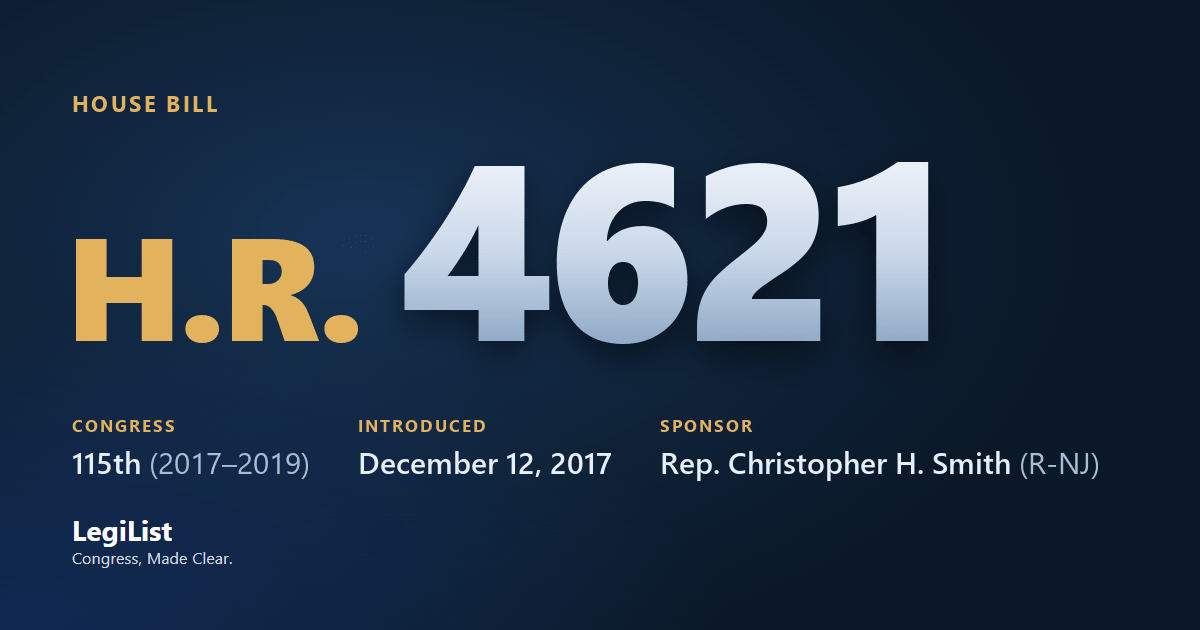
Global Brain Health Act of 2017
Latest action · Dec 15, 2017 Referred to the Subcommittee on Health.
Progress
Where this bill reached, and when. A stage with no date was not reached; one that failed a vote and later carried shows the date it carried.
- IntroducedDec 12, 2017
- Passed HouseNot reached
- Passed SenateNot reached
- To the PresidentNot reached
- Became lawNot reached
Summary
Global Brain Health Act of 2017
This bill directs the U.S. Agency for International Development (USAID) to establish the Global Autism Assistance Program to: (1) support activities by nongovernmental organizations and other service providers focused on autism in developing countries, and (2) establish a "teach the teachers" program to train health and education professionals working with such children.
The President may provide assistance to support a network of trained medical practitioners to treat hydrocephalus in children at pediatric hospitals and hydrocephalus treatment centers in developing countries. Such assistance shall provide for surgeon training and establishment of at least 20 treatment centers.
The Department of Health and Human Services (HHS) shall negotiate with the World Health Organization to develop the Global Alzheimer's Disease and Dementia Action Plan and establish a related Global Alzheimer's Disease and Dementia Fund.
The President shall appoint a high-level official to lead federal efforts to develop the plan and the fund and facilitate partnerships to identify new treatment approaches for Alzheimer's disease and other forms of dementia.
HHS shall investigate the foreign aid implications of Alzheimer's disease and other forms of dementia.
Cosponsors 2
Members who signed on, in the order they did. All signed on Dec 12, 2017.
| Seat | Cosponsor | Signed on | |
|---|---|---|---|
| D-MA | James P. McGovern | Original | Dec 12, 2017 |
| D-TN | Steve Cohen | Original | Dec 12, 2017 |
Committees 2
Where it was sent and what each committee and subcommittee did with it, in order.
| Chamber | Committee | What it did |
|---|---|---|
| House | Foreign Affairs Committee | Referred Dec 12, 2017 |
| House | Energy and Commerce Committee | Referred Dec 12, 2017 |
| Health Subcommittee | Referred Dec 15, 2017 |
Actions 3
Everything that happened, newest first.
- Dec 15, 2017Referred to the Subcommittee on Health.
- Dec 12, 2017Introduced in House
- Dec 12, 2017Referred to the Committee on Foreign Affairs, and in addition to the Committee on Energy and Commerce, for a period to be subsequently determined by the Speaker, in each case for consideration of such provisions as fall within the jurisdiction of the committee concerned.
Research
What has been written about this bill: committee reports, cost estimates, the sponsor’s authority statement, printed hearings and the Congressional Research Service’s work.
Constitutional authority
The sponsor’s statement, as printed in the Congressional Record, vol. 163, no. 202, December 12, 2017, page H9845.
Related bills 1
Companion bills and other measures the record links to this one.
| Bill | Title | Relationship | Latest action |
|---|---|---|---|
| HR 2077 | Global Brain Health Act of 2019 | Reintroduced Bill | Apr 4, 2019 |
Titles 2
Every title it has carried, official and short, at each stage.
- Official Title as Introduced
- To galvanize United States Government programs in support of brain health for global victims of autism, hydrocephalus and Alzheimer's and other forms of dementia, and for other purposes.
- Short Titles as Introduced
- Global Brain Health Act of 2017
Subjects
Assigned by the Library of Congress. Policy area: International Affairs.
- Aging
- Child care and development
- Child health
- Congressional oversight
- Digestive and metabolic diseases
- Education programs funding
- Federal officials
- Foreign aid and international relief
- Health care quality
- Health information and medical records
- Health personnel
- Health programs administration and funding
- Health promotion and preventive care
- Hereditary and development disorders
- International Affairs
- International organizations and cooperation
- Medical education
- Medical research
- Neurological disorders
- Nutrition and diet
- Public-private cooperation
- Special education
- Surgery and anesthesia
- Teaching, teachers, curricula
- World health
Text 1
Each version as it was printed, newest first.
- Dec 12, 2017Introduced in House
Support LegiList
This page is free, carries no paywall, and is built and maintained by one person. If the record here is useful to you, a few dollars keeps it going.
Everything here is as published by Congress: the summary is the Congressional Research Service's, the action wording is the clerks', and the subjects are the Library of Congress's. How far it got is read from the actions themselves, taking the most recent one of each kind, so a bill that failed a vote and later passed is shown as having passed. Records come from this bill on Congress.gov and govinfo.gov; cost estimates are the Congressional Budget Office's, and the hearings are the printed hearings GovInfo publishes, which can appear months after the hearing.