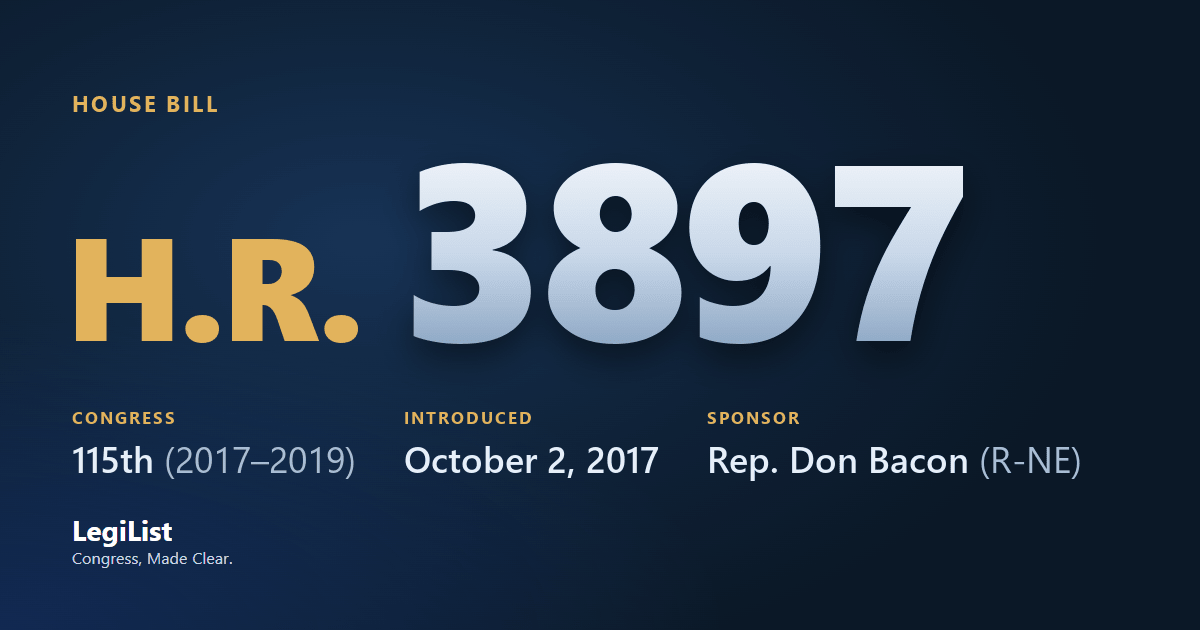
Gold Star Family Support and Installation Access Act of 2017
Latest action · Nov 8, 2017 Received in the Senate and Read twice and referred to the Committee on Armed Services.
Progress
Where this bill reached, and when. A stage with no date was not reached; one that failed a vote and later carried shows the date it carried.
- IntroducedOct 2, 2017
- Passed HouseNov 7, 2017
- Passed SenateNot reached
- To the PresidentNot reached
- Became lawNot reached
Summary
Gold Star Family Support and Installation Access Act of 2017
This bill directs the appropriate military department to issue a standardized Gold Star Installation Access Card to the widow and dependent children of a deceased member of the Armed Forces to allow them to gain unescorted access to military installations to attend memorial events, visit gravesites, and obtain on-installation services and benefits.
The Department of Defense shall prescribe regulations to provide that a surviving spouse of a deceased member, regardless of martial status, who has guardianship of dependent children of the deceased member, is entitled to use commissary stores and MWR retail facilities to the same extent and on the same basis as the unremarried spouse of a member of the uniformed services.
Cosponsors 89
Members who signed on, in the order they did. Signatures ran from Oct 2, 2017 to Nov 6, 2017; 8 are original cosponsors, there from the day it was introduced.
| Seat | Cosponsor | Signed on | |
|---|---|---|---|
| D-MD | Anthony G. Brown | Original | Oct 2, 2017 |
| R-FL | Brian J. Mast | Original | Oct 2, 2017 |
| D-CA | Jimmy Panetta | Original | Oct 2, 2017 |
| R-AZ | Martha McSally | Original | Oct 2, 2017 |
| R-FL | Neal P. Dunn | Original | Oct 2, 2017 |
| D-CA | Salud O. Carbajal | Original | Oct 2, 2017 |
| D-MA | Seth Moulton | Original | Oct 2, 2017 |
| R-OK | Steve Russell | Original | Oct 2, 2017 |
| R-NJ | Frank A. LoBiondo | Oct 11, 2017 | |
| D-GA | Sanford D. Bishop, Jr. | Oct 11, 2017 | |
| D-CA | Jackie Speier | Oct 12, 2017 | |
| R-TX | Pete Olson | Oct 12, 2017 | |
| D-AZ | Ruben Gallego | Oct 12, 2017 | |
| R-NY | Tom Reed | Oct 12, 2017 | |
| R-KY | Andy Barr | Oct 19, 2017 |
Committees 2
Where it was sent and what each committee and subcommittee did with it, in order.
| Chamber | Committee | What it did |
|---|---|---|
| House | Armed Services Committee | Referred Oct 2, 2017Discharged Nov 7, 2017 |
| Military Personnel Subcommittee | Referred Oct 17, 2017 | |
| Senate | Armed Services Committee | Referred Nov 8, 2017 |
Actions 9
Everything that happened, newest first.
- Nov 8, 2017Received in the Senate and Read twice and referred to the Committee on Armed Services.
- Nov 7, 2017Mr. Bacon asked unanimous consent to discharge from committee and consider.
- Nov 7, 2017Committee on Armed Services discharged.
- Nov 7, 2017Considered by unanimous consent. (consideration: CR H8545)
- Nov 7, 2017Passed/agreed to in House: On passage Passed without objection. (text: CR H8545)
- Nov 7, 2017Motion to reconsider laid on the table Agreed to without objection.
- Oct 17, 2017Referred to the Subcommittee on Military Personnel.
- Oct 2, 2017Introduced in House
- Oct 2, 2017Referred to the House Committee on Armed Services.
In the Congressional Record 1
Days the Record’s own index lists this bill, newest first, with the pages and the members it names. Pages starting H are the House, S the Senate, E Extensions of Remarks.
Research
What has been written about this bill: committee reports, cost estimates, the sponsor’s authority statement, printed hearings and the Congressional Research Service’s work.
Constitutional authority
The sponsor’s statement, as printed in the Congressional Record, vol. 163, no. 157, October 2, 2017, page H7671.
Related bills 2
Companion bills and other measures the record links to this one.
| Bill | Title | Relationship | Latest action |
|---|---|---|---|
| S 2088 | Gold Star Family Support and Installation Access Act of 2017 | Identical bill | Nov 7, 2017 |
| HR 5515 | John S. McCain National Defense Authorization Act for Fiscal Year 2019 | Related bill | Aug 13, 2018 |
Titles 3
Every title it has carried, official and short, at each stage.
- Official Title as Introduced
- To amend title 10, United States Code, to provide for the issuance of the Gold Star Installation Access Card to the surviving spouse, dependent children, and other next of kin of a member of the Armed Forces who dies while serving on certain active or reserve duty, to ensure that a remarried surviving spouse with dependent children of the deceased member remains eligible for installation benefits to which the surviving spouse was previously eligible, and for other purposes.
- Short Titles as Introduced
- Gold Star Family Support and Installation Access Act of 2017
- Short Titles as Passed House
- Gold Star Family Support and Installation Access Act of 2017
Subjects
Assigned by the Library of Congress. Policy area: Armed Forces and National Security.
Text 3
Each version as it was printed, newest first.
- Nov 8, 2017Referred in Senate
- Nov 7, 2017Engrossed in House
- Oct 2, 2017Introduced in House
Support LegiList
This page is free, carries no paywall, and is built and maintained by one person. If the record here is useful to you, a few dollars keeps it going.
Everything here is as published by Congress: the summary is the Congressional Research Service's, the action wording is the clerks', and the subjects are the Library of Congress's. How far it got is read from the actions themselves, taking the most recent one of each kind, so a bill that failed a vote and later passed is shown as having passed. Records come from this bill on Congress.gov and govinfo.gov; cost estimates are the Congressional Budget Office's, and the hearings are the printed hearings GovInfo publishes, which can appear months after the hearing.